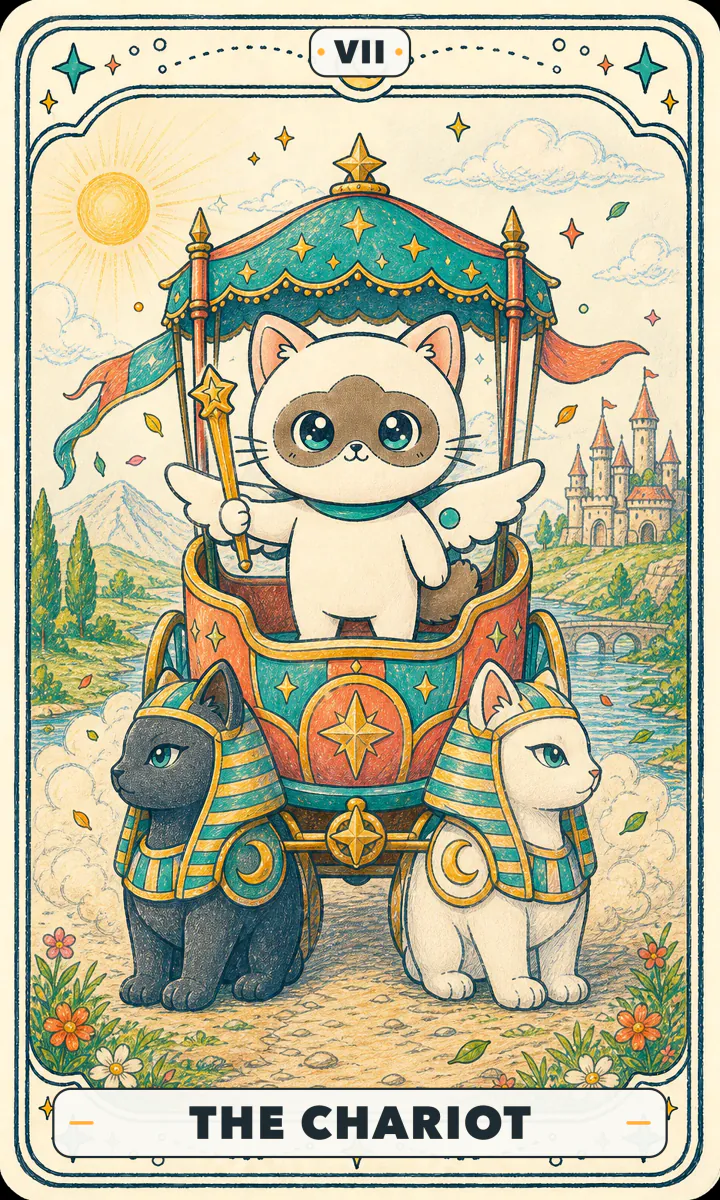
Il Carro
The Chariot
Vittoria, controllo
Risposta rapida
Il significato principale di Il Carro è Forza di volontà nel superare gli ostacoli. Al dritto, solitamente indica Vittoria, forza di volontà, autocontrollo, determinazione. Simboleggia l'unione; rovesciata, potrebbe suggerire Perdita di controllo, aggressività, sconfitta, mancanza di direzione. Può indica.
Immagini della carta
Un guerriero sta su un carro sotto un baldacchino stellato, con le lune crescenti sulle spalle. Il carro è trainato da due sfingi, una nera e una bianca, anche se non sono visibili le redini. Un fiume e un castello riempiono lo sfondo.
Significato al dritto
Vittoria, forza di volontà, autocontrollo, determinazione. Simboleggia l'unione delle forze opposte (le sfingi bianche e nere) attraverso la pura volontà di superare gli ostacoli.
Significato rovesciato
Perdita di controllo, aggressività, sconfitta, mancanza di direzione. Può indicare che sei stato lacerato da emozioni o forze contrastanti, portando fuori rotta il tuo percorso.
Amore, carriera, denaro e crescita
Amore
In amore, Il Carro indica Forza di volontà nel superare gli ostacoli. Rileggilo confrontandolo con il modo in cui si comporta effettivamente la relazione e con ciò che scegliete entrambi.
Carriera
In materia di carriera, Il Carro indica Forza di volontà nel superare gli ostacoli. Inizia individuando quali risorse controlli e quale sarà la tua prossima mossa.
Soldi
In materia di soldi, Il Carro indica Forza di volontà nel superare gli ostacoli. Non considerare una lettura simbolica come una conclusione di investimento: segui i fatti, il budget e la tua tolleranza al rischio.
Crescita personale
Per la crescita personale, Il Carro indica Forza di volontà nel superare gli ostacoli. Annota la domanda che solleva, quindi trasformala in un'azione che puoi effettivamente verificare.
Cosa prova l'altra persona
Quando Il Carro indica cosa prova l'altra persona, il tema del suo atteggiamento verso di te è: Forza di volontà nel superare gli ostacoli. Al dritto il sentimento è rivolto all'esterno e si vede; rovesciata, per ora resta dentro di lei. Non prenderla come una sentenza: verificala con il modo in cui si comporta davvero.
Sì o no
Al dritto
Sì
Rovesciata
No
Questa è la nostra lettura veloce, basata sulla direzione in cui tende il significato della carta. Le tradizioni non sono d'accordo sulle singole carte, e un "Forse" deve essere valutato rispetto alla posizione nello spread e alla situazione reale piuttosto che essere preso come una risposta di una sola parola.
Testo originale di Waite (1911)
Simbolismo interiore (originale)
Una figura eretta e principesca che porta una spada sguainata e corrisponde, a grandi linee, alla descrizione tradizionale che ho dato nella prima parte. Sulle spalle dell'eroe vittorioso si suppongono gli Urim e Thummim. Egli ha condotto prigioniera la prigionia; è la conquista su tutti i piani — nella mente, nella scienza, nel progresso, in certe prove dell'iniziazione. Ha così risposto alla Sfinge, ed è per questo motivo che ho accolto la variante di Eliphas Lévi: due sfingi trainano dunque il suo carro. Egli è soprattutto il trionfo nella mente.
Per questa ragione va inteso (a) che la domanda della sfinge riguarda un Mistero della Natura e non del mondo della Grazia, al quale l'auriga non potrebbe dare alcuna risposta; (b) che i piani della sua conquista sono manifesti o esterni, e non dentro di lui; (c) che la liberazione che egli compie può lasciarlo nella schiavitù dell'intelletto logico; (d) che le prove d'iniziazione che ha superato in trionfo vanno intese in senso fisico o razionale, e (e) che se giungesse alle colonne di quel Tempio fra le quali siede la Papessa, non potrebbe aprire il rotolo chiamato Tora, né saprebbe rispondere se lei lo interrogasse. Non è regalità ereditaria e non è sacerdozio.
Significato originale al dritto
Soccorso, provvidenza; anche guerra, trionfo, presunzione, vendetta, guai.
Significato originale invertito
Sommossa, lite, disputa, causa legale, sconfitta.
Citato da A. E. Waite, The Pictorial Key to the Tarot (1911), illustrato da Pamela Colman Smith. Il testo è di pubblico dominio.
Origini del mito e dei simboli
Trionfo è il nome originario del mazzo stesso. Le sfingi sono una sostituzione di Lévi, e il carro di Platone vi è stato accostato più tardi.
Iconografia documentata
Attestata da oggetti o testi giunti fino a noi
È da questa carta che l'intero mazzo ha preso il nome
Il nome più antico degli arcani maggiori è trionfi. La tradizione iconografica è quella del trionfo romano e dei Trionfi di Petrarca, con la sua fila di carri trionfali ciascuno dei quali vince il precedente: Amore vince l'uomo, Pudicizia vince Amore, Morte vince Pudicizia, Fama vince Morte, Tempo vince Fama, Eternità vince Tempo. L'intera serie dei trionfi è quello stesso corteo in cui «il successivo batte il precedente», e il Carro è la carta che ne disegna il motivo nel modo più esplicito.
Fonte Il nome originario dei trionfi; la tradizione iconografica dei Trionfi di Petrarca (I Trionfi, XIV secolo)
Corrispondenza esoterica
Una tesi tradizionale con fonti, ma costruita dentro un sistema occulto
Due sfingi, e un enigma già risolto
Nei mazzi più antichi il carro era tirato da due cavalli. Waite afferma di aver «accettato la variante di Eliphas Lévi» mettendovi al loro posto due sfingi, e scrive che l'auriga «ha risposto alla Sfinge», un'allusione a Edipo che risolve l'enigma. Poi, nello stesso respiro, ridimensiona quella vittoria: l'enigma della sfinge appartiene a «un Mistero della Natura», e se l'auriga giungesse alle due colonne fra cui siede la Papessa, «non potrebbe aprire il rotolo chiamato Tora».
Fonte Waite, The Pictorial Key to the Tarot, 1911, Il Carro; la ricostruzione della carta di Eliphas Lévi
Urim e Thummim sulle spalle
Waite scrive che l'auriga porta sulle spalle Urim e Thummim, gli oggetti del pettorale del sommo sacerdote ebraico usati per interrogare Dio (Esodo 28,30). Sulla carta gli spallacci sono disegnati come due volti simili a lune. Ancora una volta: una sfinge greca e uno strumento sacerdotale ebraico, fianco a fianco sulla stessa carta.
Fonte Esodo 28,30; Waite, The Pictorial Key to the Tarot, 1911, Il Carro
Il Cancro: avanzare dentro un guscio
La Golden Dawn associa il Carro al Cancro (lettera ebraica Cheth). Il carro è un guscio duro, e la figura al suo interno è insieme protetta e rinchiusa: questo spiega perché la vittoria su questa carta abbia sempre il sapore di qualcosa tenuto insieme dalla volontà, più che di un successo facile.
Fonte Attribuzioni zodiacali nel Book T della Golden Dawn
Lettura moderna
Diffusa solo dal Novecento; estranea alle origini della carta
Il carro dell'anima di Platone: si adatta benissimo, ma è stato adattato dopo
Il passo più citato a proposito di questa carta è il Fedro di Platone: l'anima come un auriga che guida due cavalli, uno nero e uno bianco, uno che tira verso l'alto e uno verso il basso, e il compito dell'auriga è farli andare nella stessa direzione. Le sfingi nera e bianca della carta vi corrispondono magnificamente, ma quelle sfingi ce le ha messe Lévi negli anni Cinquanta dell'Ottocento, e non c'è alcuna linea di discendenza fra l'immagine di Platone e il carro trionfale del Quattrocento. Come strumento per capire la carta funziona bene. Come fonte è semplicemente sbagliato.
Fonte Lettura moderna divulgativa; il carro dell'anima è nel Fedro di Platone 246a-254e
Scritto da BESTAROT, non citato da fonti storiche. Ogni affermazione è contrassegnata da quanto bene è dimostrata; gli strati interpretativi moderni sono utili per la lettura, ma non costituiscono l’origine storica della carta.
Studia il tema: Mito e origini dei simboli (Accademia capitolo 6)