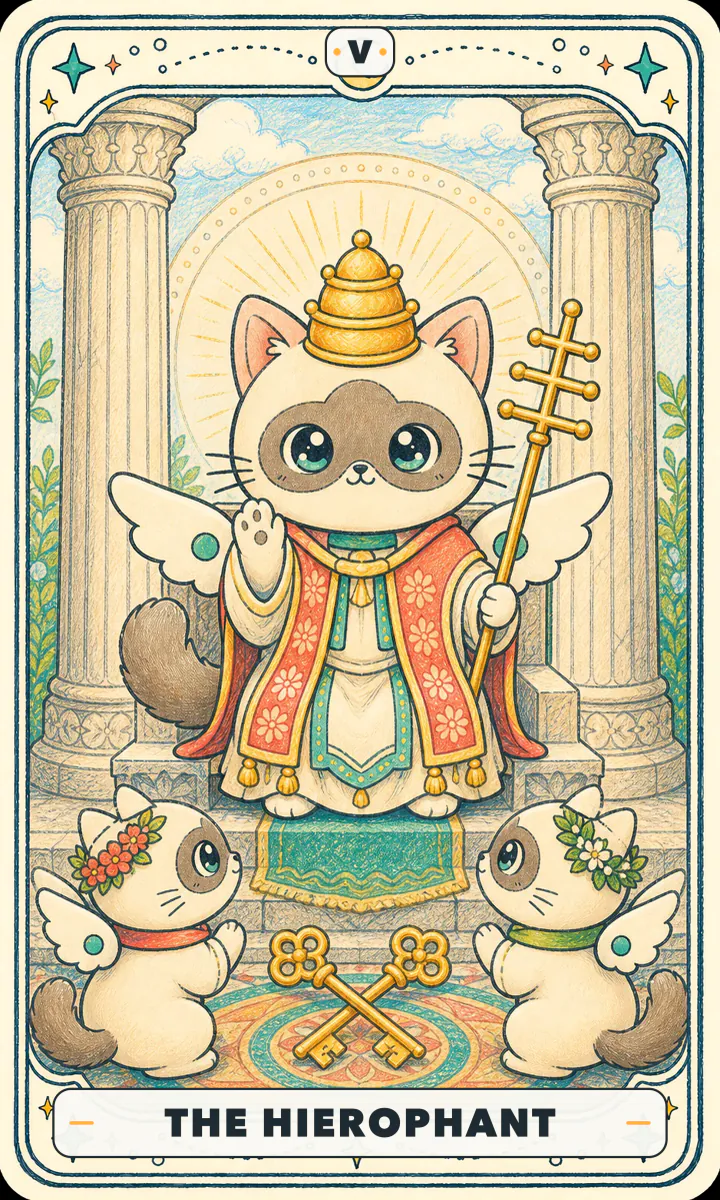
Lo Ierofante
The Hierophant
Tradizione, Fede
Risposta rapida
Il significato principale di Lo Ierofante è Guida spirituale. Al dritto, solitamente indica Tradizione, fede, educazione, guida spirituale, appartenenza. Simboleggia il ris; rovesciata, potrebbe suggerire Tradizione sfidante, credenze non convenzionali, consigli ipocriti, ribellione.
Immagini della carta
Il Gerofante, vestito di tre paramenti, siede tra due pilastri di pietra e porta una tripla corona. La sua mano sinistra tiene un bastone a tripla croce, la sua destra è alzata in segno di benedizione. Due chiavi incrociate giacciono ai suoi piedi e due accoliti si inginocchiano davanti a lui.
Significato al dritto
Tradizione, fede, educazione, guida spirituale, appartenenza. Simboleggia il rispetto delle convenzioni sociali stabilite o la ricerca dell'aiuto della saggezza tradizionale.
Significato rovesciato
Tradizione sfidante, credenze non convenzionali, consigli ipocriti, ribellione. Può indicare la rottura con le convenzioni o il sentirsi vincolati dai dogmi.
Amore, carriera, denaro e crescita
Amore
In amore, Lo Ierofante indica Guida spirituale. Rileggilo confrontandolo con il modo in cui si comporta effettivamente la relazione e con ciò che scegliete entrambi.
Carriera
In materia di carriera, Lo Ierofante indica Guida spirituale. Inizia individuando quali risorse controlli e quale sarà la tua prossima mossa.
Soldi
In materia di soldi, Lo Ierofante indica Guida spirituale. Non considerare una lettura simbolica come una conclusione di investimento: segui i fatti, il budget e la tua tolleranza al rischio.
Crescita personale
Per la crescita personale, Lo Ierofante indica Guida spirituale. Annota la domanda che solleva, quindi trasformala in un'azione che puoi effettivamente verificare.
Cosa prova l'altra persona
Quando Lo Ierofante indica cosa prova l'altra persona, il tema del suo atteggiamento verso di te è: Guida spirituale. Al dritto il sentimento è rivolto all'esterno e si vede; rovesciata, per ora resta dentro di lei. Non prenderla come una sentenza: verificala con il modo in cui si comporta davvero.
Sì o no
Al dritto
Sì
Rovesciata
Forse
Questa è la nostra lettura veloce, basata sulla direzione in cui tende il significato della carta. Le tradizioni non sono d'accordo sulle singole carte, e un "Forse" deve essere valutato rispetto alla posizione nello spread e alla situazione reale piuttosto che essere preso come una risposta di una sola parola.
Testo originale di Waite (1911)
Simbolismo interiore (originale)
Porta la triplice corona e siede tra due colonne, ma non sono quelle del Tempio custodito dalla Papessa. Nella mano sinistra regge uno scettro che termina con la triplice croce, e con la destra fa il noto segno ecclesiastico detto dell'esoterismo, che distingue la parte manifesta e la parte nascosta della dottrina. È degno di nota, a questo proposito, che la Papessa non fa alcun segno. Ai suoi piedi ci sono le chiavi incrociate, e due ministri sacerdotali in camice sono inginocchiati davanti a lui. Di solito è stato chiamato il Papa, che è un'applicazione particolare dell'ufficio più generale che egli simboleggia. È il potere che governa la religione esteriore, così come la Papessa è il genio dominante del potere esoterico e appartato. I significati propri di questa carta hanno subito un deplorevole miscuglio da parte di quasi tutti. Grand Orient dice giustamente che lo Ierofante è il potere delle chiavi, la dottrina ortodossa essoterica e il lato esteriore della vita che conduce alla dottrina; ma non è certo il principe della dottrina occulta, come ha suggerito un altro commentatore.
È piuttosto la summa totius theologiæ, quando è giunta alla più estrema rigidità di espressione; ma simboleggia anche tutte le cose giuste e sacre sul versante manifesto. In quanto tale, è il canale della grazia che appartiene al mondo dell'istituzione, distinto da quello della Natura, ed è la guida alla salvezza per il genere umano nel suo insieme. È l'ordine e il capo della gerarchia riconosciuta, che è il riflesso di un altro e più grande ordine gerarchico; ma può accadere che il pontefice dimentichi il significato di questo suo stato simbolico e agisca come se contenesse nelle proprie misure tutto ciò che il suo segno significa o che il suo simbolo cerca di manifestare. Non è, come si è creduto, la filosofia — se non sul versante teologico; non è l'ispirazione; e non è la religione, benché ne sia un modo di espressione.
Significato originale al dritto
Matrimonio, alleanza, prigionia, servitù; secondo un'altra versione, misericordia e bontà; ispirazione; l'uomo a cui il consultante ricorre.
Significato originale invertito
Società, buona intesa, concordia, eccesso di gentilezza, debolezza.
Citato da A. E. Waite, The Pictorial Key to the Tarot (1911), illustrato da Pamela Colman Smith. Il testo è di pubblico dominio.
Origini del mito e dei simboli
L'immagine è un papa; il nome è il titolo del sacerdote che presiedeva i Misteri eleusini greci. A cambiarlo fu Waite.
Iconografia documentata
Attestata da oggetti o testi giunti fino a noi
L'immagine è semplicemente un papa
Nei primi mazzi italiani questa carta si chiama Il Papa, in coppia con la Papessa. Ogni elemento della carta è dotazione istituzionale cattolica standard: il triregno, lo scettro con la croce a tre bracci, le chiavi incrociate ai suoi piedi, e le chiavi vengono da Matteo 16,19, le chiavi del regno dei cieli affidate a Pietro. Waite stesso lo scrive: di solito è stato chiamato il Papa.
Fonte Il nome italiano antico Il Papa; Matteo 16,19 (le chiavi del regno); Waite 1911
La parola Ierofante è greca
Ribattezzare il Papa come Ierofante fu una pratica della generazione di Waite. La parola è greca, ἱεροφάντης, letteralmente «colui che mostra le cose sacre», ed era il titolo ufficiale del sacerdote che presiedeva i Misteri eleusini, il cui mito centrale è quello di Demetra e Persefone. Su questa carta c'è dunque un autentico filo greco. Solo che non sta nell'immagine: sta nel nome, e fu applicato soltanto alla fine dell'Ottocento.
Fonte ἱεροφάντης è il titolo del sacerdote che presiedeva a Eleusi; il cambio di nome è in Waite 1911
Corrispondenza esoterica
Una tesi tradizionale con fonti, ma costruita dentro un sistema occulto
Il Toro e il peso dell'istituzione
La Golden Dawn associa lo Ierofante al Toro (lettera ebraica Vau). Da qui viene il registro della stabilità, del reggere un peso, del muoversi lentamente e non cambiare, che si accorda bene con una carta definita come il potere dominante della religione costituita.
Fonte Attribuzioni zodiacali nel Book T della Golden Dawn
Lettura moderna
Diffusa solo dal Novecento; estranea alle origini della carta
Leggerlo come maestro spirituale significa leggerlo al contrario
L'abitudine contemporanea è leggere questa carta come il guru, il maestro spirituale, l'autorità interiore. Il testo di Waite la definisce esattamente all'opposto: lo Ierofante è «il potere dominante della religione esteriore», contrapposto al potere esoterico e appartato che la Papessa rappresenta, e Waite nega esplicitamente che sia il principe della dottrina occulta. Vale a dire: questa carta governa le istituzioni, la dottrina pubblica e le procedure, non una guida spirituale privata.
Fonte Lettura moderna divulgativa; Waite 1911 respinge la lettura del «principe della dottrina occulta» in questa stessa voce
Scritto da BESTAROT, non citato da fonti storiche. Ogni affermazione è contrassegnata da quanto bene è dimostrata; gli strati interpretativi moderni sono utili per la lettura, ma non costituiscono l’origine storica della carta.
Studia il tema: Mito e origini dei simboli (Accademia capitolo 6)