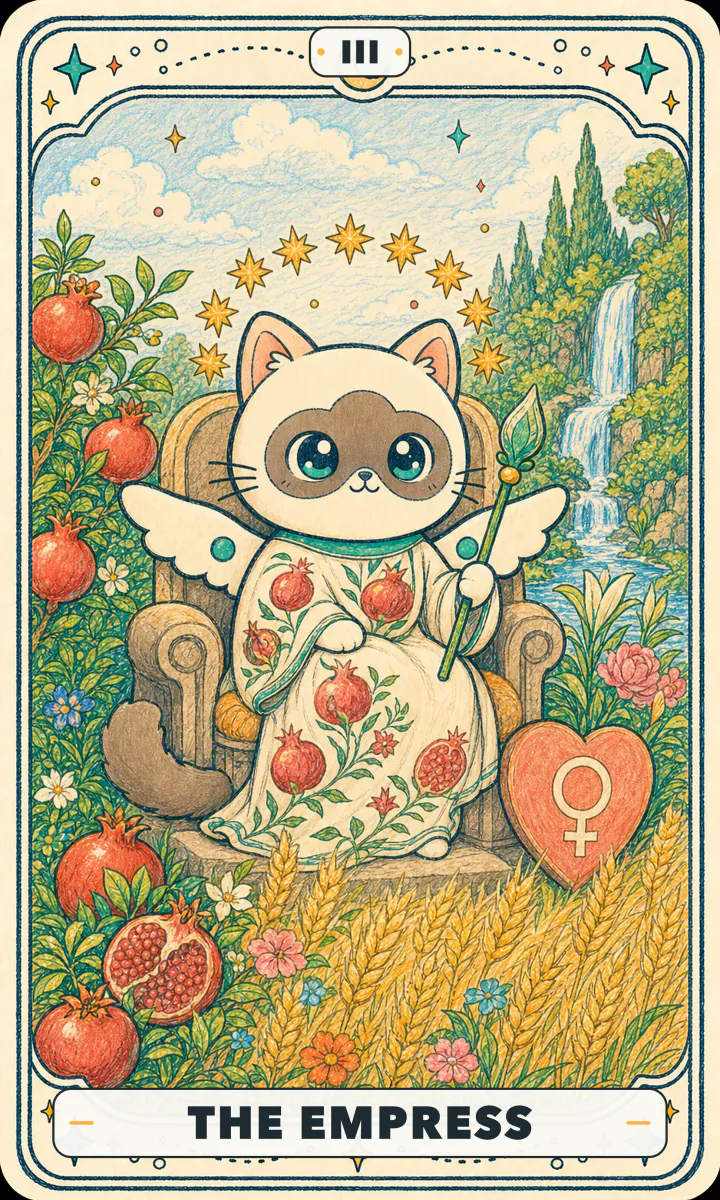
L'Imperatrice
The Empress
Abbondanza, maternità
Risposta rapida
Il significato principale di L'Imperatrice è La generosità e il nutrimento della natura. Al dritto, solitamente indica Abbondanza, maternità, creatività, natura, piacere sensuale. Simboleggia la ricc; rovesciata, potrebbe suggerire Dipendenza, creatività bloccata, problemi domestici, stravaganza. Può indicare c.
Immagini della carta
Una donna a figura intera siede su un trono immersa nella natura, indossando un abito bianco decorato con melograni. Davanti a lei si trova un campo di grano e dietro una cascata. Indossa una corona di dodici stelle, tiene in mano uno scettro e ai suoi piedi poggia uno scudo a forma di cuore con il simbolo di Venere.
Significato al dritto
Abbondanza, maternità, creatività, natura, piacere sensuale. Simboleggia la ricchezza materiale ed emotiva, un momento favorevole per coltivare nuovi progetti o assaporare la vita.
Significato rovesciato
Dipendenza, creatività bloccata, problemi domestici, stravaganza. Può indicare cure soffocanti, mancanza di crescita o scarsità materiale.
Amore, carriera, denaro e crescita
Amore
In amore, L'Imperatrice indica La generosità e il nutrimento della natura. Rileggilo confrontandolo con il modo in cui si comporta effettivamente la relazione e con ciò che scegliete entrambi.
Carriera
In materia di carriera, L'Imperatrice indica La generosità e il nutrimento della natura. Inizia individuando quali risorse controlli e quale sarà la tua prossima mossa.
Soldi
In materia di soldi, L'Imperatrice indica La generosità e il nutrimento della natura. Non considerare una lettura simbolica come una conclusione di investimento: segui i fatti, il budget e la tua tolleranza al rischio.
Crescita personale
Per la crescita personale, L'Imperatrice indica La generosità e il nutrimento della natura. Annota la domanda che solleva, quindi trasformala in un'azione che puoi effettivamente verificare.
Cosa prova l'altra persona
Quando L'Imperatrice indica cosa prova l'altra persona, il tema del suo atteggiamento verso di te è: La generosità e il nutrimento della natura. Al dritto il sentimento è rivolto all'esterno e si vede; rovesciata, per ora resta dentro di lei. Non prenderla come una sentenza: verificala con il modo in cui si comporta davvero.
Sì o no
Al dritto
Sì
Rovesciata
No
Questa è la nostra lettura veloce, basata sulla direzione in cui tende il significato della carta. Le tradizioni non sono d'accordo sulle singole carte, e un "Forse" deve essere valutato rispetto alla posizione nello spread e alla situazione reale piuttosto che essere preso come una risposta di una sola parola.
Testo originale di Waite (1911)
Simbolismo interiore (originale)
Una figura maestosa, seduta, dalle vesti sontuose e dall'aspetto regale, come una figlia del cielo e della terra. Il suo diadema è di dodici stelle, raccolte in un grappolo. Il simbolo di Venere è sullo scudo che le sta accanto. Davanti a lei matura un campo di grano, e più in là c'è una cascata. Lo scettro che regge è sormontato dal globo di questo mondo. Ella è il Giardino dell'Eden inferiore, il Paradiso Terrestre, tutto ciò che è simboleggiato dalla casa visibile dell'uomo. Non è la Regina coeli, ma è pur sempre il refugium peccatorum, la madre feconda di migliaia. Vi sono anche certi aspetti per i quali è stata descritta correttamente come il desiderio e le sue ali, come la donna vestita di sole, come la Gloria Mundi e il velo del Sancta Sanctorum; ma non è, posso aggiungere, l'anima che ha messo le ali, a meno che l'intero simbolismo non venga computato in un altro e insolito modo. È soprattutto la fecondità universale e il senso esteriore della Parola. Ciò è ovvio, perché nessun messaggio diretto è stato dato all'uomo come quello che è portato dalla donna; ma lei stessa non ne porta l'interpretazione.
In un altro ordine di idee, la carta dell'Imperatrice significa la porta o il varco attraverso cui si ottiene l'ingresso in questa vita, come nel Giardino di Venere; e poi la via che da lì conduce fuori, verso ciò che sta oltre, è il segreto noto alla Papessa: è lei a comunicarlo agli eletti. La maggior parte delle antiche attribuzioni di questa carta sono del tutto sbagliate quanto al simbolismo — come, per esempio, la sua identificazione con il Verbo, la Natura Divina, la Triade e così via.
Significato originale al dritto
Fecondità, azione, iniziativa, lunghezza di giorni; l'ignoto, il clandestino; anche difficoltà, dubbio, ignoranza.
Significato originale invertito
Luce, verità, lo sbrogliarsi di faccende intricate, pubbliche feste; secondo un'altra lettura, esitazione.
Citato da A. E. Waite, The Pictorial Key to the Tarot (1911), illustrato da Pamela Colman Smith. Il testo è di pubblico dominio.
Origini del mito e dei simboli
Lo scudo porta il segno di Venere, ma la corona di dodici stelle è iconografia mariana, e Waite vi tracciò deliberatamente un confine.
Iconografia documentata
Attestata da oggetti o testi giunti fino a noi
Lei e l'Imperatore sono una coppia di sovrani secolari
Nei primi mazzi questa carta è L'Imperatrice, in coppia con L'Imperatore, e raffigura la più alta carica mondana. Letta insieme alla coppia Papessa e Papa, la testa del corteo dei trionfi è formata da due serie simmetriche di cariche, quella ecclesiastica e quella secolare, ciascuna con un uomo e una donna. È un diagramma dell'ordine sociale rinascimentale, non un pantheon.
Fonte I nomi delle carte e la struttura della sequenza dei trionfi nei primi tarocchi italiani
Corrispondenza esoterica
Una tesi tradizionale con fonti, ma costruita dentro un sistema occulto
Lo scudo di Venere e il giardino di Venere
Waite afferma che lo scudo accanto a lei reca l'emblema di Venere, e definisce l'ingresso in questa vita attraverso questa carta un ingresso «come nel Giardino di Venere». Venere nel pantheon romano corrisponde all'Afrodite greca. Anche l'attribuzione della Golden Dawn è Venere (lettera ebraica Daleth). Il campo di grano maturo davanti a lei e l'acqua corrente alle sue spalle sono immagini di fertilità aggiunte da Waite.
Fonte Waite, The Pictorial Key to the Tarot, 1911, L'Imperatrice; attribuzioni planetarie nel Book T della Golden Dawn
La corona di dodici stelle viene dall'Apocalisse, e Waite traccia un confine
Porta una corona di dodici stelle, e Waite usa anche l'espressione «la donna vestita di sole», da Apocalisse 12,1, una delle formule più fisse nelle immagini della Vergine. Arriva persino a prendere in prestito due titoli dalle litanie mariane: Regina coeli, regina del cielo, e refugium peccatorum, rifugio dei peccatori. E subito dopo scrive: «Non è la Regina coeli». È la seconda volta che mette su una carta l'iconografia di una tradizione e poi rifiuta l'identità che ne deriva, esattamente come fa con Iside alla voce della Papessa.
Fonte Apocalisse 12,1; Waite, The Pictorial Key to the Tarot, 1911, L'Imperatrice
Lettura moderna
Diffusa solo dal Novecento; estranea alle origini della carta
Demetra e la madre terra: un accostamento moderno
Poiché sulla carta c'è del grano, la si legge spesso come Demetra, la dea greca delle messi, o come una generica madre terra. Il campo di grano c'è davvero, ma la cornice data da Waite è il Giardino dell'Eden inferiore, il paradiso terrestre, più l'iconografia mariana, non il mito agricolo greco. Collegarla alla madre di Persefone rende il discorso scorrevole. Quel collegamento l'ha fatto il materiale didattico moderno.
Fonte Lettura moderna divulgativa; il mito di Demetra è nell'Inno omerico a Demetra
Scritto da BESTAROT, non citato da fonti storiche. Ogni affermazione è contrassegnata da quanto bene è dimostrata; gli strati interpretativi moderni sono utili per la lettura, ma non costituiscono l’origine storica della carta.
Studia il tema: Mito e origini dei simboli (Accademia capitolo 6)