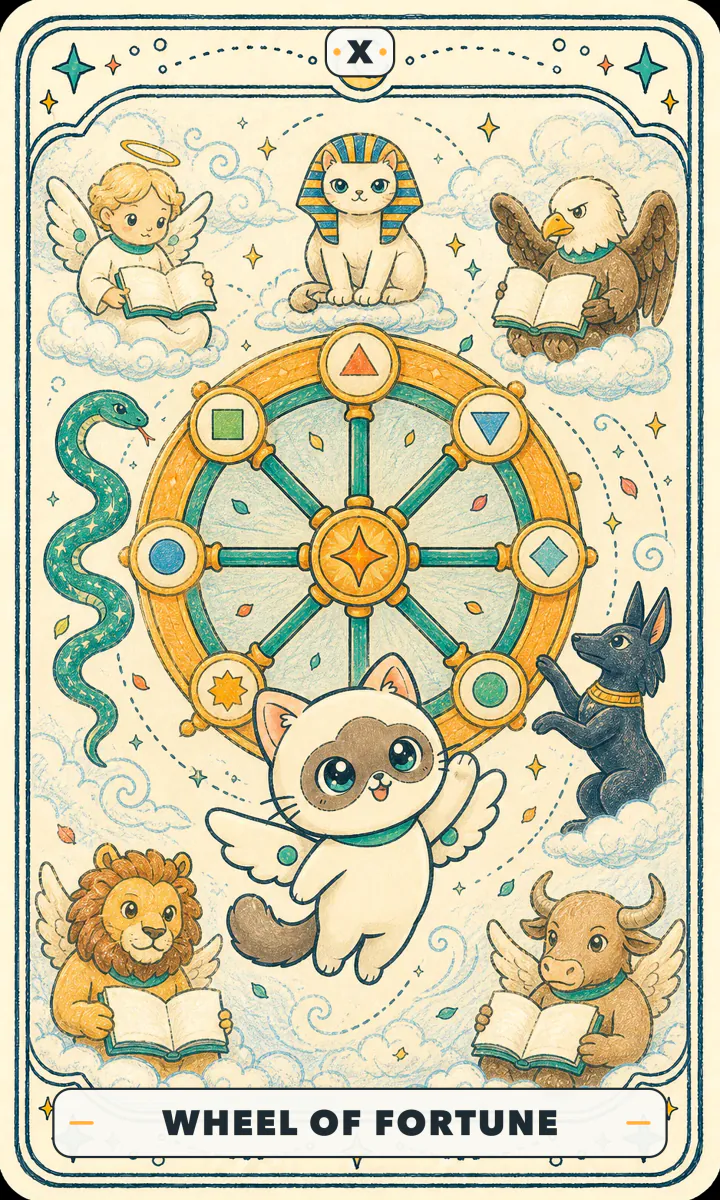
Ruota della fortuna
Wheel of Fortune
Punto di svolta, Cicli
Risposta rapida
Il significato principale di Ruota della fortuna è La forza irresistibile del destino. Al dritto, solitamente indica Un punto di svolta, fortuna, karma, forze fuori dal tuo controllo. Simboleggia l; rovesciata, potrebbe suggerire Sfortuna, battute d’arresto dovute alla resistenza al cambiamento, un ciclo inte.
Immagini della carta
Una grande ruota su cui sono incisi simboli alchemici fluttua nel cielo azzurro. Attorno ad esso, i quattro esseri viventi (uomo, aquila, leone e toro) siedono leggendo libri. Una sfinge poggia in cima alla ruota, Anubi si erge alla sua base e un serpente discende lungo il suo lato.
Significato al dritto
Un punto di svolta, fortuna, karma, forze fuori dal tuo controllo. Simboleggia l'ascesa e la caduta della fortuna, un promemoria per muoversi con il cambiamento e cogliere l'attimo.
Significato rovesciato
Sfortuna, battute d’arresto dovute alla resistenza al cambiamento, un ciclo interrotto. Può indicare un punto basso temporaneo o un tentativo di forzare il controllo su ciò che è incontrollabile.
Amore, carriera, denaro e crescita
Amore
In amore, Ruota della fortuna indica La forza irresistibile del destino. Rileggilo confrontandolo con il modo in cui si comporta effettivamente la relazione e con ciò che scegliete entrambi.
Carriera
In materia di carriera, Ruota della fortuna indica La forza irresistibile del destino. Inizia individuando quali risorse controlli e quale sarà la tua prossima mossa.
Soldi
In materia di soldi, Ruota della fortuna indica La forza irresistibile del destino. Non considerare una lettura simbolica come una conclusione di investimento: segui i fatti, il budget e la tua tolleranza al rischio.
Crescita personale
Per la crescita personale, Ruota della fortuna indica La forza irresistibile del destino. Annota la domanda che solleva, quindi trasformala in un'azione che puoi effettivamente verificare.
Cosa prova l'altra persona
Quando Ruota della fortuna indica cosa prova l'altra persona, il tema del suo atteggiamento verso di te è: La forza irresistibile del destino. Al dritto il sentimento è rivolto all'esterno e si vede; rovesciata, per ora resta dentro di lei. Non prenderla come una sentenza: verificala con il modo in cui si comporta davvero.
Sì o no
Al dritto
Sì
Rovesciata
No
Questa è la nostra lettura veloce, basata sulla direzione in cui tende il significato della carta. Le tradizioni non sono d'accordo sulle singole carte, e un "Forse" deve essere valutato rispetto alla posizione nello spread e alla situazione reale piuttosto che essere preso come una risposta di una sola parola.
Testo originale di Waite (1911)
Simbolismo interiore (originale)
In questo simbolo ho seguito ancora una volta la ricostruzione di Eliphas Lévi, che ne ha fornito diverse varianti. È legittimo — come ho accennato — usare il simbolismo egizio quando serve al nostro scopo, purché non vi si sottintenda alcuna teoria sull'origine. Ho però presentato Tifone nella sua forma di serpente. Il simbolismo, naturalmente, non è esclusivamente egizio, poiché i quattro Esseri Viventi di Ezechiele occupano gli angoli della carta, e la ruota stessa segue altre indicazioni di Lévi riguardo alla visione di Ezechiele, come illustrazione di questa particolare Chiave dei Tarocchi. Secondo l'occultista francese, e nel disegno stesso, l'immagine simbolica sta per il moto perpetuo di un universo fluido e per il flusso della vita umana. La Sfinge ne è l'equilibrio. La traslitterazione di Taro in Rota è iscritta sulla ruota, alternata alle lettere del Nome Divino — a mostrare che la Provvidenza è implicata in tutto. Ma questa è l'intenzione divina interiore, e la corrispondente intenzione esteriore è rappresentata dai quattro Esseri Viventi. Talvolta la sfinge è raffigurata accovacciata su un piedistallo in alto, il che tradisce il simbolismo, perché svuota l'idea essenziale della stabilità in mezzo al movimento.
Dietro la nozione generale espressa dal simbolo si trova la negazione del caso e della fatalità che esso implica. Si può aggiungere che, dai tempi di Lévi in poi, le spiegazioni occulte di questa carta sono — perfino per l'occultismo stesso — di un genere singolarmente insulso. Si è detto che significhi principio, fecondità, onore virile, autorità di governo, ecc. Le conclusioni della comune predizione della sorte valgono di più, sul loro piano.
Significato originale al dritto
Destino, fortuna, successo, elevazione, buona sorte, felicità.
Significato originale invertito
Aumento, abbondanza, sovrabbondanza.
Citato da A. E. Waite, The Pictorial Key to the Tarot (1911), illustrato da Pamela Colman Smith. Il testo è di pubblico dominio.
Origini del mito e dei simboli
Un motivo iconografico medievale, una visione di Ezechiele e una ricostruzione ottocentesca di gusto egizio, sovrapposti su un'unica carta.
Iconografia documentata
Attestata da oggetti o testi giunti fino a noi
La ruota della fortuna non l'hanno inventata i tarocchi
La Rota Fortunae fu uno dei motivi iconografici più diffusi nell'Europa medievale, di secoli più antico dei tarocchi. L'idea viene dal secondo libro della Consolazione della filosofia di Boezio: la Fortuna gira la sua ruota, che porta le persone in alto e poi di nuovo in basso. I manoscritti medievali e i rosoni delle cattedrali la disegnavano come quattro figure su una ruota, ciascuna con un motto latino: «regnerò / regno / ho regnato / sono senza regno». Le carte dei trionfi compaiono nell'Italia del Quattrocento disegnando quello stesso motivo; non partono da zero.
Fonte Boezio, Consolazione della filosofia II (524 circa); i quattro motti compaiono in immagini di manoscritti medievali come il codice dei Carmina Burana (1230 circa)
La dea greca dietro la Fortuna
La Fortuna romana corrisponde alla Tyche greca, dea del caso, raffigurata nell'arte classica con un timone, una cornucopia o una ruota. Nota che cosa governa: il caso, non il destino. Filare e tagliare il filo della vita spetta alle Moire, un altro gruppo di figure. Le due cose erano già distinte nell'antichità, e questa carta eredita la prima.
Fonte L'iconografia classica di Tyche / Fortuna nella statuaria e nelle monete
Gli esseri viventi agli angoli vengono dalla Bibbia ebraica
L'uomo, l'aquila, il bue e il leone ai quattro angoli non sono mito greco. Sono i quattro esseri viventi di Ezechiele 1,10, ripresi in Apocalisse 4,7 e fissati da allora come emblemi dei quattro evangelisti: ecco perché tutti e quattro tengono dei libri. La ruota di una dea greca e la visione di un profeta ebreo sulla stessa carta sono del tutto normali nell'iconografia rinascimentale. Non c'è alcun bisogno, né alcun fondamento, per ricondurle a un unico «sistema originario».
Fonte Ezechiele 1,10, Apocalisse 4,7; Waite 1911 afferma che gli esseri viventi vengono da Ezechiele
Corrispondenza esoterica
Una tesi tradizionale con fonti, ma costruita dentro un sistema occulto
Tifone in forma di serpente e la sfinge: la ricostruzione di Lévi
Waite dice apertamente che questa carta «segue la ricostruzione di Eliphas Lévi», e che ha rappresentato Tifone, la figura mostruosa del mito greco, in forma di serpente, con la sfinge in cima alla ruota come equilibrio all'interno del suo moto. La versione di Lévi ha anche una figura dalla testa di sciacallo che sale, Ermanubi, fusione ellenistica di Ermes e Anubi; è un disegno di Lévi, e il testo di Waite non la nomina. Le lettere T-A-R-O sulla ruota si possono leggere in giro come ROTA, alternate alle lettere ebraiche del Nome Divino. Tutto questo è costruzione occultista ottocentesca, non storia della carta.
Fonte Waite, The Pictorial Key to the Tarot, 1911, La Ruota della Fortuna; Eliphas Lévi, Dogme et Rituel de la Haute Magie, 1854-56
L'attribuzione a Giove della Golden Dawn
La Golden Dawn lega ogni trionfo a un pianeta o a un segno, e alla Ruota della Fortuna tocca Giove (lettera ebraica Kaph). Giove è il corrispettivo romano dello Zeus greco, e porta con sé espansione, buona sorte e un allargamento di scala. La catena risale effettivamente al pantheon greco, purché sia chiaro che a fare il collegamento è il sistema, e non un pittore del Quattrocento che disegna Zeus.
Fonte Attribuzioni planetarie dei trionfi nel Book T della Golden Dawn
Lettura moderna
Diffusa solo dal Novecento; estranea alle origini della carta
La ruota del karma e le tre Parche: aggiunte successive
Leggere questa carta come una ruota del karma deriva dall'importazione teosofica, a fine Ottocento, delle idee indiane sul karma nell'esoterismo occidentale. Nulla nell'iconografia rinascimentale dei trionfi porta quel significato. Far corrispondere tre posizioni della ruota alle tre Moire è lo stesso tipo di operazione: un'analogia didattica moderna, non qualcosa che faccia l'iconografia classica. Entrambe sono utili in un consulto. Nessuna delle due è una fonte.
Fonte Lettura moderna divulgativa, senza fondamento storico
Scritto da BESTAROT, non citato da fonti storiche. Ogni affermazione è contrassegnata da quanto bene è dimostrata; gli strati interpretativi moderni sono utili per la lettura, ma non costituiscono l’origine storica della carta.
Studia il tema: Mito e origini dei simboli (Accademia capitolo 6)