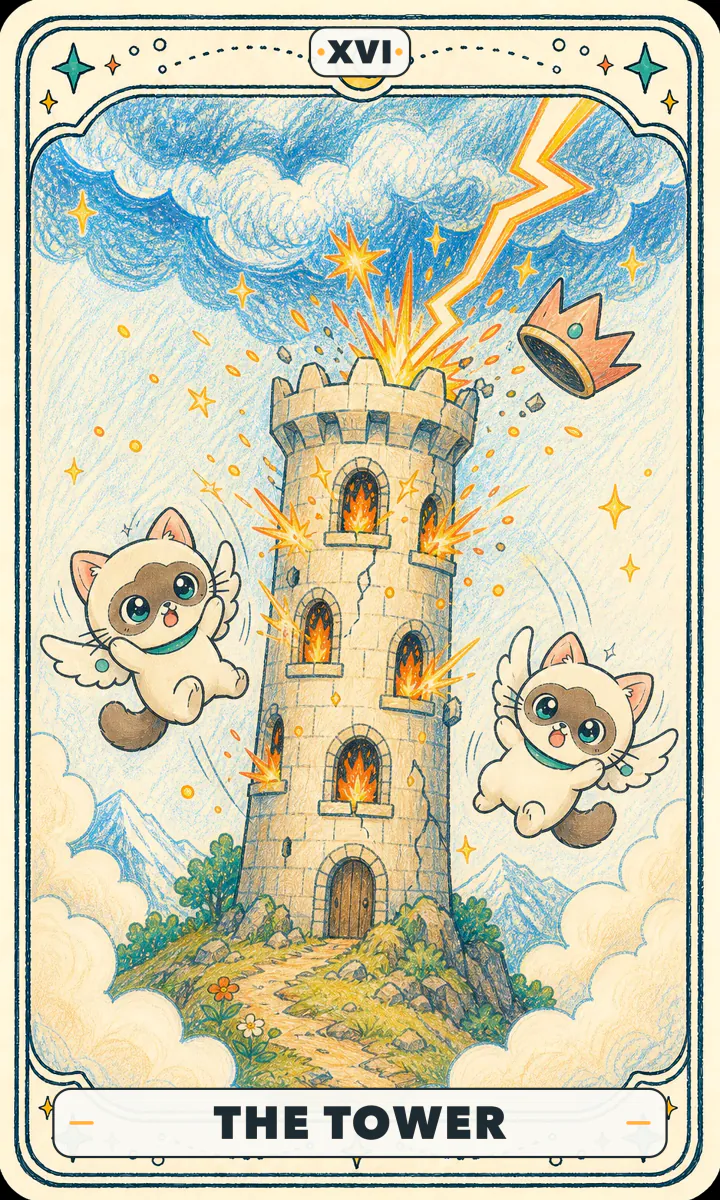
La Torre
The Tower
Agitación, colapso
Respuesta rápida
El significado principal de La Torre es Un despertar repentino. Del derecho, suele apuntar a Cambio repentino, colapso, despertar, desastre. Simboliza una estructura constru; invertida, puede sugerir Desastre evitado, miedo al cambio, apenas aguantando, un lento colapso. Puede in.
Imagen de la carta
Una torre que se eleva entre las nubes es alcanzada por un rayo en su cima, que cae desde lo alto. La torre arde cuando dos figuras (que representan estatus y riqueza) caen de cabeza. El fondo es un cielo nocturno negro lloviendo chispas.
Significado al derecho
Cambio repentino, colapso, despertar, desastre. Simboliza una estructura construida sobre cimientos falsos que está siendo destruida por la fuerza, dolorosa pero que entrega la verdad sin adornos.
Significado invertido
Desastre evitado, miedo al cambio, apenas aguantando, un lento colapso. Puede indicar confusión interna o intento de encubrir problemas que ya han ocurrido.
Amor, carrera, dinero y crecimiento
Amor
En el amor, La Torre señala a Un despertar repentino. Vuelve a leerlo teniendo en cuenta cómo se comporta realmente la relación y lo que ambos están eligiendo.
Carrera
En cuestiones profesionales, La Torre apunta a Un despertar repentino. Empiece por determinar qué recursos controla y cuál será su próximo paso.
Dinero
En cuestiones de dinero, La Torre apunta a Un despertar repentino. No trates una lectura simbólica como una conclusión de inversión; guíate por los hechos, el presupuesto y tu propia tolerancia al riesgo.
Crecimiento personal
Para el crecimiento personal, La Torre apunta a Un despertar repentino. Escribe la pregunta que plantea y luego conviértela en una acción que realmente puedas comprobar.
Lo que siente la otra persona
Cuando La Torre indica lo que siente la otra persona, el tema de su actitud hacia ti es: Un despertar repentino. Al derecho, ese sentimiento se muestra hacia fuera; invertida, por ahora se queda dentro. No la tomes como un veredicto: contrástala con cómo actúa realmente.
Sí o no
Al derecho
No
Invertida
Tal vez
Esta es nuestra propia lectura rápida, basada en la dirección en la que se inclina el significado de la carta. Las tradiciones no están de acuerdo con respecto a las cartas individuales, y un "Quizás" debe sopesarse con la posición en la distribución y su situación real en lugar de tomarse como una respuesta de una sola palabra.
Texto original de Waite (1911)
Simbolismo interior (original)
Las explicaciones ocultistas que se atribuyen a esta carta son pobres y en su mayoría desconcertantes. Es ocioso indicar que representa la ruina en todos sus aspectos, porque lo lleva a la vista en la superficie. Se dice además que contiene la primera alusión a un edificio material, pero no concibo que la Torre sea más o menos material que las columnas que hemos encontrado en tres casos anteriores. No veo nada que autorice a Papus a suponer que es literalmente la caída de Adán, pero hay más a favor de su alternativa: que significa la materialización de la palabra espiritual. El bibliógrafo Christian imagina que es el derrumbe de la mente que busca penetrar el misterio de Dios (la Naturaleza). Estoy más de acuerdo con Grand Orient en que es la ruina de la Casa de la Vida, cuando el mal ha prevalecido en ella, y sobre todo en que es el desgarro de una Casa de Doctrina. Entiendo, sin embargo, que la referencia es a una Casa de la Falsedad. Ilustra también del modo más amplio la vieja verdad de que «si el Señor no edifica la casa, en vano trabajan los que la edifican».
Hay un sentido en el que la catástrofe es un reflejo de la carta anterior, pero no del lado del simbolismo que he intentado indicar en ella. Es, más exactamente, una cuestión de analogía: una trata de la caída en el estado material y animal, mientras que la otra significa la destrucción en el lado intelectual. Se ha hablado de la Torre como el castigo del orgullo y el intelecto aplastado en su intento de penetrar el Misterio de Dios (la Naturaleza); pero en ninguno de los dos casos explican estas interpretaciones a las dos personas que son las víctimas vivas. Una es la palabra literal vaciada de sentido y la otra su falsa interpretación. En un sentido aún más hondo, puede significar también el fin de una dispensación, pero no hay posibilidad aquí de considerar esta intrincada cuestión.
Significado original del derecho
Miseria, aflicción, indigencia, adversidad, calamidad, deshonra, engaño, ruina. Es en particular una carta de catástrofe imprevista.
Significado original invertido
Según una versión, lo mismo en menor grado; también opresión, encarcelamiento, tiranía.
Citado de A. E. Waite, The Pictorial Key to the Tarot (1911), ilustrado por Pamela Colman Smith. El texto es de dominio público.
Orígenes de mitos y símbolos
Su antiguo nombre es la Casa de Dios, y en esta entrada Waite derriba tres lecturas una tras otra.
Imaginería documentada
Atestiguada por objetos o textos conservados
Su antiguo nombre era la Casa de Dios
En la tradición de Marsella la carta es La Maison Dieu, la Casa de Dios; las barajas italianas la llaman también la Torre o el Fuego del Infierno. Una torre alcanzada por un rayo en la imaginería medieval suele remitir a la Torre de Babel (Génesis 11:1-9): personas que construyen juntas para llegar al cielo, interrumpidas, con su lengua confundida. Las palabras «Casa de Dios» del nombre de la carta indican que lo que se hace añicos no es un edificio corriente, sino una estructura que pretendía ser un camino hacia el cielo.
Fuente El nombre de Marsella La Maison Dieu; la Torre de Babel está en Génesis 11:1-9
Correspondencia esotérica
Una afirmación tradicional con fuente, pero construida dentro de un sistema ocultista
Tres lecturas, derribadas una a una
Waite hace aquí algo inusual y rechaza a tres autores seguidos. Dice que no ve razón para aceptar la lectura de Papus de la carta como la caída de Adán; no adopta la explicación del bibliógrafo Paul Christian, según la cual es la mente que intenta penetrar el misterio de Dios y resulta derribada; y prefiere la lectura de Grand Orient, la ruina de la Casa de la Vida y, sobre todo, el desgarro de una Casa de la Doctrina, añadiendo el Salmo 127:1: «Si el Señor no construye la casa, en vano se afanan los que la construyen».
Fuente Waite, The Pictorial Key to the Tarot, 1911, La Torre; Salmo 127:1
Marte: la fuerza que ejecuta la demolición
La Golden Dawn asigna a la Torre el planeta Marte (letra hebrea Pe, literalmente «boca»). Marte es el dios romano que corresponde al Ares griego. Repentino, externo, innegociable: eso es lo que aporta esta correspondencia.
Fuente Atribuciones planetarias del Libro T de la Golden Dawn
Lectura moderna
Popular solo desde el siglo XX; sin relación con el origen de la carta
El «gran avance» y Zeus lanzando rayos: dos añadidos modernos
Suavizar la Torre como «revelación repentina, gran avance, estructuras viejas que se aflojan» es una lectura moderna consoladora. Otros asocian el rayo que cae sobre la torre con Zeus lanzando rayos o con el Ragnarök nórdico, lo que es pura asociación visual. El linaje iconográfico de la carta es la Torre de Babel y la Casa de Dios; ninguno de los dos añadidos modernos se sitúa en ninguna parte de esa línea.
Fuente Lectura popular moderna, sin base histórica
Escrito por BESTAROT, no citado de fuentes históricas. Cada afirmación se etiqueta según su grado de evidencia; Las capas interpretativas modernas son útiles para la lectura, pero no representan el origen histórico de la carta.
Estudie el tema: Orígenes de mitos y símbolos (capítulo 6 de la Academia)