Templanza
Temperance
Equilibrio, Mezcla
Respuesta rápida
El significado principal de Templanza es La alquimia y armonización de energías.. Del derecho, suele apuntar a Equilibrio, moderación, compenetración, paciencia. Simboliza armonizar elementos; invertida, puede sugerir Desequilibrio, extremos, exceso, impaciencia. Puede indicar turbulencia emociona.
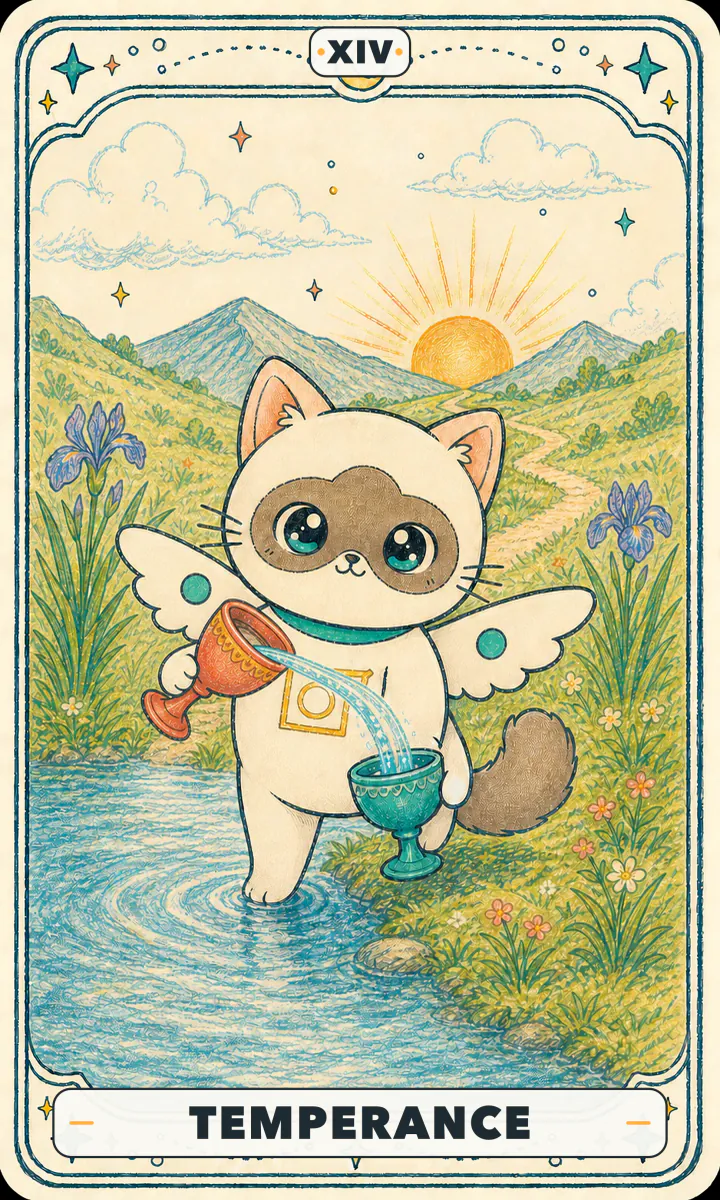
Imagen de la carta
Un ángel está parado con un pie en el agua y el otro en la orilla. Sostiene dos tazas y milagrosamente vierte agua entre ellas en ángulo sin derramar una gota. Un emblema de cuadrado y triángulo marca su pecho y un camino conduce hacia el sol al fondo.
Significado al derecho
Equilibrio, moderación, compenetración, paciencia. Simboliza armonizar elementos opuestos, encontrar el camino medio y crear algo nuevo a través de una fusión casi alquímica.
Significado invertido
Desequilibrio, extremos, exceso, impaciencia. Puede indicar turbulencia emocional o pérdida del punto de equilibrio en una relación o situación.
Amor, carrera, dinero y crecimiento
Amor
En el amor, Templanza señala a La alquimia y armonización de energías.. Vuelve a leerlo teniendo en cuenta cómo se comporta realmente la relación y lo que ambos están eligiendo.
Carrera
En cuestiones profesionales, Templanza apunta a La alquimia y armonización de energías.. Empiece por determinar qué recursos controla y cuál será su próximo paso.
Dinero
En cuestiones de dinero, Templanza apunta a La alquimia y armonización de energías.. No trates una lectura simbólica como una conclusión de inversión; guíate por los hechos, el presupuesto y tu propia tolerancia al riesgo.
Crecimiento personal
Para el crecimiento personal, Templanza apunta a La alquimia y armonización de energías.. Escribe la pregunta que plantea y luego conviértela en una acción que realmente puedas comprobar.
Lo que siente la otra persona
Cuando Templanza indica lo que siente la otra persona, el tema de su actitud hacia ti es: La alquimia y armonización de energías.. Al derecho, ese sentimiento se muestra hacia fuera; invertida, por ahora se queda dentro. No la tomes como un veredicto: contrástala con cómo actúa realmente.
Sí o no
Al derecho
Sí
Invertida
No
Esta es nuestra propia lectura rápida, basada en la dirección en la que se inclina el significado de la carta. Las tradiciones no están de acuerdo con respecto a las cartas individuales, y un "Quizás" debe sopesarse con la posición en la distribución y su situación real en lugar de tomarse como una respuesta de una sola palabra.
Texto original de Waite (1911)
Simbolismo interior (original)
Un ángel alado, con el signo del sol en la frente y en el pecho el cuadrado y el triángulo del septenario. Hablo de él en masculino, pero la figura no es ni varón ni mujer. Se considera que vierte las esencias de la vida de un cáliz a otro. Tiene un pie sobre la tierra y otro sobre las aguas, ilustrando así la naturaleza de las esencias. Un camino directo sube hasta ciertas alturas al filo del horizonte, y arriba hay una gran luz, a través de la cual se ve vagamente una corona. De ahí una parte del Secreto de la Vida Eterna, tal como es posible al hombre en su encarnación. Aquí se renuncia a todos los emblemas convencionales.
Y también a los significados convencionales, que aluden a los cambios de las estaciones, al movimiento perpetuo de la vida e incluso a la combinación de ideas. No es cierto, además, decir que la figura simboliza al genio del sol, aunque es la analogía de la luz solar, realizada en la tercera parte de nuestra triplicidad humana. Se la llama Templanza, de manera fantasiosa, porque, cuando su regla se impone en nuestra conciencia, templa, combina y armoniza las naturalezas psíquica y material. Bajo esa regla conocemos en nuestra parte racional algo de dónde venimos y adónde vamos.
Significado original del derecho
Economía, moderación, frugalidad, administración, acomodo.
Significado original invertido
Cosas relacionadas con iglesias, religiones, sectas, el sacerdocio, a veces incluso el sacerdote que casará al Consultante; también desunión, combinaciones desafortunadas, intereses en competencia.
Citado de A. E. Waite, The Pictorial Key to the Tarot (1911), ilustrado por Pamela Colman Smith. El texto es de dominio público.
Orígenes de mitos y símbolos
Verter líquido entre dos recipientes es, sin más, la forma estándar de dibujar la virtud de la Templanza. No hace falta ningún rodeo por el mito griego.
Imaginería documentada
Atestiguada por objetos o textos conservados
El acto de verter es la propia Templanza
La Templanza (Temperantia) es una de las cuatro virtudes cardinales, y la personificación medieval fija es una mujer que vierte líquido entre dos recipientes; la referencia es la antigua costumbre de rebajar el vino con agua: no beberlo puro es el modelo cotidiano de la templanza. El gesto central de esta carta no es otra cosa: es una ilustración literal de la palabra. Junto con la Fuerza (Fortaleza) y la Justicia, esta baraja contiene tres de las virtudes cardinales; solo falta la Prudencia.
Fuente Las cuatro virtudes cardinales clásicas; el esquema de la mezcla de agua en las personificaciones medievales de la Temperantia
Correspondencia esotérica
Una afirmación tradicional con fuente, pero construida dentro de un sistema ocultista
La figura de Waite no es ni masculina ni femenina
Waite escribe: el signo del sol en la frente, en el pecho «el cuadrado y el triángulo del septenario», un pie en tierra y otro en el agua. Se toma la molestia de declarar que se refiere a la figura en masculino, «pero la figura no es ni masculina ni femenina», rechaza la afirmación de que simbolice el genio del sol, y dice que el nombre de Templanza se le aplica «de forma caprichosa», porque lo que realmente hace es templar las dos naturalezas, espíritu y materia.
Fuente Waite, The Pictorial Key to the Tarot, 1911, Templanza (compárese con el original en el panel de fuentes de esta página)
Sagitario y el camino que asciende
La Golden Dawn asigna a la Templanza el signo de Sagitario (letra hebrea Sámej). El sendero de la carta, que corre recto hacia colinas lejanas con una luz sobre ellas, concuerda con el sentido sagitariano de disparar hacia algo lejano. Es resultado del diseño del sistema, no el origen de la imagen.
Fuente Atribuciones zodiacales del Libro T de la Golden Dawn
Lectura moderna
Popular solo desde el siglo XX; sin relación con el origen de la carta
Iris y Ganimedes: una identificación moderna
Como la carta muestra una figura alada que vierte agua, a menudo se la asocia con Iris, la diosa griega del arcoíris, o con Ganimedes, el copero de los dioses vinculado a Acuario. Ambos son figuras reales del mito griego, pero ninguno tiene línea de descendencia alguna con el esquema de la mezcla de agua de la virtud de la Templanza: en la historia de la imagen, el acto de verter fue primero el distintivo de una virtud, y solo después lectores posteriores lo identificaron con alguna deidad.
Fuente Lectura popular moderna; Iris y Ganimedes son figuras del mito griego
Escrito por BESTAROT, no citado de fuentes históricas. Cada afirmación se etiqueta según su grado de evidencia; Las capas interpretativas modernas son útiles para la lectura, pero no representan el origen histórico de la carta.
Estudie el tema: Orígenes de mitos y símbolos (capítulo 6 de la Academia)