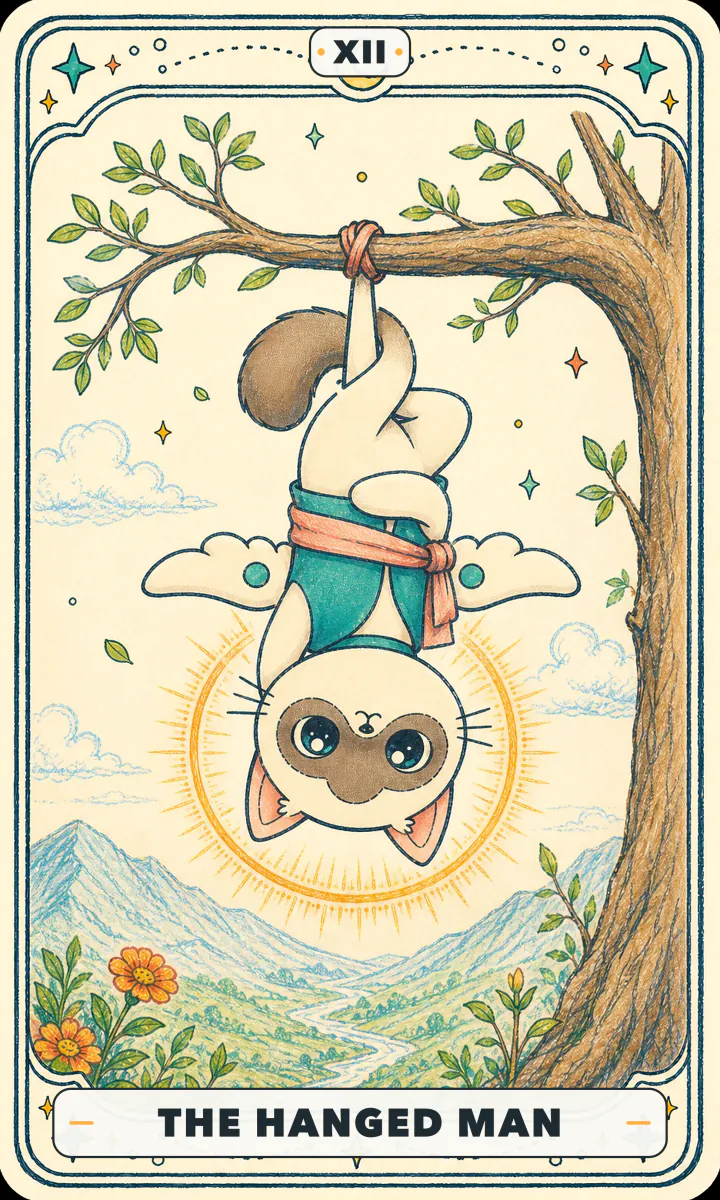
El hombre ahorcado
The Hanged Man
Sacrificio, nueva perspectiva
Respuesta rápida
El significado principal de El hombre ahorcado es Ver el mundo desde otro ángulo. Del derecho, suele apuntar a Sacrificio, una nueva perspectiva, suspensión, dejar ir. Simboliza la obtención; invertida, puede sugerir Sacrificio innecesario, demora, estancamiento, lucha. Puede indicar sufrimiento.
Imagen de la carta
Un hombre cuelga boca abajo por un pie de un árbol en forma de T, con las piernas formando un 4. Un halo brilla alrededor de su cabeza y su expresión es más serena que dolorosa. Viste una túnica azul y calzas rojas.
Significado al derecho
Sacrificio, una nueva perspectiva, suspensión, dejar ir. Simboliza la obtención de una sabiduría superior y una visión completamente nueva del mundo a través de la quietud deliberada o la entrega del ego.
Significado invertido
Sacrificio innecesario, demora, estancamiento, lucha. Puede indicar sufrimiento por razones equivocadas o ser incapaz de liberarse de alguna atadura.
Amor, carrera, dinero y crecimiento
Amor
En el amor, El hombre ahorcado señala a Ver el mundo desde otro ángulo. Vuelve a leerlo teniendo en cuenta cómo se comporta realmente la relación y lo que ambos están eligiendo.
Carrera
En cuestiones profesionales, El hombre ahorcado apunta a Ver el mundo desde otro ángulo. Empiece por determinar qué recursos controla y cuál será su próximo paso.
Dinero
En cuestiones de dinero, El hombre ahorcado apunta a Ver el mundo desde otro ángulo. No trates una lectura simbólica como una conclusión de inversión; guíate por los hechos, el presupuesto y tu propia tolerancia al riesgo.
Crecimiento personal
Para el crecimiento personal, El hombre ahorcado apunta a Ver el mundo desde otro ángulo. Escribe la pregunta que plantea y luego conviértela en una acción que realmente puedas comprobar.
Lo que siente la otra persona
Cuando El hombre ahorcado indica lo que siente la otra persona, el tema de su actitud hacia ti es: Ver el mundo desde otro ángulo. Al derecho, ese sentimiento se muestra hacia fuera; invertida, por ahora se queda dentro. No la tomes como un veredicto: contrástala con cómo actúa realmente.
Sí o no
Al derecho
Tal vez
Invertida
No
Esta es nuestra propia lectura rápida, basada en la dirección en la que se inclina el significado de la carta. Las tradiciones no están de acuerdo con respecto a las cartas individuales, y un "Quizás" debe sopesarse con la posición en la distribución y su situación real en lugar de tomarse como una respuesta de una sola palabra.
Texto original de Waite (1911)
Simbolismo interior (original)
La horca de la que pende forma una cruz Tau, mientras que la figura, por la posición de las piernas, forma una cruz gamada (fylfot). Hay un nimbo en torno a la cabeza del aparente mártir. Ha de notarse (1) que el árbol del sacrificio es madera viva, con hojas; (2) que el rostro expresa un profundo arrobamiento, no sufrimiento; (3) que la figura, en su conjunto, sugiere la vida en suspenso, pero vida y no muerte. Es una carta de profundo significado, pero todo el significado está velado. Uno de sus editores sugiere que Eliphas Lévi no conocía el sentido, lo cual es indudable; tampoco lo conocía el propio editor. Se la ha llamado falsamente carta del martirio, carta de la prudencia, carta de la Gran Obra, carta del deber; pero podemos agotar todas las interpretaciones publicadas y no hallar más que vanidad. Diré con toda sencillez, por mi parte, que expresa la relación, en uno de sus aspectos, entre lo Divino y el Universo.
Quien pueda entender que la historia de su naturaleza superior está incrustada en este simbolismo recibirá insinuaciones acerca de un gran despertar que es posible, y sabrá que tras el sagrado Misterio de la Muerte hay un glorioso Misterio de la Resurrección.
Significado original del derecho
Sabiduría, circunspección, discernimiento, pruebas, sacrificio, intuición, adivinación, profecía.
Significado original invertido
Egoísmo, la multitud, el cuerpo político.
Citado de A. E. Waite, The Pictorial Key to the Tarot (1911), ilustrado por Pamela Colman Smith. El texto es de dominio público.
Orígenes de mitos y símbolos
La imagen es un castigo medieval italiano para los traidores. Odín se le asoció mucho más tarde.
Imaginería documentada
Atestiguada por objetos o textos conservados
Pinturas infamantes: colgar cabeza abajo era un castigo
La Italia medieval tenía una pena pública llamada pittura infamante: el retrato de un traidor, de un deudor insolvente o de un enemigo político se pintaba colgado de un pie en el muro exterior de un edificio público para que todos lo vieran. En las primeras barajas italianas esta carta es L'Appeso, el colgado, y aparece también como Il Traditore, el traidor. Para un espectador del siglo XV, en otras palabras, la primera lectura de esta carta era «este hombre ha sido condenado», no «este hombre está meditando».
Fuente La pittura infamante medieval italiana; los nombres italianos tempranos L'Appeso / Il Traditore
Correspondencia esotérica
Una afirmación tradicional con fuente, pero construida dentro de un sistema ocultista
Waite tachó él mismo la lectura del martirio
Waite rechaza una a una las lecturas populares: la carta, escribe, «ha sido llamada falsamente carta del martirio, carta de la prudencia, carta de la Gran Obra, carta del deber». Pide al lector que observe tres cosas: el árbol del sacrificio es madera viva con hojas; el rostro expresa un profundo arrobamiento, no sufrimiento; y la figura en su conjunto sugiere «la vida en suspenso, pero vida y no muerte». Su propia lectura es una relación entre lo Divino y el Universo. El patíbulo forma una cruz en Tau, y las piernas cruzadas lo que él llama una cruz fylfot.
Fuente Waite, The Pictorial Key to the Tarot, 1911, El Hombre Ahorcado (compárese con el original en el panel de fuentes de esta página)
El elemento agua y la letra Mem
La Golden Dawn asigna al Hombre Ahorcado el elemento agua y la letra hebrea Mem, que significa literalmente agua. La suspensión, el soltar, el dejarse llevar por la corriente: todo ese registro procede de aquí y no de ningún planeta. Tres triunfos (el Tonto, el Hombre Ahorcado y el Juicio) reciben en este sistema las tres letras elementales en lugar de atribuciones planetarias.
Fuente Atribuciones de las letras elementales en el Libro T de la Golden Dawn
Lectura moderna
Popular solo desde el siglo XX; sin relación con el origen de la carta
El sacrificio de Odín: útil, siempre que se sepa que se añadió
La lectura moderna más popular vincula esta carta con el mito nórdico: Odín se cuelga del árbol del mundo durante nueve noches, herido por una lanza, sacrificado a sí mismo, y al final obtiene las runas. El pasaje es auténtico (Hávamál 138-139). Pero hay dos cosas que conviene tener claras. Primero, el texto dice que colgó «de un árbol azotado por el viento nueve largas noches» y nunca dice que cabeza abajo; la inversión la pusieron lectores posteriores para ajustar el texto a la imagen. Segundo, el pasaje no tiene ninguna relación histórica con el tarot: la distancia en el tiempo y el espacio es demasiado grande. Como recurso mnemotécnico funciona bien. Solo que no lo enseñe como el origen de la carta.
Fuente Lectura popular moderna; el autosacrificio de Odín está en el Hávamál 138-139
Escrito por BESTAROT, no citado de fuentes históricas. Cada afirmación se etiqueta según su grado de evidencia; Las capas interpretativas modernas son útiles para la lectura, pero no representan el origen histórico de la carta.
Estudie el tema: Orígenes de mitos y símbolos (capítulo 6 de la Academia)