el diablo
The Devil
Esclavitud, Deseo
Respuesta rápida
El significado principal de el diablo es Las tentaciones del mundo material.. Del derecho, suele apuntar a Bondage, materialismo, deseo, adicción. Simboliza estar controlado por los anhel; invertida, puede sugerir Liberarse, despertar, liberarse de la dependencia, afrontar la sombra. Puede ind.
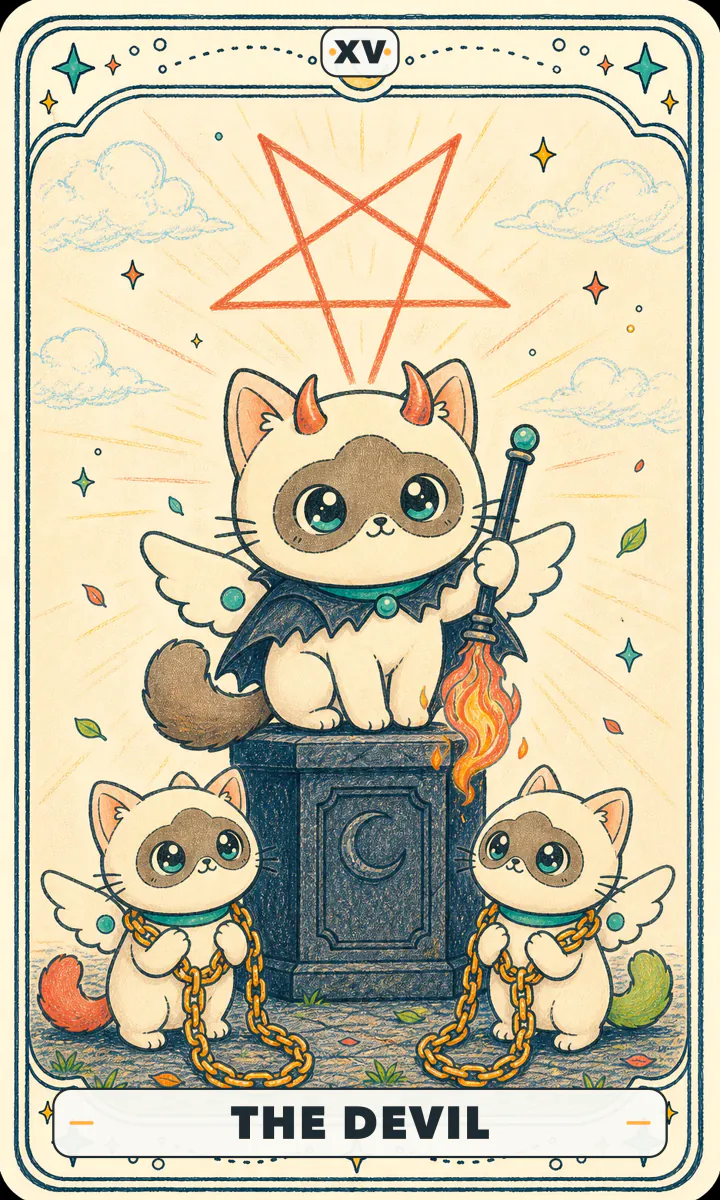
Imagen de la carta
Un enorme diablo (Baphomet) se agacha sobre un cubo negro, con un pentagrama invertido sobre su cabeza. Abajo, un hombre y una mujer están encadenados sin apretar (cadenas que aparentemente podrían soltarse ellos mismos), a quienes les han crecido cuernos y colas.
Significado al derecho
Bondage, materialismo, deseo, adicción. Simboliza estar controlado por los anhelos materiales o el miedo, y darse cuenta de que esa esclavitud a menudo proviene de los propios apegos.
Significado invertido
Liberarse, despertar, liberarse de la dependencia, afrontar la sombra. Puede indicar que se comienza a ver la raíz del problema y se trabaja para escapar de una relación o hábito poco saludable.
Amor, carrera, dinero y crecimiento
Amor
En el amor, el diablo señala a Las tentaciones del mundo material.. Vuelve a leerlo teniendo en cuenta cómo se comporta realmente la relación y lo que ambos están eligiendo.
Carrera
En cuestiones profesionales, el diablo apunta a Las tentaciones del mundo material.. Empiece por determinar qué recursos controla y cuál será su próximo paso.
Dinero
En cuestiones de dinero, el diablo apunta a Las tentaciones del mundo material.. No trates una lectura simbólica como una conclusión de inversión; guíate por los hechos, el presupuesto y tu propia tolerancia al riesgo.
Crecimiento personal
Para el crecimiento personal, el diablo apunta a Las tentaciones del mundo material.. Escribe la pregunta que plantea y luego conviértela en una acción que realmente puedas comprobar.
Lo que siente la otra persona
Cuando el diablo indica lo que siente la otra persona, el tema de su actitud hacia ti es: Las tentaciones del mundo material.. Al derecho, ese sentimiento se muestra hacia fuera; invertida, por ahora se queda dentro. No la tomes como un veredicto: contrástala con cómo actúa realmente.
Sí o no
Al derecho
No
Invertida
Sí
Esta es nuestra propia lectura rápida, basada en la dirección en la que se inclina el significado de la carta. Las tradiciones no están de acuerdo con respecto a las cartas individuales, y un "Quizás" debe sopesarse con la posición en la distribución y su situación real en lugar de tomarse como una respuesta de una sola palabra.
Texto original de Waite (1911)
Simbolismo interior (original)
El diseño es un acomodo, un término medio o una armonía entre varios motivos mencionados en la primera parte. El Macho Cabrío Cornudo de Mendes, con alas como las de un murciélago, está de pie sobre un altar. En la boca del estómago está el signo de Mercurio. La mano derecha está alzada y extendida, y es lo contrario de la bendición que da el Hierofante en la quinta carta. En la mano izquierda hay una gran antorcha encendida, invertida hacia la tierra. En la frente hay un pentagrama invertido. Delante del altar hay una argolla, de la que parten dos cadenas hasta el cuello de dos figuras, hombre y mujer. Son análogas a las de la quinta carta, como Adán y Eva después de la Caída. De ahí la cadena y la fatalidad de la vida material.
Las figuras tienen cola, para significar la naturaleza animal, pero hay inteligencia humana en los rostros, y el que se alza por encima de ellas no ha de ser su amo para siempre. Aun ahora, también él es un siervo, sostenido por el mal que hay en él y ciego a la libertad del servicio. Con más de su habitual escarnio hacia las artes que fingía respetar e interpretar como maestro en ellas, Eliphas Lévi afirma que la figura bafomética es la ciencia oculta y la magia. Otro comentarista dice que en el mundo Divino significa la predestinación, pero en ese mundo no hay correspondencia con las cosas que abajo son propias del bruto. Lo que sí significa es el Morador del Umbral fuera del Jardín Místico, cuando son expulsados de él quienes han comido el fruto prohibido.
Significado original del derecho
Estrago, violencia, vehemencia, esfuerzos extraordinarios, fuerza, fatalidad; lo que está predestinado, pero no por ello es malo.
Significado original invertido
Fatalidad maligna, debilidad, mezquindad, ceguera.
Citado de A. E. Waite, The Pictorial Key to the Tarot (1911), ilustrado por Pamela Colman Smith. El texto es de dominio público.
Orígenes de mitos y símbolos
El macho cabrío de esta carta es el Baphomet que Lévi dibujó en 1856. No es el dios griego Pan.
Correspondencia esotérica
Una afirmación tradicional con fuente, pero construida dentro de un sistema ocultista
El «Macho Cabrío de Mendes» procede de Lévi
El texto de Waite lo dice sin rodeos: el Macho Cabrío Cornudo de Mendes, con alas de murciélago, de pie sobre un altar. La figura es el Baphomet de Mendes que Eliphas Lévi dibujó en 1856, fusionando el dios carnero de la ciudad egipcia de Mendes descrito por Heródoto con el Baphomet del que se acusó a los templarios en sus procesos. El signo de Mercurio en el vientre, la antorcha invertida, el pentagrama invertido en la frente: todos ellos son piezas del diseño de Lévi. Dicho llanamente: el diablo de esta carta tiene poco más de cien años.
Fuente Waite, The Pictorial Key to the Tarot, 1911, El Diablo; la lámina del Baphomet en Eliphas Lévi, Dogme et Rituel de la Haute Magie, 1856
Las cadenas están sueltas, y es Waite quien lo dice
El hombre y la mujer ante el altar están encadenados a una argolla, y Waite dice que son «análogos a los de la quinta carta, como si fueran Adán y Eva después de la Caída». Pero sigue de inmediato: sus rostros muestran «inteligencia humana en los rostros», la figura entronizada sobre ellos «no ha de ser su amo para siempre», e «incluso ahora, también él es un siervo». Los collares sueltos, que pueden quitarse en cualquier momento, proceden exactamente de este pasaje.
Fuente Waite, The Pictorial Key to the Tarot, 1911, El Diablo
Capricornio: la otra identidad del macho cabrío
La Golden Dawn asigna al Diablo el signo de Capricornio (letra hebrea Ayin, literalmente «ojo»). El propio glifo del signo es una cabra, así que la correspondencia se asienta en la imagen sin fricción alguna, pero conviene respetar el orden. Lévi dibujó primero el diablo con cabeza de macho cabrío, y el sistema lo vinculó a Capricornio después, no al revés.
Fuente Atribuciones zodiacales del Libro T de la Golden Dawn
Lectura moderna
Popular solo desde el siglo XX; sin relación con el origen de la carta
Pan: la figura identificada erróneamente con más frecuencia aquí
Muchos materiales dicen que esta carta representa al dios griego Pan, símbolo del instinto reprimido por la civilización. Pan tiene, en efecto, patas y cuernos de cabra, y la imaginería cristiana sí lo tomó prestado al construir el aspecto del diablo. Pero la fuente directa de la figura de esta carta es el Baphomet de Lévi, con todo un aparato del ocultismo del siglo XIX de por medio. El «instinto reprimido» es aún más tardío: procede de las lecturas psicologizadas del siglo XX.
Fuente Lectura popular moderna; Pan pertenece al mito griego, un linaje distinto del Baphomet de Lévi
Escrito por BESTAROT, no citado de fuentes históricas. Cada afirmación se etiqueta según su grado de evidencia; Las capas interpretativas modernas son útiles para la lectura, pero no representan el origen histórico de la carta.
Estudie el tema: Orígenes de mitos y símbolos (capítulo 6 de la Academia)