Justicia
Justice
Justicia, verdad
Respuesta rápida
El significado principal de Justicia es El equilibrio objetivo de causa y efecto.. Del derecho, suele apuntar a Justicia, verdad, causa y efecto, la ley. Simboliza la evaluación objetiva y las; invertida, puede sugerir Injusticia, prejuicios, evasión de responsabilidades, disputas legales. Puede in.
Imagen de la carta
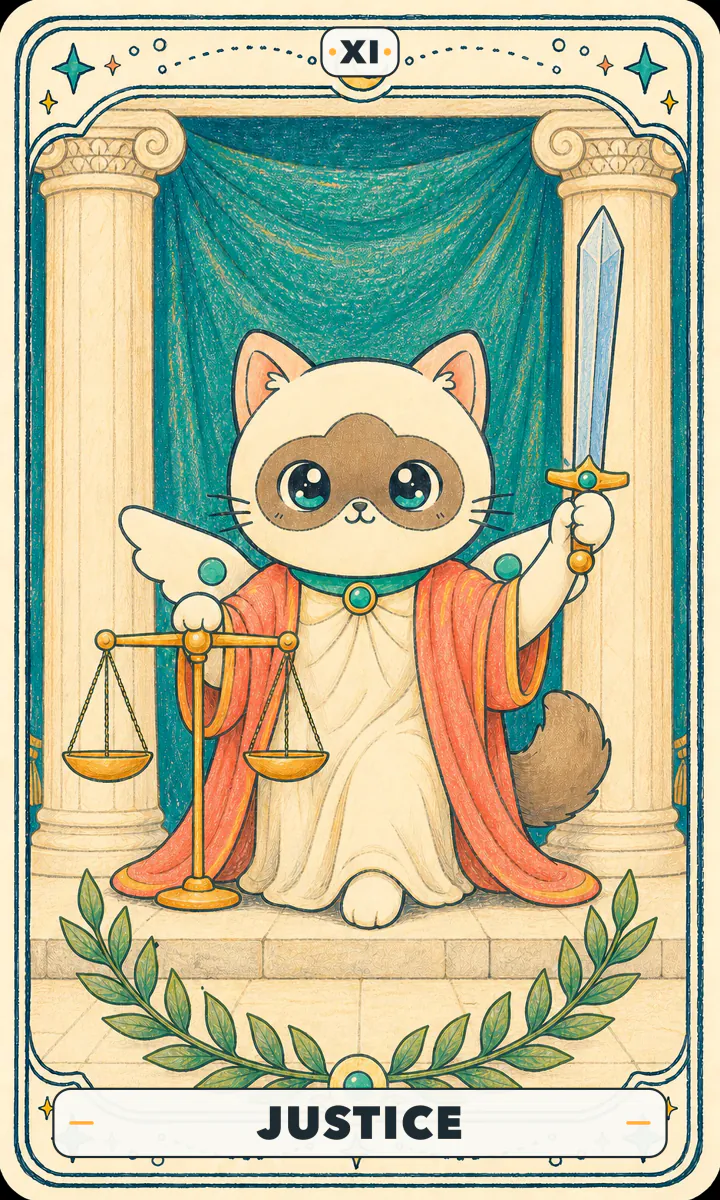
Una mujer severa está sentada entre dos pilares de piedra ante un velo púrpura. Su mano derecha levanta una espada (razón) mientras que su izquierda sostiene una balanza (equilibrio). Un pie expuesto simboliza la acción.
Significado al derecho
Justicia, verdad, causa y efecto, la ley. Simboliza la evaluación objetiva y las decisiones basadas en hechos, subrayando la ley del karma: cosechas lo que siembras.
Significado invertido
Injusticia, prejuicios, evasión de responsabilidades, disputas legales. Puede indicar que lo tratan injustamente o que se está engañando a sí mismo y negándose a enfrentar la verdad.
Amor, carrera, dinero y crecimiento
Amor
En el amor, Justicia señala a El equilibrio objetivo de causa y efecto.. Vuelve a leerlo teniendo en cuenta cómo se comporta realmente la relación y lo que ambos están eligiendo.
Carrera
En cuestiones profesionales, Justicia apunta a El equilibrio objetivo de causa y efecto.. Empiece por determinar qué recursos controla y cuál será su próximo paso.
Dinero
En cuestiones de dinero, Justicia apunta a El equilibrio objetivo de causa y efecto.. No trates una lectura simbólica como una conclusión de inversión; guíate por los hechos, el presupuesto y tu propia tolerancia al riesgo.
Crecimiento personal
Para el crecimiento personal, Justicia apunta a El equilibrio objetivo de causa y efecto.. Escribe la pregunta que plantea y luego conviértela en una acción que realmente puedas comprobar.
Lo que siente la otra persona
Cuando Justicia indica lo que siente la otra persona, el tema de su actitud hacia ti es: El equilibrio objetivo de causa y efecto.. Al derecho, ese sentimiento se muestra hacia fuera; invertida, por ahora se queda dentro. No la tomes como un veredicto: contrástala con cómo actúa realmente.
Sí o no
Al derecho
Tal vez
Invertida
No
Esta es nuestra propia lectura rápida, basada en la dirección en la que se inclina el significado de la carta. Las tradiciones no están de acuerdo con respecto a las cartas individuales, y un "Quizás" debe sopesarse con la posición en la distribución y su situación real en lugar de tomarse como una respuesta de una sola palabra.
Texto original de Waite (1911)
Simbolismo interior (original)
Como esta carta sigue el simbolismo tradicional y lleva ante todo sus significados evidentes, poco hay que decir de ella fuera de las escasas consideraciones reunidas en la primera parte, a las que se remite al lector.
Se verá, sin embargo, que la figura está sentada entre columnas, como la Suma Sacerdotisa, y por ello parece conveniente indicar que el principio moral que da a cada uno según sus obras, aunque desde luego guarde estricta analogía con las cosas superiores, difiere en su esencia de la justicia espiritual implicada en la idea de la elección. Esta última pertenece a un orden misterioso de la Providencia, en virtud del cual es posible que ciertos hombres conciban la idea de consagrarse a las cosas más altas. Su operación es como el soplo del Espíritu, que sopla donde quiere, y no tenemos canon de crítica ni fundamento de explicación acerca de ella. Es análoga a la posesión de los dones de las hadas, los altos dones y los dones graciosos del poeta: los tenemos o no los tenemos, y su presencia es tan misteriosa como su ausencia. La ley de la Justicia, sin embargo, no está implicada en ninguna de las dos alternativas. En conclusión, las columnas de la Justicia dan a un mundo y las columnas de la Suma Sacerdotisa a otro.
Significado original del derecho
Equidad, rectitud, probidad, poder ejecutivo; triunfo de la parte que tiene razón en un pleito.
Significado original invertido
La ley en todas sus ramas, complicaciones legales, intolerancia, parcialidad, severidad excesiva.
Citado de A. E. Waite, The Pictorial Key to the Tarot (1911), ilustrado por Pamela Colman Smith. El texto es de dominio público.
Orígenes de mitos y símbolos
La diosa clásica de la justicia lleva espada y balanza, pero no tiene los ojos vendados: la venda se añadió siglos después.
Imaginería documentada
Atestiguada por objetos o textos conservados
La Justicia entre las virtudes cardinales, según un esquema clásico
La Justicia (Iustitia) es una de las cuatro virtudes cardinales clásicas y, junto con la Fuerza (Fortaleza) y la Templanza, tiene su propio triunfo en esta baraja. La personificación con espada y balanza es la forma fija desde Roma: la balanza pesa, la espada ejecuta. En el lado griego hay dos figuras: Temis rige la ley y el orden divinos, y Dike el veredicto justo entre los seres humanos; Roma reunió toda esa línea en Iustitia.
Fuente Las cuatro virtudes cardinales clásicas; la iconografía clásica y los dominios de Iustitia / Temis / Dike
No tiene los ojos vendados, y eso importa
La Justicia que hoy se alza ante los tribunales suele llevar los ojos vendados, pero ese añadido solo se generalizó después del siglo XVI, y empezó con un matiz satírico (la insinuación de que el juez no ve). La Justicia del tarot tiene los ojos abiertos y mira de frente a quien lee. Así que la carta no trata de negarse a mirar en nombre de la imparcialidad; trata de ver con claridad y luego sopesar: los dos esquemas difieren en un solo gesto, y los significados acaban muy lejos uno del otro.
Fuente La Justicia con los ojos vendados es una evolución de la imaginería posterior al siglo XVI; la Justicia del tarot no lleva venda
Correspondencia esotérica
Una afirmación tradicional con fuente, pero construida dentro de un sistema ocultista
También se sienta entre dos columnas, pero se abren a otro lugar
Waite señala que la figura está «sentada entre columnas, como la Suma Sacerdotisa», y se cuida de trazar la línea: la Justicia trata del principio moral de dar a cada uno según sus obras, y es lo que «difiere en su esencia» de la justicia espiritual de la elección propia de la Suma Sacerdotisa. Su conclusión es una sola frase: «las columnas de la Justicia se abren a un mundo y las columnas de la Suma Sacerdotisa a otro». La atribución de la Golden Dawn es Libra (letra hebrea Lámed).
Fuente Waite, The Pictorial Key to the Tarot, 1911, La Justicia; atribuciones zodiacales del Libro T de la Golden Dawn
Lectura moderna
Popular solo desde el siglo XX; sin relación con el origen de la carta
El «ajuste de cuentas kármico» se trasladó aquí más tarde
Leer la Justicia como karma y retribución cósmica es la misma mercancía que la «rueda del karma» de la Rueda de la Fortuna: la fusión que siguió a la importación teosófica, a finales del siglo XIX, de las ideas indias del karma al esoterismo occidental. La diosa clásica pesa y juzga el caso que tiene delante. Saldar cuentas de una vida a otra no es asunto suyo.
Fuente Lectura popular moderna, sin base histórica
Escrito por BESTAROT, no citado de fuentes históricas. Cada afirmación se etiqueta según su grado de evidencia; Las capas interpretativas modernas son útiles para la lectura, pero no representan el origen histórico de la carta.
Estudie el tema: Orígenes de mitos y símbolos (capítulo 6 de la Academia)