el carro
The Chariot
Victoria, Control
Respuesta rápida
El significado principal de el carro es Fuerza de voluntad para superar obstáculos.. Del derecho, suele apuntar a Victoria, fuerza de voluntad, autocontrol, determinación. Simboliza la unión de; invertida, puede sugerir Pérdida de control, agresión, derrota, falta de dirección. Puede indicar que te.
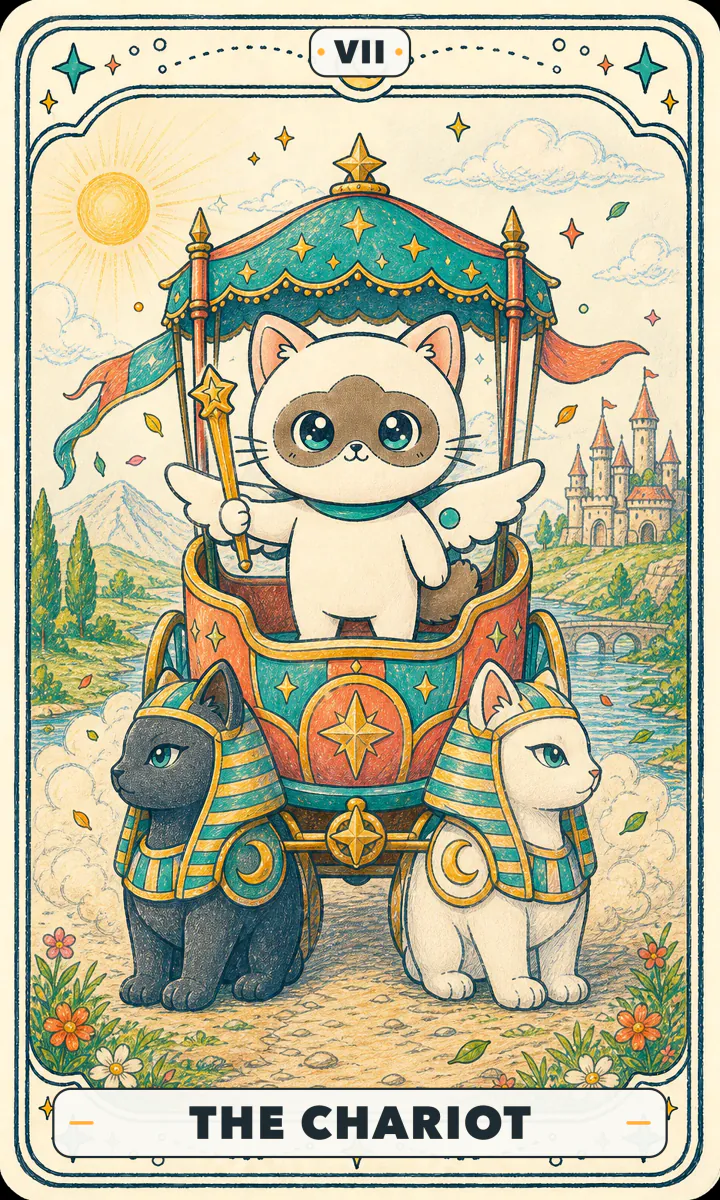
Imagen de la carta
Un guerrero se encuentra en un carro bajo un dosel estrellado, con lunas crecientes sobre sus hombros. El carro está tirado por dos esfinges, una negra y otra blanca, aunque no se ven riendas. Un río y un castillo llenan el fondo.
Significado al derecho
Victoria, fuerza de voluntad, autocontrol, determinación. Simboliza la unión de fuerzas opuestas (las esfinges blancas y negras) mediante pura voluntad de superar obstáculos.
Significado invertido
Pérdida de control, agresión, derrota, falta de dirección. Puede indicar que te desgarran emociones o fuerzas en conflicto, desviando tu camino.
Amor, carrera, dinero y crecimiento
Amor
En el amor, el carro señala a Fuerza de voluntad para superar obstáculos.. Vuelve a leerlo teniendo en cuenta cómo se comporta realmente la relación y lo que ambos están eligiendo.
Carrera
En cuestiones profesionales, el carro apunta a Fuerza de voluntad para superar obstáculos.. Empiece por determinar qué recursos controla y cuál será su próximo paso.
Dinero
En cuestiones de dinero, el carro apunta a Fuerza de voluntad para superar obstáculos.. No trates una lectura simbólica como una conclusión de inversión; guíate por los hechos, el presupuesto y tu propia tolerancia al riesgo.
Crecimiento personal
Para el crecimiento personal, el carro apunta a Fuerza de voluntad para superar obstáculos.. Escribe la pregunta que plantea y luego conviértela en una acción que realmente puedas comprobar.
Lo que siente la otra persona
Cuando el carro indica lo que siente la otra persona, el tema de su actitud hacia ti es: Fuerza de voluntad para superar obstáculos.. Al derecho, ese sentimiento se muestra hacia fuera; invertida, por ahora se queda dentro. No la tomes como un veredicto: contrástala con cómo actúa realmente.
Sí o no
Al derecho
Sí
Invertida
No
Esta es nuestra propia lectura rápida, basada en la dirección en la que se inclina el significado de la carta. Las tradiciones no están de acuerdo con respecto a las cartas individuales, y un "Quizás" debe sopesarse con la posición en la distribución y su situación real en lugar de tomarse como una respuesta de una sola palabra.
Texto original de Waite (1911)
Simbolismo interior (original)
Una figura erguida y principesca que lleva una espada desenvainada y que corresponde, a grandes rasgos, a la descripción tradicional que he dado en la primera parte. Sobre los hombros del héroe victorioso se supone que están el Urim y el Tumim. Ha llevado cautiva a la cautividad; es la conquista en todos los planos: en la mente, en la ciencia, en el progreso, en ciertas pruebas de iniciación. Así ha respondido a la Esfinge, y es por esta razón por lo que he aceptado la variante de Eliphas Lévi: dos esfinges tiran de su carro. Es, por encima de todo, el triunfo en la mente.
Por esta razón ha de entenderse (a) que la pregunta de la esfinge atañe a un Misterio de la Naturaleza y no del mundo de la Gracia, al que el auriga no podría dar respuesta; (b) que los planos de su conquista son manifiestos o externos y no están dentro de él; (c) que la liberación que efectúa puede dejarlo a él mismo en la servidumbre del entendimiento lógico; (d) que las pruebas de iniciación por las que ha pasado triunfante han de entenderse física o racionalmente; y (e) que si llegara a las columnas de aquel Templo entre las cuales está sentada la Suma Sacerdotisa, no podría abrir el rollo llamado Tora, ni sabría responder si ella lo interrogara. No es la realeza hereditaria y no es el sacerdocio.
Significado original del derecho
Socorro, providencia; también guerra, triunfo, presunción, venganza, problemas.
Significado original invertido
Motín, riña, disputa, litigio, derrota.
Citado de A. E. Waite, The Pictorial Key to the Tarot (1911), ilustrado por Pamela Colman Smith. El texto es de dominio público.
Orígenes de mitos y símbolos
Triunfo es el nombre original de la propia baraja. Las esfinges son una sustitución de Lévi, y el carro de Platón lo añadieron manos posteriores.
Imaginería documentada
Atestiguada por objetos o textos conservados
De esta carta tomó su nombre toda la baraja
El nombre más antiguo de los triunfos es trionfi, «triunfos». La tradición iconográfica es la procesión triunfal romana y los Trionfi de Petrarca, con su fila de carros triunfales en la que cada uno vence al anterior: el Amor vence al hombre, la Castidad vence al Amor, la Muerte vence a la Castidad, la Fama vence a la Muerte, el Tiempo vence a la Fama, la Eternidad vence al Tiempo. Toda la serie de triunfos es ese mismo cortejo en que «el siguiente vence al anterior», y el Carro es la carta que dibuja el motivo con mayor claridad.
Fuente El nombre original de los triunfos, trionfi; la tradición iconográfica de los Trionfi de Petrarca (I Trionfi, siglo XIV)
Correspondencia esotérica
Una afirmación tradicional con fuente, pero construida dentro de un sistema ocultista
Dos esfinges, y un enigma ya resuelto
Las barajas más antiguas tenían dos caballos tirando del carro. Waite afirma que ha «aceptado la variante de Eliphas Lévi» y ha puesto en su lugar dos esfinges, y escribe que el auriga «ha respondido a la Esfinge», una alusión a Edipo resolviendo el enigma. Acto seguido resta valor a esa victoria: el enigma de la esfinge pertenece a «un Misterio de la Naturaleza», y si el auriga llegara a las dos columnas donde se sienta la Suma Sacerdotisa, «no podría abrir el rollo llamado Tora».
Fuente Waite, The Pictorial Key to the Tarot, 1911, El Carro; la reconstrucción de la carta por Eliphas Lévi
Los Urim y Tumim sobre sus hombros
Waite escribe que el auriga lleva los Urim y Tumim sobre los hombros: los objetos del pectoral del sumo sacerdote hebreo usados para consultar a Dios (Éxodo 28:30). En la carta, las hombreras se dibujan como dos rostros semejantes a lunas. Una vez más: una esfinge griega y un instrumento sacerdotal hebreo, uno junto a otro en la misma carta.
Fuente Éxodo 28:30; Waite, The Pictorial Key to the Tarot, 1911, El Carro
Cáncer: avanzar dentro de un caparazón
La Golden Dawn asigna al Carro el signo de Cáncer (letra hebrea Jet). El carro es un caparazón duro, y la figura que va dentro está a la vez protegida y encerrada, lo que explica por qué la victoria de esta carta siempre sabe a algo sostenido por la voluntad, más que a un triunfo fácil.
Fuente Atribuciones zodiacales del Libro T de la Golden Dawn
Lectura moderna
Popular solo desde el siglo XX; sin relación con el origen de la carta
El carro del alma de Platón: encaja muy bien, pero se encajó después
El pasaje que más se cita sobre esta carta es el Fedro de Platón: el alma como un auriga que conduce dos caballos, uno negro y otro blanco, uno que tira hacia arriba y otro hacia abajo, y la tarea del conductor es hacer que vayan en la misma dirección. Las esfinges negra y blanca de la carta responden a ello de maravilla, pero esas esfinges las puso Lévi en la década de 1850, y no hay línea de descendencia entre la imagen de Platón y el carro triunfal del siglo XV. Funciona bien como herramienta para entender la carta. Como fuente, sencillamente es errónea.
Fuente Lectura popular moderna; el carro del alma está en el Fedro de Platón, 246a-254e
Escrito por BESTAROT, no citado de fuentes históricas. Cada afirmación se etiqueta según su grado de evidencia; Las capas interpretativas modernas son útiles para la lectura, pero no representan el origen histórico de la carta.
Estudie el tema: Orígenes de mitos y símbolos (capítulo 6 de la Academia)