El Hierofante
The Hierophant
Tradición, Fe
Respuesta rápida
El significado principal de El Hierofante es guía espiritual. Del derecho, suele apuntar a Tradición, fe, educación, guía espiritual, pertenencia. Simboliza seguir convenc; invertida, puede sugerir Tradición desafiante, creencias poco convencionales, consejos hipócritas, rebeli.
Imagen de la carta
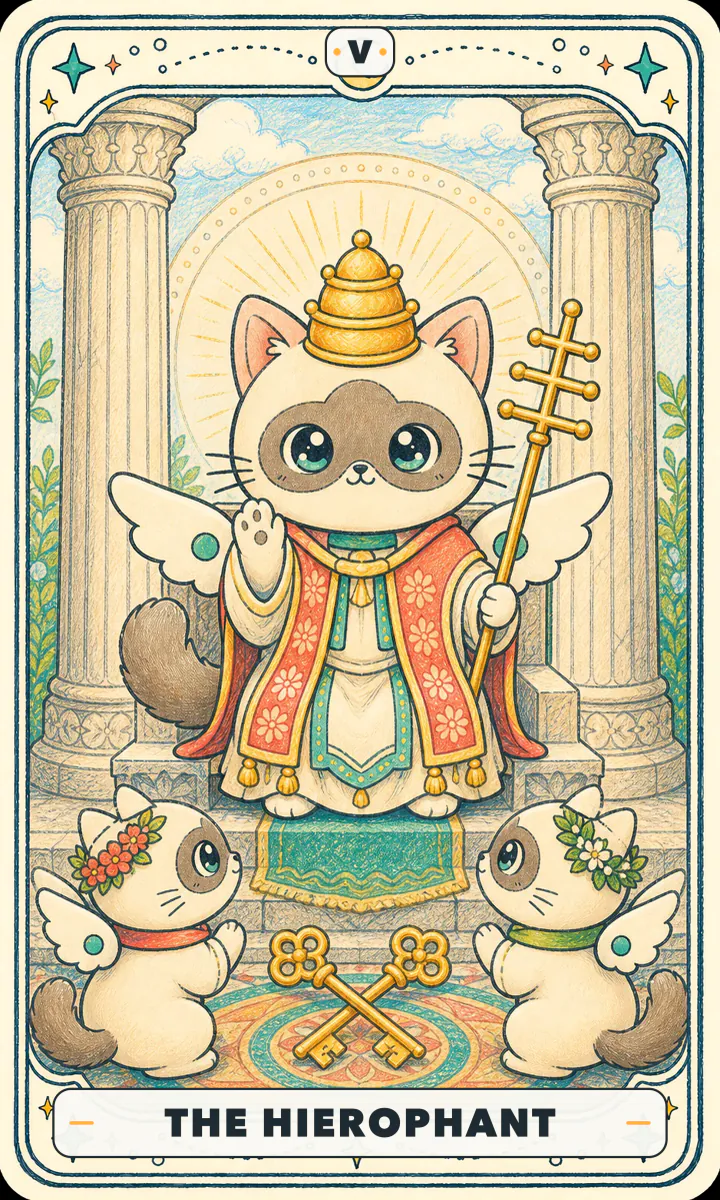
El Hierofante, ataviado con tres vestimentas, se sienta entre dos pilares de piedra y lleva una triple corona. Su mano izquierda sostiene un bastón de triple cruz, su derecha está levantada en señal de bendición. Dos llaves cruzadas yacen a sus pies y dos acólitos se arrodillan ante él.
Significado al derecho
Tradición, fe, educación, guía espiritual, pertenencia. Simboliza seguir convenciones sociales establecidas o buscar la ayuda de la sabiduría tradicional.
Significado invertido
Tradición desafiante, creencias poco convencionales, consejos hipócritas, rebelión. Puede indicar romper con las convenciones o sentirse limitado por un dogma.
Amor, carrera, dinero y crecimiento
Amor
En el amor, El Hierofante señala a guía espiritual. Vuelve a leerlo teniendo en cuenta cómo se comporta realmente la relación y lo que ambos están eligiendo.
Carrera
En cuestiones profesionales, El Hierofante apunta a guía espiritual. Empiece por determinar qué recursos controla y cuál será su próximo paso.
Dinero
En cuestiones de dinero, El Hierofante apunta a guía espiritual. No trates una lectura simbólica como una conclusión de inversión; guíate por los hechos, el presupuesto y tu propia tolerancia al riesgo.
Crecimiento personal
Para el crecimiento personal, El Hierofante apunta a guía espiritual. Escribe la pregunta que plantea y luego conviértela en una acción que realmente puedas comprobar.
Lo que siente la otra persona
Cuando El Hierofante indica lo que siente la otra persona, el tema de su actitud hacia ti es: guía espiritual. Al derecho, ese sentimiento se muestra hacia fuera; invertida, por ahora se queda dentro. No la tomes como un veredicto: contrástala con cómo actúa realmente.
Sí o no
Al derecho
Sí
Invertida
Tal vez
Esta es nuestra propia lectura rápida, basada en la dirección en la que se inclina el significado de la carta. Las tradiciones no están de acuerdo con respecto a las cartas individuales, y un "Quizás" debe sopesarse con la posición en la distribución y su situación real en lugar de tomarse como una respuesta de una sola palabra.
Texto original de Waite (1911)
Simbolismo interior (original)
Lleva la triple corona y está sentado entre dos columnas, pero no son las del Templo que guarda la Suma Sacerdotisa. En la mano izquierda sostiene un cetro rematado por la triple cruz, y con la derecha hace el conocido signo eclesiástico que se llama de esoterismo, y que distingue entre la parte manifiesta y la parte oculta de la doctrina. Es de notar a este respecto que la Suma Sacerdotisa no hace ningún signo. A sus pies están las llaves cruzadas, y dos ministros sacerdotales con alba se arrodillan ante él. Se le ha llamado por lo común el Papa, que es una aplicación particular del oficio más general que simboliza. Es el poder gobernante de la religión externa, así como la Suma Sacerdotisa es el genio que prevalece en el poder esotérico y retirado. Los significados propios de esta carta han sufrido una lamentable mezcla a manos de casi todos. Grand Orient dice con verdad que el Hierofante es el poder de las llaves, la doctrina ortodoxa exotérica y el lado exterior de la vida que conduce a la doctrina; pero desde luego no es el príncipe de la doctrina oculta, como ha sugerido otro comentarista.
Es más bien la summa totius theologiæ, cuando ha pasado a la máxima rigidez de expresión; pero simboliza también todo lo que es justo y sagrado en el lado manifiesto. Como tal, es el cauce de la gracia propio del mundo de la institución, a diferencia del de la Naturaleza, y es el guía de la salvación para el género humano en general. Es el orden y la cabeza de la jerarquía reconocida, que es el reflejo de otro orden jerárquico mayor; pero puede suceder que el pontífice olvide el significado de este su estado simbólico y actúe como si contuviera dentro de sus propias medidas todo lo que su signo significa o su símbolo pretende mostrar. No es, como se ha pensado, la filosofía, salvo en su lado teológico; no es la inspiración; y no es la religión, aunque es un modo de expresarla.
Significado original del derecho
Matrimonio, alianza, cautiverio, servidumbre; según otra versión, misericordia y bondad; inspiración; el hombre al que recurre el Consultante.
Significado original invertido
Sociedad, buen entendimiento, concordia, exceso de bondad, debilidad.
Citado de A. E. Waite, The Pictorial Key to the Tarot (1911), ilustrado por Pamela Colman Smith. El texto es de dominio público.
Orígenes de mitos y símbolos
La imagen es un papa; el nombre es el título del sacerdote que presidía los Misterios eleusinos griegos. Fue Waite quien lo cambió.
Imaginería documentada
Atestiguada por objetos o textos conservados
La imagen es simplemente un papa
En las primeras barajas italianas esta carta es Il Papa, el Papa, emparejado con la Papisa. Cada elemento de la carta es equipamiento institucional católico estándar: la triple corona, el báculo de la triple cruz, las llaves cruzadas a sus pies; y las llaves proceden de Mateo 16:19, las llaves del reino de los cielos entregadas a Pedro. Waite lo escribe él mismo: habitualmente se le ha llamado el Papa.
Fuente El nombre italiano temprano Il Papa; Mateo 16:19 (las llaves del reino); Waite 1911
La palabra Hierofante es griega
Rebautizar al Papa como Hierofante fue práctica de la generación de Waite. La palabra es griega, ἱεροφάντης, literalmente «el que muestra las cosas sagradas», y era el título oficial del sacerdote que presidía los Misterios eleusinos, cuyo mito central es el de Deméter y Perséfone. Así que en esta carta hay un auténtico hilo griego. Solo que no está en la imagen; está en el nombre, y se le añadió apenas a finales del siglo XIX.
Fuente ἱεροφάντης es el título del sacerdote que presidía en Eleusis; el cambio de nombre está en Waite 1911
Correspondencia esotérica
Una afirmación tradicional con fuente, pero construida dentro de un sistema ocultista
Tauro y el peso de la institución
La Golden Dawn asigna al Hierofante el signo de Tauro (letra hebrea Vav). El registro de la estabilidad, de soportar peso, de moverse despacio y no cambiar procede de ahí, y encaja bien con una carta definida como el poder rector de la religión establecida.
Fuente Atribuciones zodiacales del Libro T de la Golden Dawn
Lectura moderna
Popular solo desde el siglo XX; sin relación con el origen de la carta
Leerlo como maestro espiritual es leerlo al revés
La costumbre contemporánea es leer esta carta como el gurú, el maestro espiritual, la autoridad interior. El texto de Waite la define exactamente al contrario: el Hierofante es «el poder rector de la religión exterior», opuesto al poder esotérico y recogido que representa la Suma Sacerdotisa, y niega expresamente que sea el príncipe de la doctrina oculta. Es decir: esta carta rige instituciones, doctrina pública y procedimientos, no un guía espiritual privado.
Fuente Lectura popular moderna; Waite 1911 niega la lectura de «príncipe de la doctrina oculta» en esta misma entrada
Escrito por BESTAROT, no citado de fuentes históricas. Cada afirmación se etiqueta según su grado de evidencia; Las capas interpretativas modernas son útiles para la lectura, pero no representan el origen histórico de la carta.
Estudie el tema: Orígenes de mitos y símbolos (capítulo 6 de la Academia)