los amantes
The Lovers
Amor, elección
Respuesta rápida
El significado principal de los amantes es Unión emocional profunda. Del derecho, suele apuntar a Amor, armonía, elección de valores, unión. Simboliza una profunda conexión human; invertida, puede sugerir Desarmonía, separación, malas decisiones, tentación. Puede indicar una relación.
Imagen de la carta
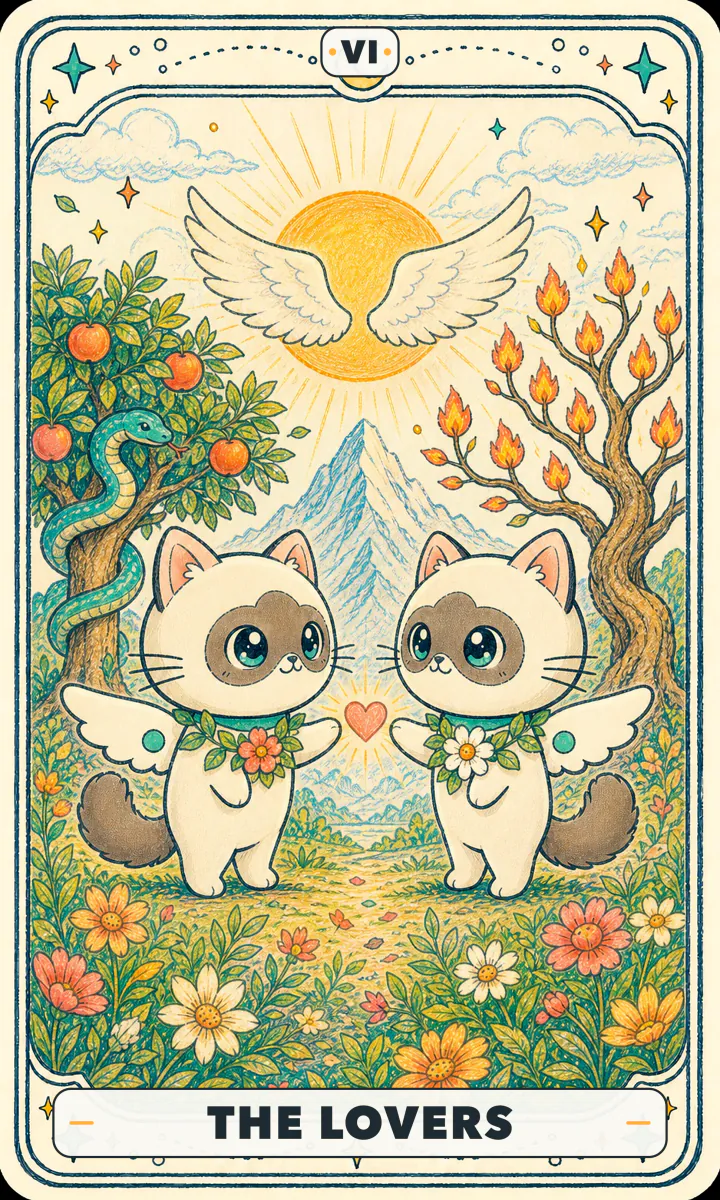
El arcángel Rafael extiende sus brazos en las nubes sobre las figuras desnudas de Adán y Eva. Detrás de Eva se encuentra el Árbol del Conocimiento entrelazado por una serpiente; detrás de Adán, el Árbol de la Vida ardiendo en llamas. Al fondo se alza una alta montaña.
Significado al derecho
Amor, armonía, elección de valores, unión. Simboliza una profunda conexión humana o enfrentar una decisión moral y emocional importante.
Significado invertido
Desarmonía, separación, malas decisiones, tentación. Puede indicar una relación rota o una decisión lamentable tomada a partir de valores fuera de lugar.
Amor, carrera, dinero y crecimiento
Amor
En el amor, los amantes señala a Unión emocional profunda. Vuelve a leerlo teniendo en cuenta cómo se comporta realmente la relación y lo que ambos están eligiendo.
Carrera
En cuestiones profesionales, los amantes apunta a Unión emocional profunda. Empiece por determinar qué recursos controla y cuál será su próximo paso.
Dinero
En cuestiones de dinero, los amantes apunta a Unión emocional profunda. No trates una lectura simbólica como una conclusión de inversión; guíate por los hechos, el presupuesto y tu propia tolerancia al riesgo.
Crecimiento personal
Para el crecimiento personal, los amantes apunta a Unión emocional profunda. Escribe la pregunta que plantea y luego conviértela en una acción que realmente puedas comprobar.
Lo que siente la otra persona
Cuando los amantes indica lo que siente la otra persona, el tema de su actitud hacia ti es: Unión emocional profunda. Al derecho, ese sentimiento se muestra hacia fuera; invertida, por ahora se queda dentro. No la tomes como un veredicto: contrástala con cómo actúa realmente.
Sí o no
Al derecho
Sí
Invertida
No
Esta es nuestra propia lectura rápida, basada en la dirección en la que se inclina el significado de la carta. Las tradiciones no están de acuerdo con respecto a las cartas individuales, y un "Quizás" debe sopesarse con la posición en la distribución y su situación real en lugar de tomarse como una respuesta de una sola palabra.
Texto original de Waite (1911)
Simbolismo interior (original)
El sol brilla en el cenit y, debajo, una gran figura alada con los brazos extendidos derrama influencias. En primer plano hay dos figuras humanas, hombre y mujer, sin velo el uno ante el otro, como Adán y Eva cuando habitaron por primera vez el paraíso del cuerpo terrenal. Detrás del hombre está el Árbol de la Vida, con doce frutos, y el Árbol del Conocimiento del Bien y del Mal está detrás de la mujer; la serpiente se enrosca en él. Las figuras sugieren juventud, virginidad, inocencia y el amor antes de que lo contamine el deseo material grosero. Esta es, con toda sencillez, la carta del amor humano, mostrado aquí como parte del camino, la verdad y la vida. Sustituye, volviendo a los primeros principios, a la antigua carta del matrimonio, que he descrito antes, y a los disparates posteriores que representaban al hombre entre el vicio y la virtud. En un sentido muy alto, la carta es un misterio de la Alianza y del Sabbat.
Lo que se sugiere respecto de la mujer es que significa esa atracción hacia la vida sensitiva que lleva en sí la idea de la Caída del Hombre; pero ella es más bien la obra de una Ley Secreta de la Providencia que una tentadora voluntaria y consciente. Es por la caída que se le imputa por lo que el hombre se levantará al fin, y solo por ella puede completarse. La carta es, por tanto, a su manera, otra insinuación acerca del gran misterio de la condición femenina. Los viejos significados se desmoronan por fuerza junto con las viejas imágenes; pero incluso como interpretaciones de estas, algunos eran del orden de lo trivial y otros eran falsos en su simbolismo.
Significado original del derecho
Atracción, amor, belleza, pruebas superadas.
Significado original invertido
Fracaso, designios insensatos. Otra versión habla de matrimonio frustrado y contrariedades de toda clase.
Citado de A. E. Waite, The Pictorial Key to the Tarot (1911), ilustrado por Pamela Colman Smith. El texto es de dominio público.
Orígenes de mitos y símbolos
Las cartas antiguas muestran a un joven en una encrucijada, que es una fábula griega. El Edén es lo que Waite puso en su lugar.
Imaginería documentada
Atestiguada por objetos o textos conservados
La carta que fue sustituida: la elección en la encrucijada
Las primeras barajas dibujan esta carta de dos maneras: como una boda, o como un joven de pie entre dos mujeres. La segunda continúa «Heracles en la encrucijada», la fábula de Pródico recogida en los Recuerdos de Sócrates de Jenofonte: la Virtud y el Vicio aparecen en forma humana y piden al joven que elija su camino. Waite dice en su propio libro que su carta sustituye «la vieja carta del matrimonio y las necedades posteriores que representaban al hombre entre el vicio y la virtud». Así que la fábula griega forma parte de verdad de la ascendencia de esta carta; simplemente la eliminó el propio autor.
Fuente Pródico, «Heracles en la encrucijada», en Jenofonte, Recuerdos de Sócrates II.1; Waite 1911 describe él mismo la sustitución
Lo que ocupó su lugar es el Edén
La versión de Waite dibuja a Adán y Eva: detrás del hombre está el Árbol de la Vida con doce frutos; detrás de la mujer, el Árbol del Conocimiento del Bien y del Mal, con la serpiente enroscada en él. Todas estas imágenes proceden de Génesis 2-3. El sentido de la carta pasa, por tanto, de «qué camino tomo» a «unión, alianza y el estado anterior a la caída». No son lo mismo.
Fuente Génesis 2-3; Waite, The Pictorial Key to the Tarot, 1911, Los Amantes
Correspondencia esotérica
Una afirmación tradicional con fuente, pero construida dentro de un sistema ocultista
Géminis, y el arcángel al que nunca se nombra
La Golden Dawn asigna a los Amantes el signo de Géminis (letra hebrea Zain). La figura alada de lo alto con los brazos extendidos suele identificarse con el arcángel Rafael, pero el texto de Waite dice solo «una gran figura alada con los brazos extendidos, que derrama influencias», sin nombrar a nadie. El nombre lo aportaron comentaristas posteriores; es una identificación hecha dentro del sistema.
Fuente Atribuciones zodiacales del Libro T de la Golden Dawn; Waite 1911 no nombra a la figura
Lectura moderna
Popular solo desde el siglo XX; sin relación con el origen de la carta
Las llamas gemelas son un producto contemporáneo
Leer esta carta como las llamas gemelas, como la otra mitad predestinada, es lenguaje New Age de las últimas dos o tres décadas. Ni la elección en la encrucijada ni la alianza del Edén tratan de parejas predestinadas. Por supuesto, puede usar la carta para hablar de relaciones en una lectura. Esa es una cuestión distinta de aquello de lo que trataba la carta en su origen.
Fuente Lectura popular moderna, sin base histórica
Escrito por BESTAROT, no citado de fuentes históricas. Cada afirmación se etiqueta según su grado de evidencia; Las capas interpretativas modernas son útiles para la lectura, pero no representan el origen histórico de la carta.
Estudie el tema: Orígenes de mitos y símbolos (capítulo 6 de la Academia)