el ermitaño
The Hermit
Introspección, Orientación
Respuesta rápida
El significado principal de el ermitaño es Buscando la verdad en soledad. Del derecho, suele apuntar a Introspección, soledad, búsqueda de la verdad, orientación. Simboliza un retiro; invertida, puede sugerir Aislamiento, soledad, rechazar consejos, sentirse perdido. Puede indicar un retr.
Imagen de la carta
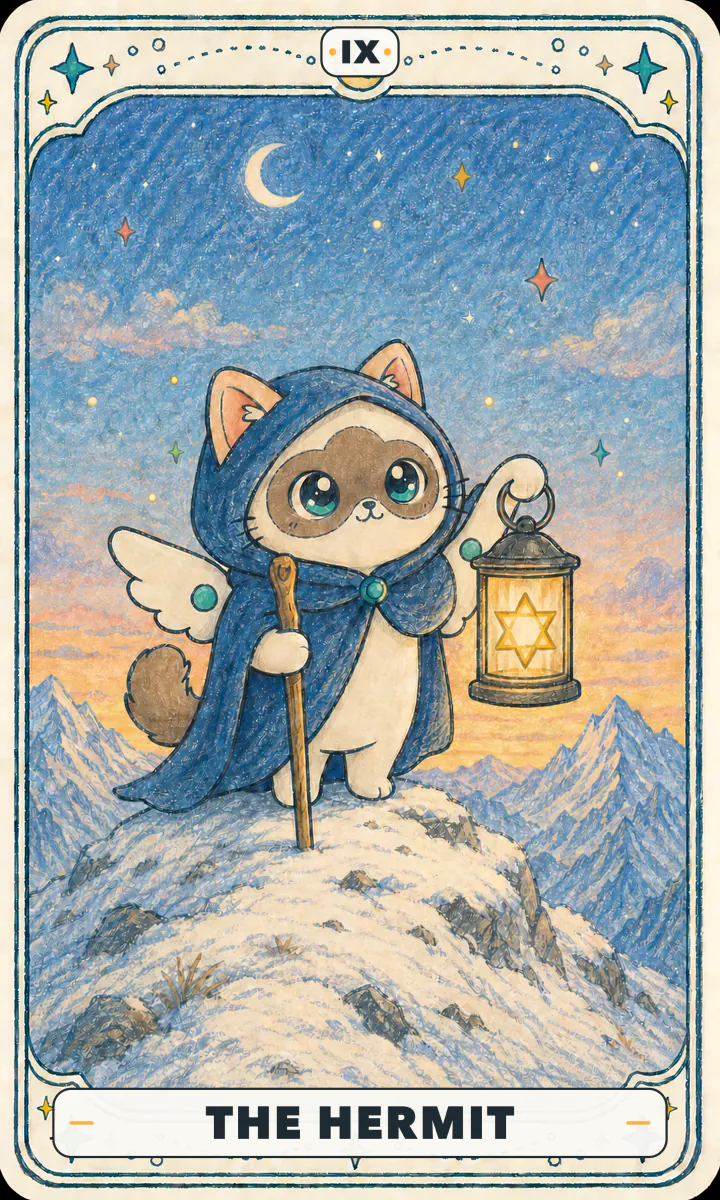
Un anciano con una capa gris se encuentra en la cima de una montaña cubierta de nieve. Se apoya en un bastón con la mano izquierda y levanta una linterna con la derecha, en cuyo interior brilla una brillante estrella de seis puntas.
Significado al derecho
Introspección, soledad, búsqueda de la verdad, orientación. Simboliza un retiro temporal al mundo interior para buscar respuestas y luz espiritual únicamente.
Significado invertido
Aislamiento, soledad, rechazar consejos, sentirse perdido. Puede indicar un retraimiento excesivo o ignorar obstinadamente la ayuda del mundo exterior.
Amor, carrera, dinero y crecimiento
Amor
En el amor, el ermitaño señala a Buscando la verdad en soledad. Vuelve a leerlo teniendo en cuenta cómo se comporta realmente la relación y lo que ambos están eligiendo.
Carrera
En cuestiones profesionales, el ermitaño apunta a Buscando la verdad en soledad. Empiece por determinar qué recursos controla y cuál será su próximo paso.
Dinero
En cuestiones de dinero, el ermitaño apunta a Buscando la verdad en soledad. No trates una lectura simbólica como una conclusión de inversión; guíate por los hechos, el presupuesto y tu propia tolerancia al riesgo.
Crecimiento personal
Para el crecimiento personal, el ermitaño apunta a Buscando la verdad en soledad. Escribe la pregunta que plantea y luego conviértela en una acción que realmente puedas comprobar.
Lo que siente la otra persona
Cuando el ermitaño indica lo que siente la otra persona, el tema de su actitud hacia ti es: Buscando la verdad en soledad. Al derecho, ese sentimiento se muestra hacia fuera; invertida, por ahora se queda dentro. No la tomes como un veredicto: contrástala con cómo actúa realmente.
Sí o no
Al derecho
Tal vez
Invertida
No
Esta es nuestra propia lectura rápida, basada en la dirección en la que se inclina el significado de la carta. Las tradiciones no están de acuerdo con respecto a las cartas individuales, y un "Quizás" debe sopesarse con la posición en la distribución y su situación real en lugar de tomarse como una respuesta de una sola palabra.
Texto original de Waite (1911)
Simbolismo interior (original)
La variación respecto de los modelos convencionales en esta carta es solo que la lámpara no está envuelta en parte en el manto de su portador, que funde la idea del Anciano de Días con la de la Luz del Mundo. Lo que brilla en la linterna es una estrella. He dicho que esta es una carta de logro, y para ampliar esta concepción se ve a la figura sosteniendo en alto su faro sobre una eminencia. Por tanto, el Ermitaño no es, como explicó Court de Gébelin, un sabio en busca de la verdad y la justicia; ni es, como propone una explicación posterior, un ejemplo especial de experiencia. Su faro insinúa que «donde yo estoy, también tú puedes estar».
Es además una carta que se entiende de forma del todo incorrecta cuando se la relaciona con la idea del aislamiento oculto, como protección del magnetismo personal contra la mezcla. Esta es una de las lecturas frívolas que debemos a Eliphas Lévi. La ha adoptado la Orden Martinista francesa, y algunos de nosotros hemos oído hablar mucho de la Filosofía Silenciosa y Desconocida envuelta en su manto, a salvo del conocimiento de los profanos. En el verdadero martinismo, el sentido de la expresión Philosophe inconnu era de otro orden. No se refería al ocultamiento intencionado de los Misterios Instituidos, y mucho menos al de sus sucedáneos, sino, como la propia carta, a la verdad de que los Misterios Divinos se protegen por sí mismos de quienes no están preparados.
Significado original del derecho
Prudencia, circunspección; también, y en especial, traición, disimulo, bribonería, corrupción.
Significado original invertido
Ocultamiento, disfraz, astucia política, miedo, cautela irreflexiva.
Citado de A. E. Waite, The Pictorial Key to the Tarot (1911), ilustrado por Pamela Colman Smith. El texto es de dominio público.
Orígenes de mitos y símbolos
Lo que sostenía en origen era un reloj de arena, el atributo del Tiempo. La lámpara llegó después.
Imaginería documentada
Atestiguada por objetos o textos conservados
Antes de que el reloj de arena se convirtiera en lámpara, era el Tiempo
En las primeras barajas italianas esta carta se llama Il Vecchio, el viejo, y aparece también como Il Gobbo, el jorobado. En el esquema más antiguo lo que el viejo sostiene en alto es un reloj de arena, el atributo fijo del Tiempo (Il Tempo), y la personificación clásica del Tiempo es precisamente Saturno con su guadaña y su reloj de arena (el Cronos griego). Solo cuando el reloj de arena se convirtió en farol pasó el peso de la carta del paso del tiempo a iluminar el camino y buscar.
Fuente El nombre italiano temprano Il Vecchio; el esquema clásico y medieval del Tiempo con un reloj de arena
Correspondencia esotérica
Una afirmación tradicional con fuente, pero construida dentro de un sistema ocultista
Hay una estrella en la lámpara, y dos títulos fundidos en una sola figura
Waite escribe que en la lámpara hay «una estrella que brilla en el farol», y que la figura «funde la idea del Anciano de Días con la Luz del Mundo». La primera procede de Daniel 7:9; la segunda es un título de Cristo. Dice también que el Ermitaño sostiene la lámpara en alto, con el sentido de «donde yo estoy, también tú puedes estar», lo contrario de un recluso encerrado en sí mismo.
Fuente Daniel 7:9; Waite, The Pictorial Key to the Tarot, 1911, El Ermitaño
Dos lecturas antiguas, tachadas en el acto por el autor
Waite nombra y rechaza a dos hombres en esta entrada. Primero a Court de Gébelin, el hombre que lanzó en 1781 la teoría del origen egipcio, que llamó al Ermitaño sabio en busca de la verdad y la justicia; Waite dice que no lo es. Después, la explicación de Lévi sobre el aislamiento oculto, sobre impedir que el propio magnetismo personal se mezcle con el de los demás; Waite la califica de «una de las interpretaciones frívolas que debemos a Eliphas Lévi». Ambas lecturas rechazadas siguen circulando hoy ampliamente en materiales de segunda mano.
Fuente Waite, The Pictorial Key to the Tarot, 1911, El Ermitaño (compárese con el original en el panel de fuentes de esta página)
Virgo y la letra Yod
La Golden Dawn asigna al Ermitaño el signo de Virgo (letra hebrea Yod). La Yod es la más pequeña de las letras hebreas, con forma de un solo punto, y a menudo se describe como el trazo a partir del cual comienza todo lo demás. De ahí procede el registro de la selección, el refinamiento y las cosas pequeñas que tienen peso.
Fuente Atribuciones zodiacales del Libro T de la Golden Dawn
Escrito por BESTAROT, no citado de fuentes históricas. Cada afirmación se etiqueta según su grado de evidencia; Las capas interpretativas modernas son útiles para la lectura, pero no representan el origen histórico de la carta.
Estudie el tema: Orígenes de mitos y símbolos (capítulo 6 de la Academia)