Rueda de la fortuna
Wheel of Fortune
Punto de inflexión, ciclos
Respuesta rápida
El significado principal de Rueda de la fortuna es La fuerza irresistible del destino. Del derecho, suele apuntar a Un punto de inflexión, suerte, karma, fuerzas fuera de tu control. Simboliza el; invertida, puede sugerir Desgracia, reveses por resistirse al cambio, un ciclo roto. Puede indicar un pun.
Imagen de la carta
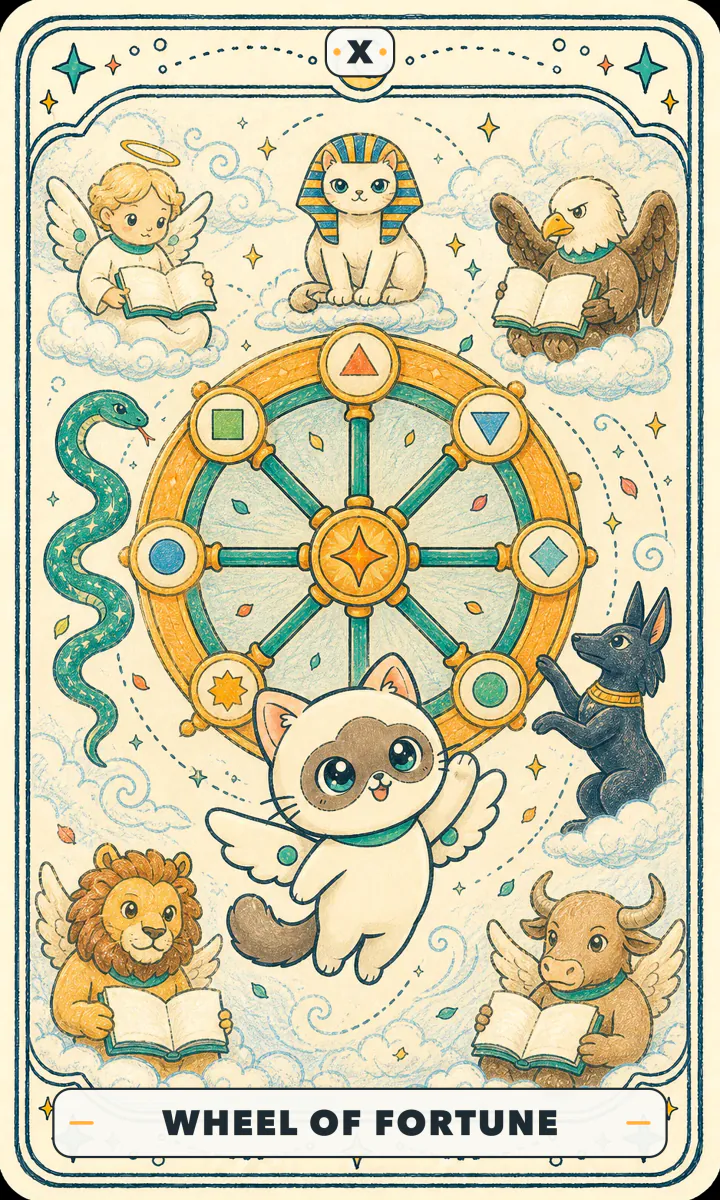
Una gran rueda con símbolos alquímicos inscritos flota en un cielo azul. A su alrededor, los cuatro seres vivientes (el hombre, el águila, el león y el toro) están sentados leyendo libros. Una esfinge descansa sobre la rueda, Anubis se eleva en su base y una serpiente desciende a lo largo de su costado.
Significado al derecho
Un punto de inflexión, suerte, karma, fuerzas fuera de tu control. Simboliza el ascenso y la caída de la fortuna, un recordatorio para avanzar con el cambio y aprovechar el momento.
Significado invertido
Desgracia, reveses por resistirse al cambio, un ciclo roto. Puede indicar un punto bajo temporal o un intento de forzar el control sobre lo incontrolable.
Amor, carrera, dinero y crecimiento
Amor
En el amor, Rueda de la fortuna señala a La fuerza irresistible del destino. Vuelve a leerlo teniendo en cuenta cómo se comporta realmente la relación y lo que ambos están eligiendo.
Carrera
En cuestiones profesionales, Rueda de la fortuna apunta a La fuerza irresistible del destino. Empiece por determinar qué recursos controla y cuál será su próximo paso.
Dinero
En cuestiones de dinero, Rueda de la fortuna apunta a La fuerza irresistible del destino. No trates una lectura simbólica como una conclusión de inversión; guíate por los hechos, el presupuesto y tu propia tolerancia al riesgo.
Crecimiento personal
Para el crecimiento personal, Rueda de la fortuna apunta a La fuerza irresistible del destino. Escribe la pregunta que plantea y luego conviértela en una acción que realmente puedas comprobar.
Lo que siente la otra persona
Cuando Rueda de la fortuna indica lo que siente la otra persona, el tema de su actitud hacia ti es: La fuerza irresistible del destino. Al derecho, ese sentimiento se muestra hacia fuera; invertida, por ahora se queda dentro. No la tomes como un veredicto: contrástala con cómo actúa realmente.
Sí o no
Al derecho
Sí
Invertida
No
Esta es nuestra propia lectura rápida, basada en la dirección en la que se inclina el significado de la carta. Las tradiciones no están de acuerdo con respecto a las cartas individuales, y un "Quizás" debe sopesarse con la posición en la distribución y su situación real en lugar de tomarse como una respuesta de una sola palabra.
Texto original de Waite (1911)
Simbolismo interior (original)
En este símbolo he seguido de nuevo la reconstrucción de Eliphas Lévi, que ha ofrecido varias variantes. Es legítimo, como he insinuado, usar el simbolismo egipcio cuando sirve a nuestro propósito, siempre que no se implique en ello ninguna teoría sobre el origen. He presentado, sin embargo, a Tifón en su forma de serpiente. El simbolismo no es, desde luego, exclusivamente egipcio, pues los cuatro Seres Vivientes de Ezequiel ocupan los ángulos de la carta, y la rueda misma sigue otras indicaciones de Lévi sobre la visión de Ezequiel, como ilustración de este Arcano del Tarot en particular. Para el ocultista francés, y en el diseño mismo, la imagen simbólica representa el movimiento perpetuo de un universo fluídico y el flujo de la vida humana. La Esfinge es el equilibrio en él. La transliteración de Taro como Rota está inscrita en la rueda, alternada con las letras del Nombre Divino, para mostrar que la Providencia está implícita en todo. Pero esta es la intención Divina interior, y la intención semejante exterior la ejemplifican los cuatro Seres Vivientes. A veces se representa a la esfinge echada sobre un pedestal en lo alto, lo que defrauda el simbolismo al anular la idea esencial de estabilidad en medio del movimiento.
Tras la noción general que expresa el símbolo está la negación del azar y la fatalidad que ello implica. Puede añadirse que, desde los días de Lévi en adelante, las explicaciones ocultistas de esta carta son, incluso para el propio ocultismo, de una clase singularmente necia. Se ha dicho que significa principio, fecundidad, honor viril, autoridad gobernante, etc. Los hallazgos de la buenaventura común son mejores que esto en su propio plano.
Significado original del derecho
Destino, fortuna, éxito, elevación, suerte, felicidad.
Significado original invertido
Aumento, abundancia, superfluidad.
Citado de A. E. Waite, The Pictorial Key to the Tarot (1911), ilustrado por Pamela Colman Smith. El texto es de dominio público.
Orígenes de mitos y símbolos
Un motivo iconográfico medieval, una visión de Ezequiel y una reconstrucción decimonónica de estilo egipcio, superpuestos en una sola carta.
Imaginería documentada
Atestiguada por objetos o textos conservados
El tarot no inventó la rueda de la fortuna
La Rota Fortunae fue uno de los motivos iconográficos más difundidos de la Europa medieval, siglos más antiguo que el tarot. La idea procede del libro II de la Consolación de la filosofía de Boecio: Fortuna hace girar su rueda, que eleva a las personas y luego las vuelve a hundir. Los manuscritos medievales y los rosetones de las catedrales la dibujaban como cuatro figuras sobre una rueda, cada una con una leyenda latina: «Reinaré / Reino / He reinado / Estoy sin reino». Los triunfos aparecen en la Italia del siglo XV dibujando ese mismo motivo; no parten de cero.
Fuente Boecio, Consolación de la filosofía II (h. 524); las cuatro leyendas aparecen en imágenes de manuscritos medievales como el manuscrito de los Carmina Burana (h. 1230)
La diosa griega detrás de Fortuna
La Fortuna romana corresponde a la Tique griega, diosa del azar, representada en el arte clásico con un timón, una cornucopia o una rueda. Fíjese en lo que rige: el azar, no el destino. Hilar y cortar el hilo de la vida corresponde a las Moiras, otro grupo de figuras distinto. Ambas cosas ya estaban diferenciadas en la Antigüedad, y esta carta hereda la primera.
Fuente Iconografía clásica de Tique / Fortuna en la estatuaria y la numismática
Los seres vivientes de las esquinas son escritura hebrea
El hombre, el águila, el buey y el león de las cuatro esquinas no son mito griego. Son los cuatro seres vivientes de Ezequiel 1:10, retomados en Apocalipsis 4:7 y fijados después como emblemas de los cuatro evangelistas, y por eso los cuatro sostienen libros. La rueda de una diosa griega y la visión de un profeta hebreo en una misma carta es algo del todo normal en la imaginería renacentista. No hay necesidad, ni fundamento, para reducirlo a un único «sistema original».
Fuente Ezequiel 1:10, Apocalipsis 4:7; Waite 1911 afirma que los seres vivientes proceden de Ezequiel
Correspondencia esotérica
Una afirmación tradicional con fuente, pero construida dentro de un sistema ocultista
Tifón en forma de serpiente y la esfinge: la reconstrucción de Lévi
Waite dice sin rodeos que esta carta «sigue la reconstrucción de Eliphas Lévi», y que ha presentado a Tifón, la figura monstruosa del mito griego, en forma de serpiente, con la esfinge en lo alto de la rueda como el equilibrio dentro de su movimiento. La versión de Lévi incluye además una figura ascendente con cabeza de chacal, Hermanubis, fusión helenística de Hermes y Anubis; ese es un diseño de Lévi, y el propio texto de Waite no lo nombra. Las letras T-A-R-O de la rueda pueden leerse en círculo como ROTA, alternadas con las letras hebreas del Nombre Divino. Todo esto es construcción ocultista del siglo XIX, no la historia de la carta.
Fuente Waite, The Pictorial Key to the Tarot, 1911, La Rueda de la Fortuna; Eliphas Lévi, Dogme et Rituel de la Haute Magie, 1854-56
La atribución de Júpiter de la Golden Dawn
La Golden Dawn vincula cada triunfo a un planeta o signo, y a la Rueda de la Fortuna le corresponde Júpiter (letra hebrea Kaf). Júpiter es el equivalente romano del Zeus griego, y aporta expansión, buena fortuna y un aumento de escala. La cadena sí llega hasta el panteón griego, siempre que tenga claro que es el sistema el que establece la conexión, y no un pintor del siglo XV dibujando a Zeus.
Fuente Atribuciones planetarias de los triunfos en el Libro T de la Golden Dawn
Lectura moderna
Popular solo desde el siglo XX; sin relación con el origen de la carta
La rueda del karma y las tres Moiras: añadidos posteriores
Leer esta carta como una rueda del karma procede de la importación teosófica, a finales del siglo XIX, de las ideas indias del karma al esoterismo occidental. Nada en la imaginería triunfal del Renacimiento tiene ese sentido. Hacer corresponder tres posiciones de la rueda con las tres Moiras es el mismo tipo de operación: una analogía didáctica moderna, no algo que haga la imaginería clásica. Ambas son útiles en una lectura. Ninguna es una fuente.
Fuente Lectura popular moderna, sin base histórica
Escrito por BESTAROT, no citado de fuentes históricas. Cada afirmación se etiqueta según su grado de evidencia; Las capas interpretativas modernas son útiles para la lectura, pero no representan el origen histórico de la carta.
Estudie el tema: Orígenes de mitos y símbolos (capítulo 6 de la Academia)