Muerte
Death
Finales, Transformación
Respuesta rápida
El significado principal de Muerte es El fin total de lo viejo.. Del derecho, suele apuntar a Finales, transformación, renacimiento, cambio inevitable. Simboliza el cierre co; invertida, puede sugerir Resistirse al cambio, al estancamiento, a la decadencia, a la incapacidad de dej.
Imagen de la carta
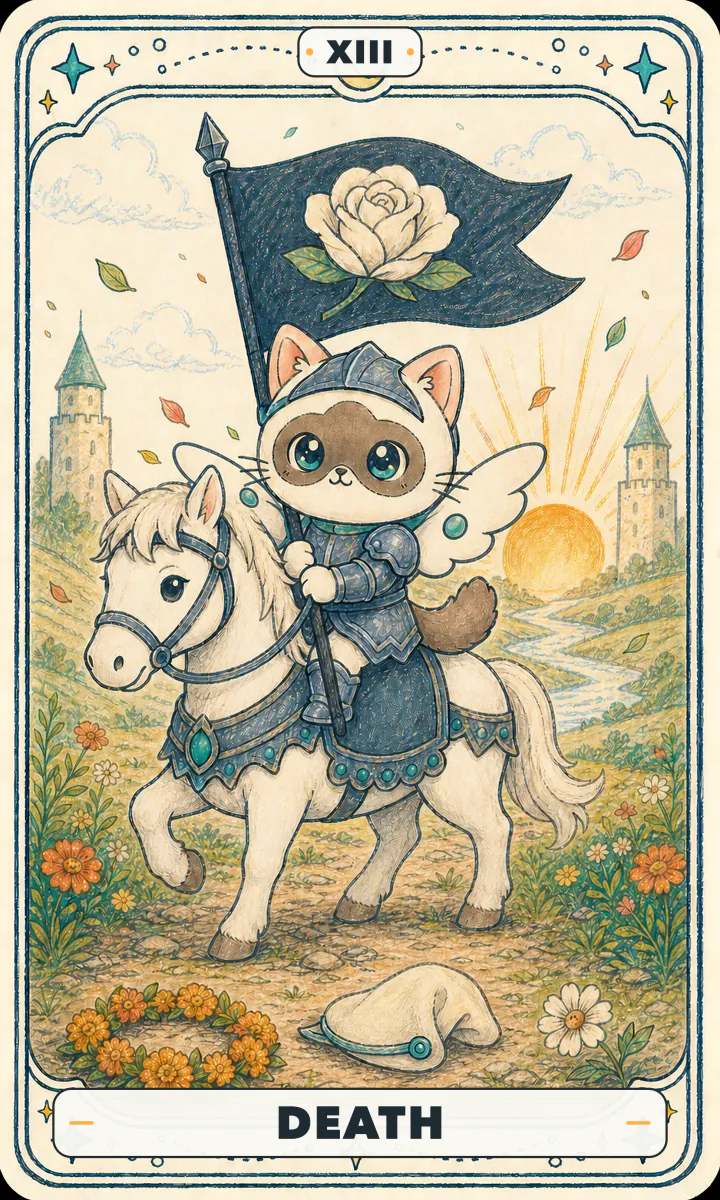
Un caballero esquelético con armadura negra avanza lentamente sobre un caballo blanco, portando un estandarte negro con una rosa blanca. Debajo de los cascos del caballo yacen un rey caído, un obispo orando y un niño inocente. Torres gemelas y un sol naciente marcan el horizonte.
Significado al derecho
Finales, transformación, renacimiento, cambio inevitable. Simboliza el cierre completo de un capítulo antiguo, dejando espacio para que crezca algo nuevo.
Significado invertido
Resistirse al cambio, al estancamiento, a la decadencia, a la incapacidad de dejarse llevar. Puede indicar aferramiento al pasado, prolongando el dolor y bloqueando la entrada a una nueva fase.
Amor, carrera, dinero y crecimiento
Amor
En el amor, Muerte señala a El fin total de lo viejo.. Vuelve a leerlo teniendo en cuenta cómo se comporta realmente la relación y lo que ambos están eligiendo.
Carrera
En cuestiones profesionales, Muerte apunta a El fin total de lo viejo.. Empiece por determinar qué recursos controla y cuál será su próximo paso.
Dinero
En cuestiones de dinero, Muerte apunta a El fin total de lo viejo.. No trates una lectura simbólica como una conclusión de inversión; guíate por los hechos, el presupuesto y tu propia tolerancia al riesgo.
Crecimiento personal
Para el crecimiento personal, Muerte apunta a El fin total de lo viejo.. Escribe la pregunta que plantea y luego conviértela en una acción que realmente puedas comprobar.
Lo que siente la otra persona
Cuando Muerte indica lo que siente la otra persona, el tema de su actitud hacia ti es: El fin total de lo viejo.. Al derecho, ese sentimiento se muestra hacia fuera; invertida, por ahora se queda dentro. No la tomes como un veredicto: contrástala con cómo actúa realmente.
Sí o no
Al derecho
No
Invertida
Tal vez
Esta es nuestra propia lectura rápida, basada en la dirección en la que se inclina el significado de la carta. Las tradiciones no están de acuerdo con respecto a las cartas individuales, y un "Quizás" debe sopesarse con la posición en la distribución y su situación real en lugar de tomarse como una respuesta de una sola palabra.
Texto original de Waite (1911)
Simbolismo interior (original)
El velo o la máscara de la vida se perpetúa en el cambio, la transformación y el paso de lo inferior a lo superior, y esto se representa con más propiedad en el Tarot rectificado mediante una de las visiones apocalípticas que mediante la tosca noción del esqueleto segador. Tras ello está todo el mundo del ascenso en el espíritu. El misterioso jinete avanza despacio, portando un estandarte negro blasonado con la Rosa Mística, que significa la vida. Entre dos columnas, al filo del horizonte, brilla el sol de la inmortalidad. El jinete no lleva arma visible, pero el rey, el niño y la doncella caen ante él, mientras un prelado con las manos juntas aguarda su fin.
No debería hacer falta señalar que la sugerencia de muerte que he hecho a propósito de la carta anterior ha de entenderse, desde luego, en sentido místico, pero no es ese el caso en la presente. El tránsito natural del hombre a la siguiente etapa de su ser es, o puede ser, una forma de su progreso; pero la entrada exótica y casi desconocida, aún en esta vida, en el estado de muerte mística es un cambio en la forma de la conciencia y el paso a un estado para el que la muerte ordinaria no es ni el camino ni la puerta. Las explicaciones ocultistas existentes de la carta 13 son, en conjunto, mejores de lo habitual: renacimiento, creación, destino, renovación y demás.
Significado original del derecho
Fin, mortalidad, destrucción, corrupción; también, para un hombre, la pérdida de un benefactor; para una mujer, muchas contrariedades; para una soltera, el fracaso de proyectos de boda.
Significado original invertido
Inercia, sueño, letargo, petrificación, sonambulismo; esperanza destruida.
Citado de A. E. Waite, The Pictorial Key to the Tarot (1911), ilustrado por Pamela Colman Smith. El texto es de dominio público.
Orígenes de mitos y símbolos
El esqueleto segador es el esquema medieval de la Danza de la Muerte; Waite dice que lo sustituyó por el jinete del Apocalipsis.
Imaginería documentada
Atestiguada por objetos o textos conservados
La Danza de la Muerte se lleva a todos por igual
Las figuras caídas en primer plano son un rey, un obispo (el clérigo que espera con las manos juntas), una doncella y un niño. Es el reparto habitual de las tradiciones iconográficas medievales de la Danza de la Muerte y el Triunfo de la Muerte: la Muerte conduce en una misma danza a personas de toda condición, papa y mendigo en la misma fila, y la idea es que el rango no cuenta nada ante ella. En los Trionfi de Petrarca, la Muerte es igualmente el carro que vence a la Castidad.
Fuente Las tradiciones iconográficas medievales de la Danza de la Muerte y el Triunfo de la Muerte; los Trionfi de Petrarca
Correspondencia esotérica
Una afirmación tradicional con fuente, pero construida dentro de un sistema ocultista
Waite sustituyó el esqueleto por un jinete
Waite lo dice claramente: el significado está «mejor representado en el Tarot rectificado por una de las visiones apocalípticas que por la tosca noción del esqueleto segador». La Muerte a caballo procede de Apocalipsis 6:8. Escribe también que el estandarte negro lleva la Rosa Mística, que «significa vida», y que entre dos columnas en el horizonte se alza «el sol de la inmortalidad». Es decir: la vida y la inmortalidad de esta carta las puso ahí deliberadamente el autor para contrapesar la muerte.
Fuente Apocalipsis 6:8; Waite, The Pictorial Key to the Tarot, 1911, La Muerte
Escorpio y la letra Nun
La Golden Dawn asigna a la Muerte el signo de Escorpio (letra hebrea Nun, que significa literalmente «pez» y a menudo se describe como ligada a la continuidad y la generación). Lo que aporta la atribución de Escorpio es el registro de un cambio completo de forma, no el de detenerse.
Fuente Atribuciones zodiacales del Libro T de la Golden Dawn
Lectura moderna
Popular solo desde el siglo XX; sin relación con el origen de la carta
«La Muerte nunca significa muerte»: eso se ha llevado demasiado lejos
Para no asustar a los consultantes, la adivinación moderna afirma por norma que esta carta solo trata de transformación y nunca de la muerte. El texto de Waite es más matizado: dice que la muerte mencionada en la carta anterior «debe, por supuesto, entenderse místicamente, pero no es así en el caso presente», y distingue entre una persona que pasa de forma natural a la siguiente etapa y la entrada en la muerte mística dentro de esta vida. Además, cosa rara en él, le dedica un elogio: las lecturas esotéricas existentes de esta carta son «en conjunto, mejores de lo habitual», y el renacimiento, la creación y la renovación cuentan todos. Así que la afirmación exacta es esta: el peso de la carta recae en una sustitución completa de la forma, no en «no tiene nada que ver con la muerte».
Fuente La advertencia adivinatoria estándar moderna; la distinción que traza Waite en esta misma entrada en 1911
Escrito por BESTAROT, no citado de fuentes históricas. Cada afirmación se etiqueta según su grado de evidencia; Las capas interpretativas modernas son útiles para la lectura, pero no representan el origen histórico de la carta.
Estudie el tema: Orígenes de mitos y símbolos (capítulo 6 de la Academia)