el emperador
The Emperor
Autoridad, Estructura
Respuesta rápida
El significado principal de el emperador es Establecer orden y reglas.. Del derecho, suele apuntar a Autoridad, estructura, figura paterna, lógica, reglas. Simboliza construir orden; invertida, puede sugerir Tiranía, rigidez, falta de disciplina, abuso de poder. Puede indicar una necesid.
Imagen de la carta
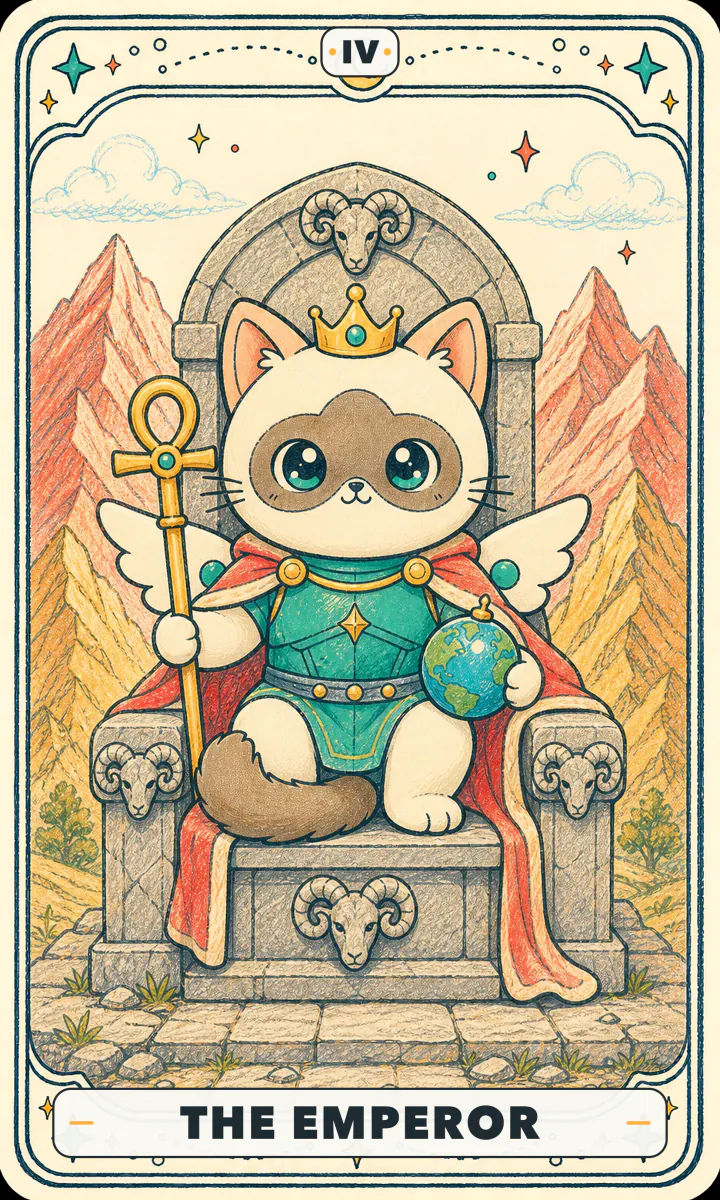
Un majestuoso anciano se sienta en un trono de piedra adornado con cabezas de carnero, sobre un fondo de cielos rojos y montañas áridas. Lleva una armadura debajo de una túnica roja y sostiene un cetro y un orbe, símbolos de poder.
Significado al derecho
Autoridad, estructura, figura paterna, lógica, reglas. Simboliza construir orden y bases sólidas, logrando el éxito a través de la disciplina y el liderazgo.
Significado invertido
Tiranía, rigidez, falta de disciplina, abuso de poder. Puede indicar una necesidad imperiosa de control o, por el contrario, debilidad y una total falta de resolución.
Amor, carrera, dinero y crecimiento
Amor
En el amor, el emperador señala a Establecer orden y reglas.. Vuelve a leerlo teniendo en cuenta cómo se comporta realmente la relación y lo que ambos están eligiendo.
Carrera
En cuestiones profesionales, el emperador apunta a Establecer orden y reglas.. Empiece por determinar qué recursos controla y cuál será su próximo paso.
Dinero
En cuestiones de dinero, el emperador apunta a Establecer orden y reglas.. No trates una lectura simbólica como una conclusión de inversión; guíate por los hechos, el presupuesto y tu propia tolerancia al riesgo.
Crecimiento personal
Para el crecimiento personal, el emperador apunta a Establecer orden y reglas.. Escribe la pregunta que plantea y luego conviértela en una acción que realmente puedas comprobar.
Lo que siente la otra persona
Cuando el emperador indica lo que siente la otra persona, el tema de su actitud hacia ti es: Establecer orden y reglas.. Al derecho, ese sentimiento se muestra hacia fuera; invertida, por ahora se queda dentro. No la tomes como un veredicto: contrástala con cómo actúa realmente.
Sí o no
Al derecho
Sí
Invertida
No
Esta es nuestra propia lectura rápida, basada en la dirección en la que se inclina el significado de la carta. Las tradiciones no están de acuerdo con respecto a las cartas individuales, y un "Quizás" debe sopesarse con la posición en la distribución y su situación real en lugar de tomarse como una respuesta de una sola palabra.
Texto original de Waite (1911)
Simbolismo interior (original)
Tiene por cetro una forma de la Crux ansata y un globo en la mano izquierda. Es un monarca coronado, imponente, majestuoso, sentado en un trono cuyos brazos rematan de frente en cabezas de carnero. Es la ejecución y la realización, el poder de este mundo, aquí revestido de los más altos de sus atributos naturales. A veces se le representa sentado sobre una piedra cúbica, lo cual, sin embargo, confunde algunas cuestiones. Es la potencia viril a la que responde la Emperatriz, y en este sentido es el que busca levantar el Velo de Isis; pero ella sigue siendo virgo intacta.
Debe entenderse que esta carta y la de la Emperatriz no representan con precisión el estado de la vida conyugal, aunque ese estado queda implícito. En la superficie, como he indicado, representan la realeza mundana, encumbrada en los asientos de los poderosos; pero por encima de esto se sugiere otra presencia. Significan también, y en especial la figura masculina, la realeza superior, que ocupa el trono del intelecto. De ahí el señorío del pensamiento más que el del mundo animal. Ambas personalidades, a su manera, están «llenas de extraña experiencia», pero la suya no es conscientemente la sabiduría que se nutre de un mundo superior. Se ha descrito al Emperador (a) como la voluntad en su forma encarnada, pero esta es solo una de sus aplicaciones, y (b) como una expresión de las virtualidades contenidas en el Ser Absoluto, pero esto es fantasía.
Significado original del derecho
Estabilidad, poder, protección, realización; una gran persona; ayuda, razón, convicción; también autoridad y voluntad.
Significado original invertido
Benevolencia, compasión, crédito; también confusión de los enemigos, obstrucción, inmadurez.
Citado de A. E. Waite, The Pictorial Key to the Tarot (1911), ilustrado por Pamela Colman Smith. El texto es de dominio público.
Orígenes de mitos y símbolos
Las cabezas de carnero del trono son Aries; el cetro que sostiene es un anj egipcio. El gusto decimonónico por Egipto quedó en la carta.
Imaginería documentada
Atestiguada por objetos o textos conservados
Él y la Emperatriz son pareja, pero no un matrimonio
En las primeras barajas el Emperador y la Emperatriz son una imagen emparejada del cargo secular. Waite se toma la molestia de señalar que las dos cartas «no representan exactamente la condición de la vida conyugal, aunque este estado esté incluido en ellas»; son más bien la realeza superior en el trono intelectual. Leer la pareja directamente como padres o como marido y mujer confunde un diagrama renacentista de cargos con un diagrama de la familia.
Fuente Las imágenes emparejadas de soberanos del tarot italiano temprano; Waite, The Pictorial Key to the Tarot, 1911, El Emperador
Correspondencia esotérica
Una afirmación tradicional con fuente, pero construida dentro de un sistema ocultista
Las cabezas de carnero significan Aries
Waite afirma que los brazos del trono rematan en cabezas de carnero. El carnero es el signo de Aries, y la atribución de la Golden Dawn para el Emperador es precisamente Aries (letra hebrea He); el regente de Aries es Marte, el Mars romano, equivalente del Ares griego. Todo el registro de iniciar, dar órdenes e imponer el orden por la fuerza desciende por esta cadena.
Fuente Waite, The Pictorial Key to the Tarot, 1911, El Emperador; atribuciones zodiacales del Libro T de la Golden Dawn
El anj y «el que busca retirar el Velo de Isis»
Al cetro que sostiene Waite lo llama Crux ansata, la cruz con asa, es decir, el anj egipcio, el signo de la vida. En el mismo párrafo escribe que el Emperador es «el que busca retirar el Velo de Isis; y sin embargo ella permanece virgo intacta». Ambos son huellas del gusto ocultista del siglo XIX por Egipto: signos egipcios tomados como vocabulario simbólico general, no una afirmación de que esta carta procediera de Egipto; Waite establece esa distinción con toda claridad en la entrada de la Rueda de la Fortuna.
Fuente Waite, The Pictorial Key to the Tarot, 1911, El Emperador; el anj es el signo egipcio de la vida
Lectura moderna
Popular solo desde el siglo XX; sin relación con el origen de la carta
El arquetipo paterno llega después de Jung
Leer al Emperador como el arquetipo del padre, como el patriarcado, emplea el vocabulario de la psicología profunda del siglo XX. La lectura funciona bien en la práctica, y conecta con un cargo que establece normas. Pero la psicología arquetípica es una construcción junguiana y no tiene nada que ver con quienes pintaron esta carta en el siglo XV.
Fuente Lectura popular moderna; el concepto de arquetipo procede de los escritos de Jung
Escrito por BESTAROT, no citado de fuentes históricas. Cada afirmación se etiqueta según su grado de evidencia; Las capas interpretativas modernas son útiles para la lectura, pero no representan el origen histórico de la carta.
Estudie el tema: Orígenes de mitos y símbolos (capítulo 6 de la Academia)