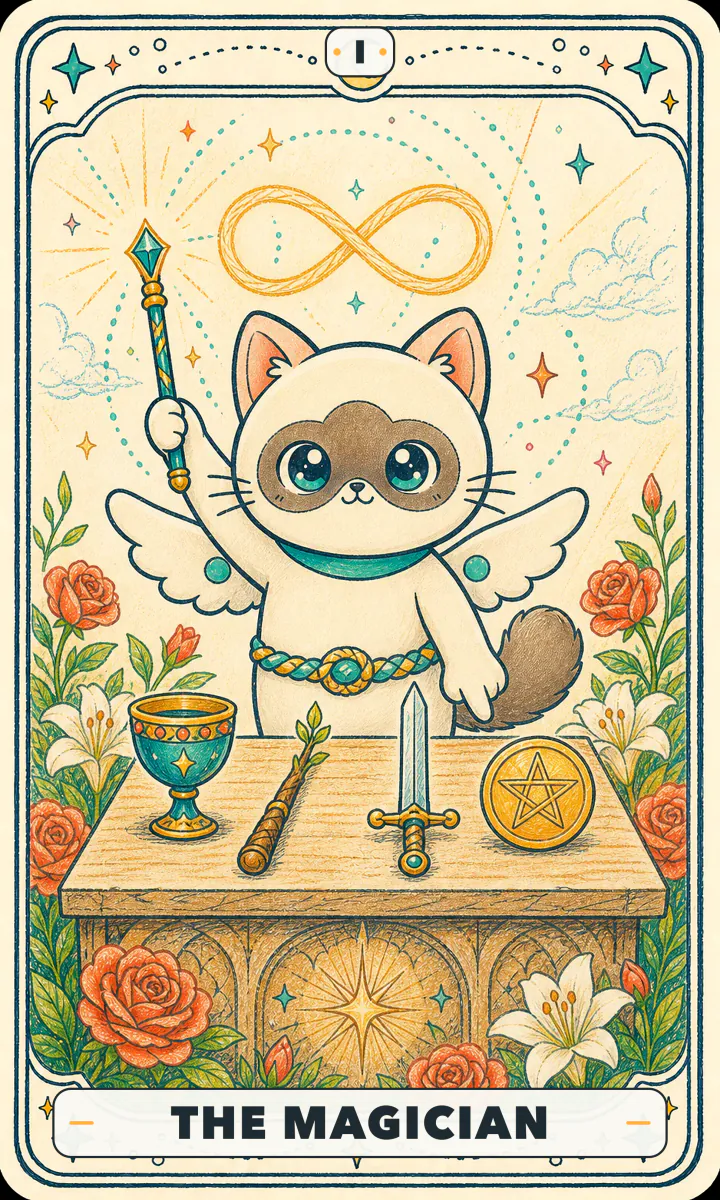
el mago
The Magician
Creación, Fuerza de Voluntad
Respuesta rápida
El significado principal de el mago es El poder de manifestar la realidad.. Del derecho, suele apuntar a Manifestación, fuerza de voluntad, habilidad, concentración. Simboliza que todos; invertida, puede sugerir Engaño, manipulación, talento desperdiciado, mala planificación. Puede indicar e.
Imagen de la carta
Un mago vestido de rojo se encuentra ante una mesa con una copa, una varita, una espada y un pentáculo, símbolos de los cuatro elementos. Una mano levanta una varita hacia el cielo mientras la otra apunta a la tierra. Sobre su cabeza flota el símbolo del infinito y una serpiente ouroboros rodea su cintura.
Significado al derecho
Manifestación, fuerza de voluntad, habilidad, concentración. Simboliza que todos los recursos están ahora en tus manos, listos para convertir las ideas en realidad.
Significado invertido
Engaño, manipulación, talento desperdiciado, mala planificación. Puede indicar el uso de habilidades para engañar a otros o tener habilidades que no se expresan.
Amor, carrera, dinero y crecimiento
Amor
En el amor, el mago señala a El poder de manifestar la realidad.. Vuelve a leerlo teniendo en cuenta cómo se comporta realmente la relación y lo que ambos están eligiendo.
Carrera
En cuestiones profesionales, el mago apunta a El poder de manifestar la realidad.. Empiece por determinar qué recursos controla y cuál será su próximo paso.
Dinero
En cuestiones de dinero, el mago apunta a El poder de manifestar la realidad.. No trates una lectura simbólica como una conclusión de inversión; guíate por los hechos, el presupuesto y tu propia tolerancia al riesgo.
Crecimiento personal
Para el crecimiento personal, el mago apunta a El poder de manifestar la realidad.. Escribe la pregunta que plantea y luego conviértela en una acción que realmente puedas comprobar.
Lo que siente la otra persona
Cuando el mago indica lo que siente la otra persona, el tema de su actitud hacia ti es: El poder de manifestar la realidad.. Al derecho, ese sentimiento se muestra hacia fuera; invertida, por ahora se queda dentro. No la tomes como un veredicto: contrástala con cómo actúa realmente.
Sí o no
Al derecho
Sí
Invertida
No
Esta es nuestra propia lectura rápida, basada en la dirección en la que se inclina el significado de la carta. Las tradiciones no están de acuerdo con respecto a las cartas individuales, y un "Quizás" debe sopesarse con la posición en la distribución y su situación real en lugar de tomarse como una respuesta de una sola palabra.
Texto original de Waite (1911)
Simbolismo interior (original)
Una figura juvenil con la túnica de un mago, que tiene el semblante del divino Apolo, sonrisa de confianza y ojos brillantes. Sobre su cabeza está el misterioso signo del Espíritu Santo, el signo de la vida, como un cordón sin fin, que forma la cifra 8 en posición horizontal ∞. Ciñe su cintura una serpiente, que parece devorar su propia cola. La mayoría lo conoce como símbolo convencional de la eternidad, pero aquí indica más en particular la eternidad del logro en el espíritu. En la mano derecha del Mago hay una vara alzada hacia el cielo, mientras que la mano izquierda señala a la tierra. Este doble signo se conoce en grados muy altos de los Misterios Instituidos; muestra el descenso de la gracia, la virtud y la luz, tomadas de las cosas de arriba y derivadas a las cosas de abajo. Lo que se sugiere en todo ello es, por tanto, la posesión y comunicación de los Poderes y Dones del Espíritu. Sobre la mesa que hay ante el Mago están los símbolos de los cuatro palos del Tarot, que significan los elementos de la vida natural; yacen como fichas ante el adepto, y él los dispone a su voluntad. Debajo hay rosas y lirios, el flos campi y el lilium convallium, convertidos en flores de jardín, para mostrar el cultivo de la aspiración. Esta carta significa el motivo divino en el hombre, que refleja a Dios, la voluntad en la liberación de su unión con lo que está arriba. Es también la unidad del ser individual en todos los planos y, en un sentido muy alto, es el pensamiento en su fijación. En relación además con lo que he llamado el signo de la vida y su vínculo con el número 8, cabe recordar que el gnosticismo cristiano habla del renacimiento en Cristo como un cambio «hacia la Ogdóada». A ese número místico se le llama la Jerusalén de arriba, la Tierra que mana Leche y Miel, el Espíritu Santo y la Tierra del Señor. Según el martinismo, el 8 es el número de Cristo.
Significado original del derecho
Destreza, diplomacia, habilidad en el trato, sutileza; enfermedad, dolor, pérdida, desastre, trampas de enemigos; confianza en sí mismo, voluntad; el Consultante, si es varón.
Significado original invertido
Médico, Mago (Magus), enfermedad mental, deshonra, inquietud.
Citado de A. E. Waite, The Pictorial Key to the Tarot (1911), ilustrado por Pamela Colman Smith. El texto es de dominio público.
Orígenes de mitos y símbolos
La figura de la carta empezó siendo un prestidigitador de feria. El rostro de Apolo es un añadido del propio Waite.
Imaginería documentada
Atestiguada por objetos o textos conservados
Empezó trabajando detrás de una mesa de caballetes
En las primeras barajas italianas esta carta es Il Bagatto, y en las francesas Le Bateleur; ambos nombres designan a un artista de feria, un saltimbanqui callejero. En las cartas antiguas está de pie ante una mesa de caballetes con cubiletes y bolitas: los accesorios del juego de manos de los cubiletes. En el orden de los triunfos es el primero del cortejo triunfal y también el más bajo. Así que esta carta no parte de «el mago que domina los elementos», sino de «un hombre que se gana la vida con las manos».
Fuente Los nombres italiano y francés tempranos Il Bagatto / Le Bateleur, y los cubiletes y bolitas de las cartas antiguas
Correspondencia esotérica
Una afirmación tradicional con fuente, pero construida dentro de un sistema ocultista
El rostro de Apolo: lo dice el propio Waite
Al describir esta carta, Waite habla de «una figura juvenil con la túnica de un mago, que tiene el rostro del divino Apolo». Es uno de los pocos lugares del libro en que el autor nombra directamente a un dios griego, así que aquí no hay nada que aceptar de segunda mano. El mismo párrafo menciona también el signo del infinito sobre su cabeza, la serpiente que se muerde la cola en su cintura (el Uróboros) y los cuatro emblemas de los palos dispuestos sobre la mesa. Su mano derecha alza una vara hacia el cielo y la izquierda señala la tierra; esto, según él, muestra «el descenso de la gracia, la virtud y la luz» de lo alto a lo bajo.
Fuente Waite, The Pictorial Key to the Tarot, 1911, El Mago (compárese con el original en el panel de fuentes de esta página)
La cadena Mercurio-Hermes
La Golden Dawn asigna al Mago el planeta Mercurio (letra hebrea Beth). Mercurio es el Mercurius romano, equivalente del Hermes griego: dios de los mensajeros, las fronteras y la destreza, y origen del nombre Hermes Trismegisto en la tradición esotérica occidental. El gesto de una mano arriba y otra abajo se lee a menudo como el «como es arriba, es abajo» de la Tabla Esmeralda. Esa lectura se sostiene dentro del sistema esotérico, pero lo que da el propio texto de Waite es la gracia que desciende de lo alto, que no es la misma afirmación.
Fuente Atribuciones planetarias de los triunfos en el Libro T de la Golden Dawn; la Tabla Esmeralda pertenece a la literatura hermética
Lectura moderna
Popular solo desde el siglo XX; sin relación con el origen de la carta
La lectura de la manifestación es contemporánea
Leer al Mago como la ley de la manifestación, como «tú eres el creador», es fruto de la entrada en el tarot del lenguaje de autoayuda de finales del siglo XX. El prestidigitador de feria no tiene nada de eso, y Waite tampoco: él escribió sobre el móvil divino en el ser humano. La lectura contemporánea tiene su utilidad. Solo que no hay que tomarla por lo que esta carta significaba en su origen.
Fuente Lectura popular moderna, sin base histórica
Escrito por BESTAROT, no citado de fuentes históricas. Cada afirmación se etiqueta según su grado de evidencia; Las capas interpretativas modernas son útiles para la lectura, pero no representan el origen histórico de la carta.
Estudie el tema: Orígenes de mitos y símbolos (capítulo 6 de la Academia)