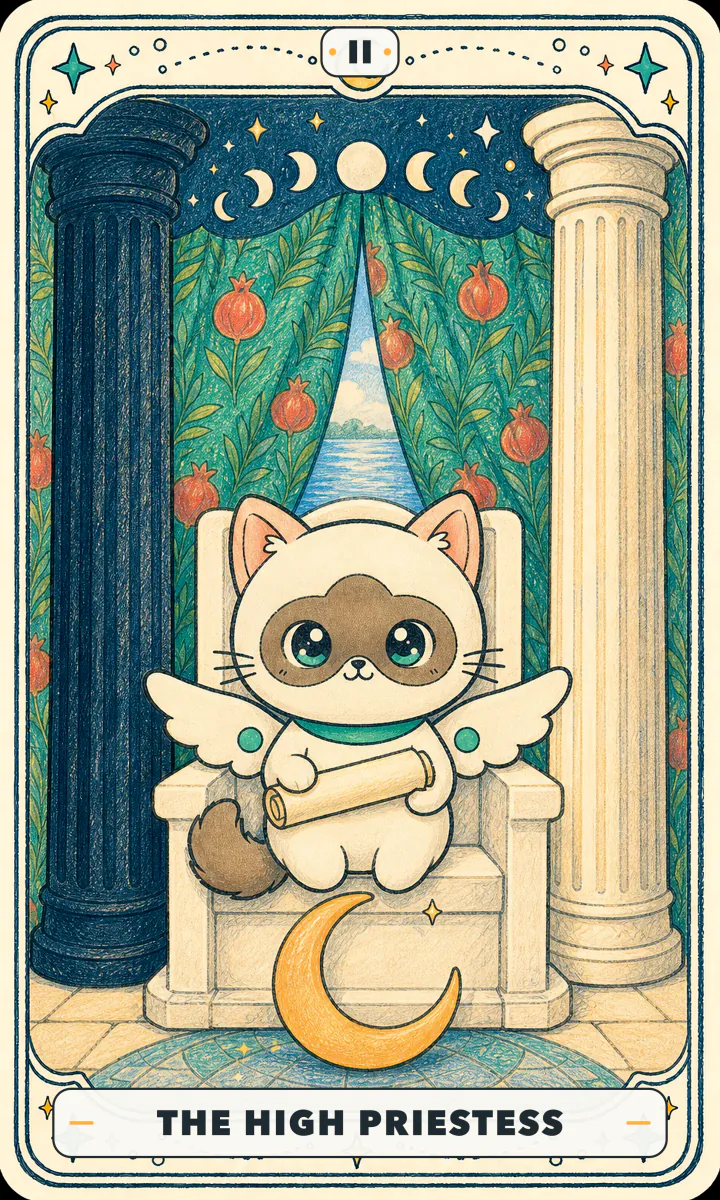
La suma sacerdotisa
The High Priestess
Intuición, Subconsciente
Respuesta rápida
El significado principal de La suma sacerdotisa es Sabiduría interior e intuición.. Del derecho, suele apuntar a Intuición, subconsciente, misterio, sabiduría interior. Simboliza la observación; invertida, puede sugerir Secretos revelados, intuición reprimida, superficialidad, inestabilidad emociona.
Imagen de la carta
Una mujer solemne se sienta entre dos pilares, uno negro y otro blanco (marcados B y J), ante un velo bordado con granadas y palmeras. Sostiene un pergamino (TORA) y una luna creciente descansa a sus pies.
Significado al derecho
Intuición, subconsciente, misterio, sabiduría interior. Simboliza la observación silenciosa y la escucha de la voz interior, encontrando respuestas a través de la intuición en lugar de la lógica.
Significado invertido
Secretos revelados, intuición reprimida, superficialidad, inestabilidad emocional. Puede indicar ignorar la voz interior o volverse retraído y distante.
Amor, carrera, dinero y crecimiento
Amor
En el amor, La suma sacerdotisa señala a Sabiduría interior e intuición.. Vuelve a leerlo teniendo en cuenta cómo se comporta realmente la relación y lo que ambos están eligiendo.
Carrera
En cuestiones profesionales, La suma sacerdotisa apunta a Sabiduría interior e intuición.. Empiece por determinar qué recursos controla y cuál será su próximo paso.
Dinero
En cuestiones de dinero, La suma sacerdotisa apunta a Sabiduría interior e intuición.. No trates una lectura simbólica como una conclusión de inversión; guíate por los hechos, el presupuesto y tu propia tolerancia al riesgo.
Crecimiento personal
Para el crecimiento personal, La suma sacerdotisa apunta a Sabiduría interior e intuición.. Escribe la pregunta que plantea y luego conviértela en una acción que realmente puedas comprobar.
Lo que siente la otra persona
Cuando La suma sacerdotisa indica lo que siente la otra persona, el tema de su actitud hacia ti es: Sabiduría interior e intuición.. Al derecho, ese sentimiento se muestra hacia fuera; invertida, por ahora se queda dentro. No la tomes como un veredicto: contrástala con cómo actúa realmente.
Sí o no
Al derecho
Tal vez
Invertida
No
Esta es nuestra propia lectura rápida, basada en la dirección en la que se inclina el significado de la carta. Las tradiciones no están de acuerdo con respecto a las cartas individuales, y un "Quizás" debe sopesarse con la posición en la distribución y su situación real en lugar de tomarse como una respuesta de una sola palabra.
Texto original de Waite (1911)
Simbolismo interior (original)
Tiene a sus pies la media luna, en la cabeza una diadema con cuernos y un globo en el centro, y sobre el pecho una gran cruz solar. El rollo que sostiene en las manos lleva inscrita la palabra Tora, que significa la Ley Mayor, la Ley Secreta y el segundo sentido de la Palabra. Su manto lo cubre en parte, para mostrar que algunas cosas se insinúan y otras se dicen. Está sentada entre las columnas blanca y negra, J. y B., del Templo místico, y detrás de ella está el velo del Templo, bordado con palmas y granadas. Las vestiduras son vaporosas y ondulantes, y el manto sugiere la luz, un resplandor tornasolado. Se la ha llamado la Ciencia Oculta en el umbral del Santuario de Isis, pero en realidad es la Iglesia Secreta, la Casa que es de Dios (la Naturaleza) y del hombre. Representa también el Segundo Matrimonio del Príncipe que ya no es de este mundo; es la Esposa y Madre espiritual, la hija de las estrellas y el Jardín del Edén Superior. Es, en suma, la Reina de la luz prestada, pero esa luz es la de todos. Es la Luna nutrida por la leche de la Madre Suprema.
En cierto modo, es también la propia Madre Suprema, es decir, es su reflejo luminoso. Es en este sentido de reflejo como su nombre más verdadero y más alto en el simbolismo es Shekiná, la gloria que cohabita. Según la Cábala, hay una Shekiná arriba y otra abajo. En el mundo superior se llama Biná, el Entendimiento Supremo que se refleja en las emanaciones que están debajo. En el mundo inferior es Maljut, entendido ese mundo, a este efecto, como un Reino bendito, y aquello con lo que se hace bendito es la Gloria que en él habita. Hablando místicamente, la Shekiná es la Esposa Espiritual del justo, y cuando él lee la Ley, ella le da el sentido Divino. Hay aspectos en los que esta carta es la más alta y la más santa de los Arcanos Mayores.
Significado original del derecho
Secretos, misterio, el futuro aún no revelado; la mujer que interesa al Consultante, si es varón; la Consultante misma, si es mujer; silencio, tenacidad; misterio, sabiduría, ciencia.
Significado original invertido
Pasión, ardor moral o físico, presunción, conocimiento superficial.
Citado de A. E. Waite, The Pictorial Key to the Tarot (1911), ilustrado por Pamela Colman Smith. El texto es de dominio público.
Orígenes de mitos y símbolos
Las primeras barajas italianas la llamaban la Papisa. Waite la situó entre las dos columnas del Templo de Salomón.
Imaginería documentada
Atestiguada por objetos o textos conservados
En su origen era la Papisa
En las primeras barajas italianas esta carta es La Papessa, la Papisa. La figura de la baraja Visconti-Sforza viste hábito de monja y la triple corona papal. Una conjetura académica la identifica con Manfreda Visconti, pariente de la familia Visconti a quien la secta guglielmita eligió «papisa» y que murió en la hoguera por hereje hacia 1300. Otra la relaciona con la legendaria papisa Juana. Ambas siguen siendo conjeturas, pero que la carta empezó siendo una figura eclesiástica lo atestiguan las barajas conservadas.
Fuente Baraja Visconti-Sforza (mediados del siglo XV); la identificación con Manfreda es una conjetura académica
Las columnas B y J proceden del Primer Libro de los Reyes
Las columnas negra y blanca que tiene detrás, marcadas con B y J, son Boaz y Jaquín, las dos columnas de bronce del pórtico del Templo de Salomón. El velo tendido entre ellas está bordado con palmeras y granadas, dos motivos decorativos habituales de ese mismo Templo: palmeras talladas en los muros y granadas en los capiteles, todo ello descrito en el Primer Libro de los Reyes. Todo el decorado de esta carta, en otras palabras, es escritura hebrea, no un santuario griego.
Fuente 1 Reyes 7:21 (las columnas), 6:29 (palmeras talladas), 7:18 (granadas en los capiteles); Waite 1911 llama a las columnas J. y B.
Correspondencia esotérica
Una afirmación tradicional con fuente, pero construida dentro de un sistema ocultista
Isis: Waite la menciona y luego discrepa
Se dice a menudo que Waite dibujó a la Suma Sacerdotisa como Isis. El texto dice casi lo contrario. Waite escribe que «se la ha llamado la Ciencia Oculta en el umbral del Santuario de Isis», y enseguida lo corrige: «pero en realidad es la Iglesia Secreta». Sí le dio la diadema con cuernos y el globo lunar, que son la iconografía de Isis, y sí inscribió en el rollo de su regazo la palabra Tora, la Ley. Pero ante la ecuación «ella es Isis», el propio autor se mostró cauto. Conviene recordarlo: leer la fuente primaria es mejor que heredar el resumen que otro hizo de ella.
Fuente Waite, The Pictorial Key to the Tarot, 1911, La Suma Sacerdotisa (compárese con el original en el panel de fuentes de esta página)
Tres rostros de la luna
La Golden Dawn asigna a la Suma Sacerdotisa la Luna (letra hebrea Guímel). El mito clásico tiene más de una diosa lunar: Selene es la luna misma, Artemisa rige la caza y la doncellez, y Hécate rige las encrucijadas, los umbrales y el paso al inframundo. Una sacerdotisa sentada en un umbral con un velo a su espalda encaja mejor con los dominios de Hécate. Pero se trata de una correspondencia construida dentro de un sistema ocultista: en la Antigüedad clásica eran tres diosas, no tres fases de una sola.
Fuente Atribuciones planetarias del Libro T de la Golden Dawn; fuentes clásicas para las diosas en sí
Lectura moderna
Popular solo desde el siglo XX; sin relación con el origen de la carta
¿Granada igual a Perséfone? Consulte primero la fuente más cercana
Las granadas del velo se leen con frecuencia como Perséfone, que comió sus semillas en el inframundo y por eso debe volver allí cada año. El mito es auténtico (Himno homérico a Deméter), pero vincularlo a esta carta es una lectura moderna. Waite escribió solo que el velo está «bordado con palmeras y granadas», sin ninguna glosa sobre el inframundo, y palmeras más granadas es exactamente la pareja decorativa del Templo. La fuente más cercana ya está a mano; no hace falta desviarse por Grecia. El marco de la triple diosa doncella-madre-anciana también es moderno y procede de The White Goddess de Robert Graves (1948).
Fuente Lectura popular moderna; el mito de Perséfone está en el Himno homérico a Deméter; el marco de la triple diosa procede de Robert Graves, The White Goddess, 1948
Escrito por BESTAROT, no citado de fuentes históricas. Cada afirmación se etiqueta según su grado de evidencia; Las capas interpretativas modernas son útiles para la lectura, pero no representan el origen histórico de la carta.
Estudie el tema: Orígenes de mitos y símbolos (capítulo 6 de la Academia)