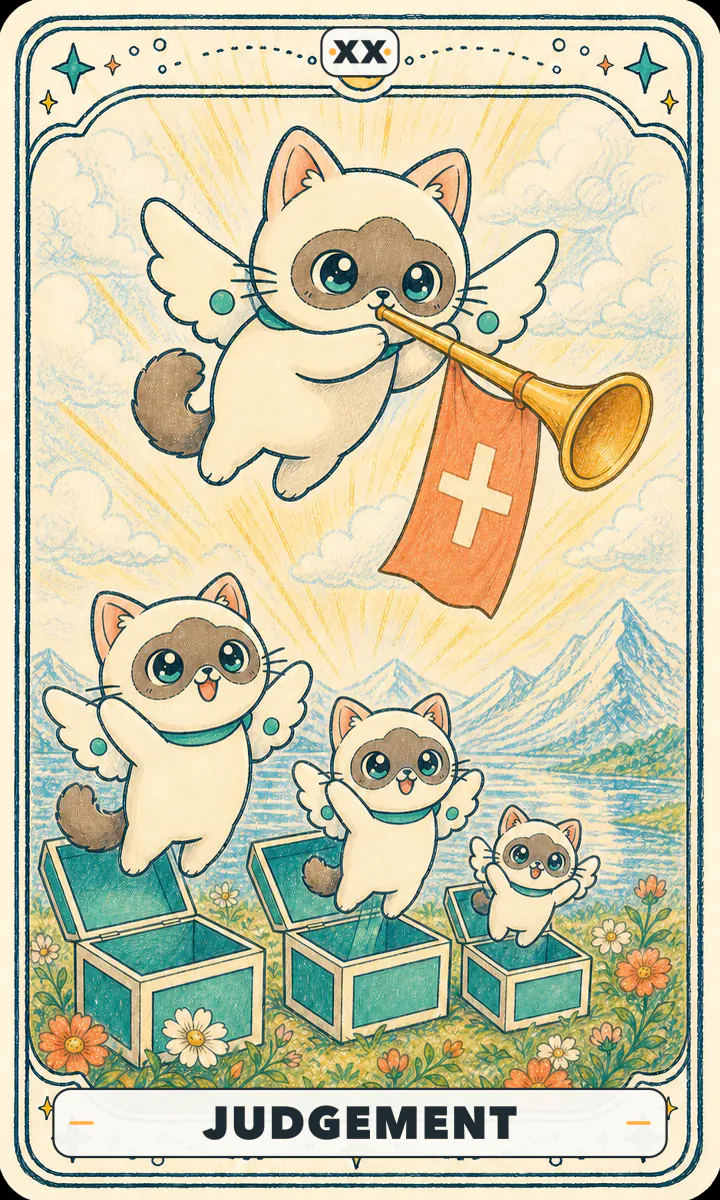
Giudizio
Judgement
Risveglio, chiamata
Risposta rapida
Il significato principale di Giudizio è L'ultima convocazione dell'anima. Al dritto, solitamente indica Risveglio, chiamata, rinascita, resa dei conti karmica. Simboleggia l'ascolto de; rovesciata, potrebbe suggerire Insicurezza, rifiuto della chiamata, incapacità di andare avanti, rimpianti. Può.
Immagini della carta
Un grande angelo suona una tromba dalle nuvole, su cui è attaccato uno stendardo con la croce rossa. Sul terreno sottostante, figure grigie (uomini, donne e bambini) si alzano da bare aperte, con le braccia tese verso l'angelo.
Significato al dritto
Risveglio, chiamata, rinascita, resa dei conti karmica. Simboleggia l'ascolto della chiamata interiore, la revisione del passato, la presa di una decisione importante e la rinascita.
Significato rovesciato
Insicurezza, rifiuto della chiamata, incapacità di andare avanti, rimpianti. Può indicare che si sta trascurando la possibilità di cambiare o che si affoga negli errori del passato senza sollievo.
Amore, carriera, denaro e crescita
Amore
In amore, Giudizio indica L'ultima convocazione dell'anima. Rileggilo confrontandolo con il modo in cui si comporta effettivamente la relazione e con ciò che scegliete entrambi.
Carriera
In materia di carriera, Giudizio indica L'ultima convocazione dell'anima. Inizia individuando quali risorse controlli e quale sarà la tua prossima mossa.
Soldi
In materia di soldi, Giudizio indica L'ultima convocazione dell'anima. Non considerare una lettura simbolica come una conclusione di investimento: segui i fatti, il budget e la tua tolleranza al rischio.
Crescita personale
Per la crescita personale, Giudizio indica L'ultima convocazione dell'anima. Annota la domanda che solleva, quindi trasformala in un'azione che puoi effettivamente verificare.
Cosa prova l'altra persona
Quando Giudizio indica cosa prova l'altra persona, il tema del suo atteggiamento verso di te è: L'ultima convocazione dell'anima. Al dritto il sentimento è rivolto all'esterno e si vede; rovesciata, per ora resta dentro di lei. Non prenderla come una sentenza: verificala con il modo in cui si comporta davvero.
Sì o no
Al dritto
Sì
Rovesciata
No
Questa è la nostra lettura veloce, basata sulla direzione in cui tende il significato della carta. Le tradizioni non sono d'accordo sulle singole carte, e un "Forse" deve essere valutato rispetto alla posizione nello spread e alla situazione reale piuttosto che essere preso come una risposta di una sola parola.
Testo originale di Waite (1911)
Simbolismo interiore (originale)
Ho detto che questo simbolo è sostanzialmente invariabile in tutti i mazzi di Tarocchi, o almeno che le variazioni non ne alterano il carattere. Il grande angelo è qui avvolto dalle nubi, ma suona la sua tromba adorna di stendardo, e sullo stendardo è raffigurata come di consueto la croce. I morti si levano dalle tombe — una donna a destra, un uomo a sinistra e, tra loro, il loro figlio, che volge le spalle. Ma in questa carta sono più di tre coloro che vengono restituiti alla vita, e si è ritenuto utile introdurre questa variazione per mostrare l'insufficienza delle spiegazioni correnti. Va notato che tutte le figure sono come una sola nello stupore, nell'adorazione e nell'estasi espressi dai loro atteggiamenti. È la carta che registra il compimento della grande opera di trasformazione in risposta alla chiamata del Superno — chiamata che è udita e a cui si risponde dall'interno.
Qui c'è l'accenno a un significato che non si può spingere oltre in questa sede. Che cos'è in noi ciò che suona una tromba, e tutto ciò che è più basso nella nostra natura si leva in risposta — quasi in un istante, quasi in un batter d'occhio? Continui pure la carta a raffigurare, per chi non sa vedere oltre, il Giudizio Universale e la resurrezione nel corpo naturale; ma chi ha occhi interiori guardi e scopra con essi. Capirà che in passato è stata chiamata giustamente una carta della vita eterna, e per questa ragione può essere paragonata a quella che va sotto il nome di Temperanza.
Significato originale al dritto
Cambiamento di posizione, rinnovamento, esito. Un'altra versione specifica una perdita totale a causa di una lite giudiziaria.
Significato originale invertito
Debolezza, pusillanimità, ingenuità; anche deliberazione, decisione, sentenza.
Citato da A. E. Waite, The Pictorial Key to the Tarot (1911), illustrato da Pamela Colman Smith. Il testo è di pubblico dominio.
Origini del mito e dei simboli
Un angelo che suona la tromba, i morti che risorgono: la fonte è il Giudizio universale cristiano, e Waite riprende persino le parole di Paolo.
Iconografia documentata
Attestata da oggetti o testi giunti fino a noi
È la composizione standard del Giudizio universale
Il titolo che Waite le dà è IL GIUDIZIO FINALE. Un angelo che suona la tromba, una croce sullo stendardo, i morti che si alzano dalle tombe: una delle scene più comuni sulle facciate e negli affreschi delle chiese medievali. La base testuale è Matteo 24,31, dove gli angeli suonano la tromba e radunano gli eletti, e 1 Tessalonicesi 4,16, con la sua tromba e la sua risurrezione. L'immagine di questa carta viene dall'escatologia cristiana. Non c'è una seconda candidata.
Fonte Matteo 24,31, 1 Tessalonicesi 4,16; la tradizione iconografica medievale del Giudizio universale
Corrispondenza esoterica
Una tesi tradizionale con fonti, ma costruita dentro un sistema occulto
«In un batter d'occhio» è un'espressione di Paolo
In questa voce Waite si chiede che cosa, dentro di noi, suoni la tromba, così che tutta la natura inferiore si levi in risposta, «quasi in un momento, quasi in un batter d'occhio». «In un batter d'occhio» viene da 1 Corinzi 15,52, nel passo sull'ultima tromba che suona e sui morti che risorgono. Waite sposta l'espressione per rileggere il Giudizio finale esteriore come una chiamata che parte dall'interno.
Fonte 1 Corinzi 15,52; Waite, The Pictorial Key to the Tarot, 1911, Il Giudizio finale
L'elemento fuoco e la lettera Shin
La Golden Dawn associa il Giudizio all'elemento fuoco e alla lettera ebraica Shin. Come il Matto (aria) e l'Impiccato (acqua), riceve una delle tre lettere elementali anziché un pianeta o un segno. La forma della Shin viene spesso descritta come tre lingue di fuoco, il che si accorda con la forza che la tromba risveglia.
Fonte Attribuzioni delle lettere elementali nel Book T della Golden Dawn
Lettura moderna
Diffusa solo dal Novecento; estranea alle origini della carta
«Sveglia» e resa dei conti karmica: vocabolario moderno
Oggi la carta viene letta comunemente come la sveglia dell'anima, o come una resa dei conti karmica finale. La prima in effetti non è lontana dall'idea di Waite che la chiamata venga udita e accolta dall'interno; si limita a usare un vocabolario diverso. La seconda è ancora lo schema karmico che esiste solo dopo la Teosofia, e non è la stessa cosa del contesto cristiano del Giudizio universale. Su questa carta qualcuno suona una tromba fuori e qualcuno risponde dentro: ridurre le due cose a «è l'universo che ti presenta il conto» ne restringe il senso.
Fonte Lettura moderna divulgativa; lo schema karmico non è una fonte per l'iconografia di questa carta
Scritto da BESTAROT, non citato da fonti storiche. Ogni affermazione è contrassegnata da quanto bene è dimostrata; gli strati interpretativi moderni sono utili per la lettura, ma non costituiscono l’origine storica della carta.
Studia il tema: Mito e origini dei simboli (Accademia capitolo 6)