
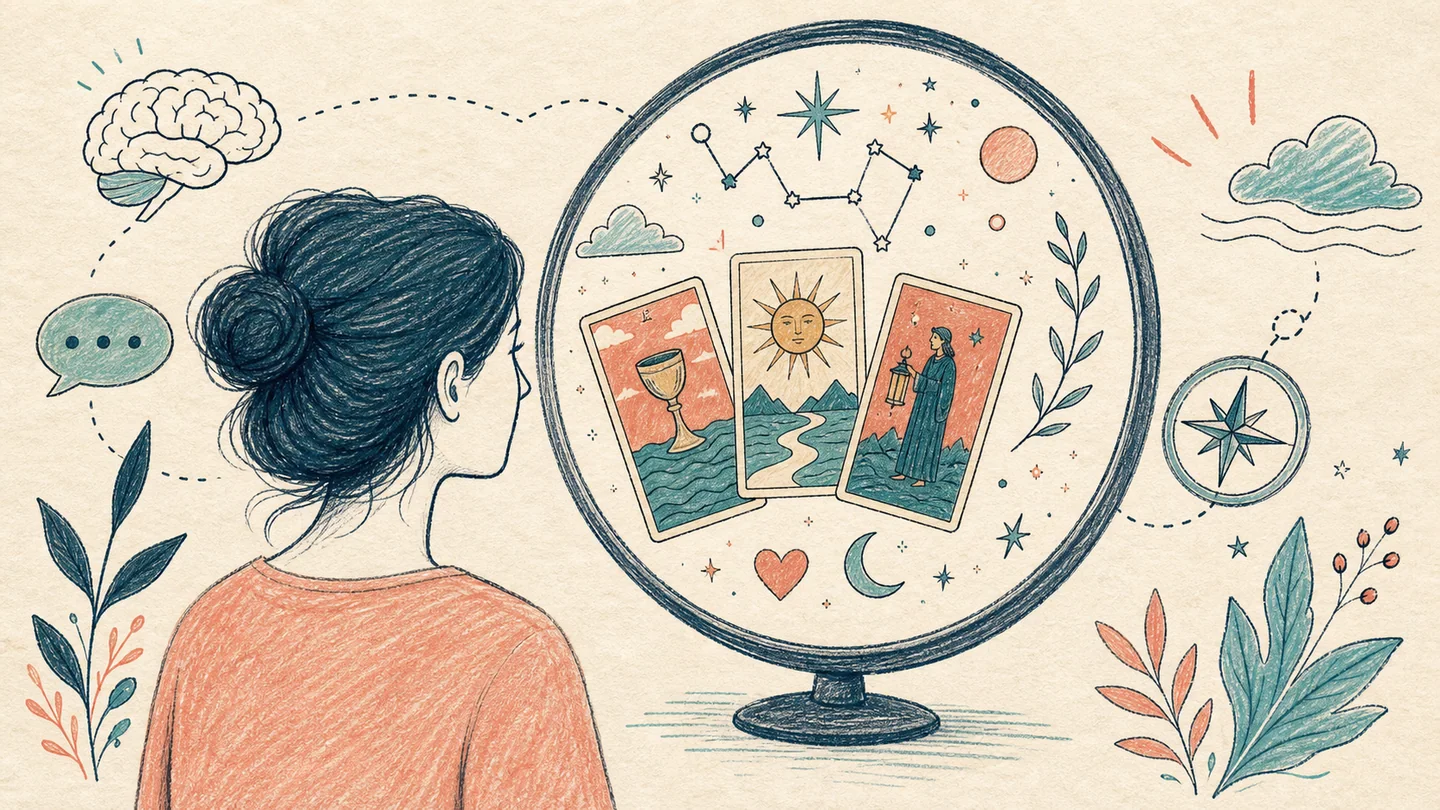
Introduction: A Cognitive Framework Beyond "Superstition"
Many people's first impression of Tarot is that of a metaphysical tool for "predicting the future." However, upon deeper practice, one discovers that its true power lies in being a mirror reflecting the inner self. The "accuracy" of Tarot does not come from mechanical prophecies on the cards, but from a process of subconscious insight and situational restructuring co-activated by the seeker and the reader within a specific sense of ritual. Understanding its principles can help us use this tool more rationally and profoundly.

I. Psychological Projection: Resonance Between the Collective Unconscious and Personal Experience
The 78 cards of the Tarot constitute a condensed symbolic universe. Starting from the pure beginning of "The Fool" to the fulfilled conclusion of "The World," it depicts the complete archetypes of human spiritual growth, turning points of fate, and emotional journeys. When we see a card in a spread, what is truly activated is our personalized association and emotional memory regarding that symbol.

Psychologist Carl Jung's theory of "Synchronicity" provides an explanation: the seemingly accidental result of drawing a card actually forms a deep resonance with the seeker's current psychological state and life lessons. For example, a person facing a career choice who draws "The Chariot" might not be receiving a prophecy of "certain victory," but rather a trigger for inner reflection on "willpower" and "control of direction." The card's imagery acts as a catalyst, awakening cognitions and intuitions that already existed but had not yet been organized.
II. Symbolic System: A Highly Abstracted Network of Meaning
Tarot cards are not realistic illustrations but a highly symbolized visual language. The patterns, colors, character actions, and background elements of each card carry multiple layers of meaning (such as the veil, moon, and scroll of "The High Priestess"). This system, refined through centuries of cultural accumulation, integrates medieval occultism, Christian philosophy, Egyptian mythology, and even Renaissance art, forming a rich "cultural gene pool."

This abstraction is precisely its advantage: it does not provide concrete answers but rather offers an open field for interpretation. A card like "The Star" can symbolize hope, inspiration, and healing, but it might also suggest a detachment from reality that is too idealized. The key to interpretation lies in the reader guiding the seeker to connect the card's universal symbolism with their own circumstances, completing a creative mapping of "symbol to personal context." The precision of this mapping depends on the seeker's self-awareness and the reader's guiding wisdom.
III. The Art of Questioning: Defining Problems and Reshaping Perspectives
The accuracy of Tarot is directly related to the quality of the questions. Vague questions (such as "What will happen to me in the future?") only yield vague responses. Effective questions often focus on:
- Core Motivation: "What is it that I truly desire?"
- Relationship Dynamics: "In this matter, what are my roles and responsibilities?"
- Resources and Obstacles: "What internal strengths do I have available? What is the biggest challenge?"
- Actionable Advice: "What is the first step I can take to improve the current situation?"
A good question is itself a process of thought clarification. When we transform chaotic anxiety into specific, explorable issues, the answers (whether from the cards or from within) naturally become clearer and more actionable. The structure of Tarot spreads (such as Past-Present-Future, or Situation-Obstacle-Advice) also forces us to examine problems from a systemic perspective, breaking the limitations of linear thinking.
IV. Self-Fulfilling Prophecy and Feedback Loops
The experience of Tarot being "accurate" partly stems from the Barnum Effect and confirmation bias—we tend to remember the parts that "hit the mark" and ignore the information that doesn't fit. However, the more positive side is that an interpretation provides a positive psychological suggestion and a blueprint for action.
When a challenging card (such as "The Tower") is interpreted as "necessary destruction and reconstruction" rather than "disaster," it can empower the seeker with courage and a constructive perspective to face upheaval. This positive reframing can change the individual's behavior and mindset, thereby indirectly "bringing about" the realization of a positive outcome. Here, Tarot plays the role of narrative healing, helping us rewrite the script of how we interpret events.
V. Scientific Perspective: Probability, Intuition, and Cognitive Science
From the perspective of cognitive science, the effectiveness of Tarot can be partially attributed to:
- Pattern Recognition: The human brain is a natural pattern seeker, capable of extracting meaningful patterns from random events. Although drawing cards is random, the brain automatically associates the card meanings with fragments of life.
- Intuition Arousal: The sense of ritual (shuffling, laying out cards) creates a psychological transition state into an "intuitive channel," filtering out daily cognitive noise and allowing subconscious information to surface more easily.
- Focusing Effect: Tarot "externalizes" the problem onto the cards, creating psychological distance that allows us to examine our situation more objectively and reduce emotional decision-making.
Conclusion: The Value of the Tool Lies with the User
The "accuracy" of Tarot is ultimately rooted in the user's willingness for self-exploration, the professional expertise of the reader, and the honest interaction between both parties. It is not a judgment of fate, but a profound tool of symbolic psychology that helps us connect with inner wisdom and see the key nodes and potential resources within complex situations. The next time you ask, "Why is it so accurate?", perhaps you should ask yourself: "What truths that already existed within me, yet went unspoken, did this reading illuminate?"
True accuracy always begins with being honest with oneself.