
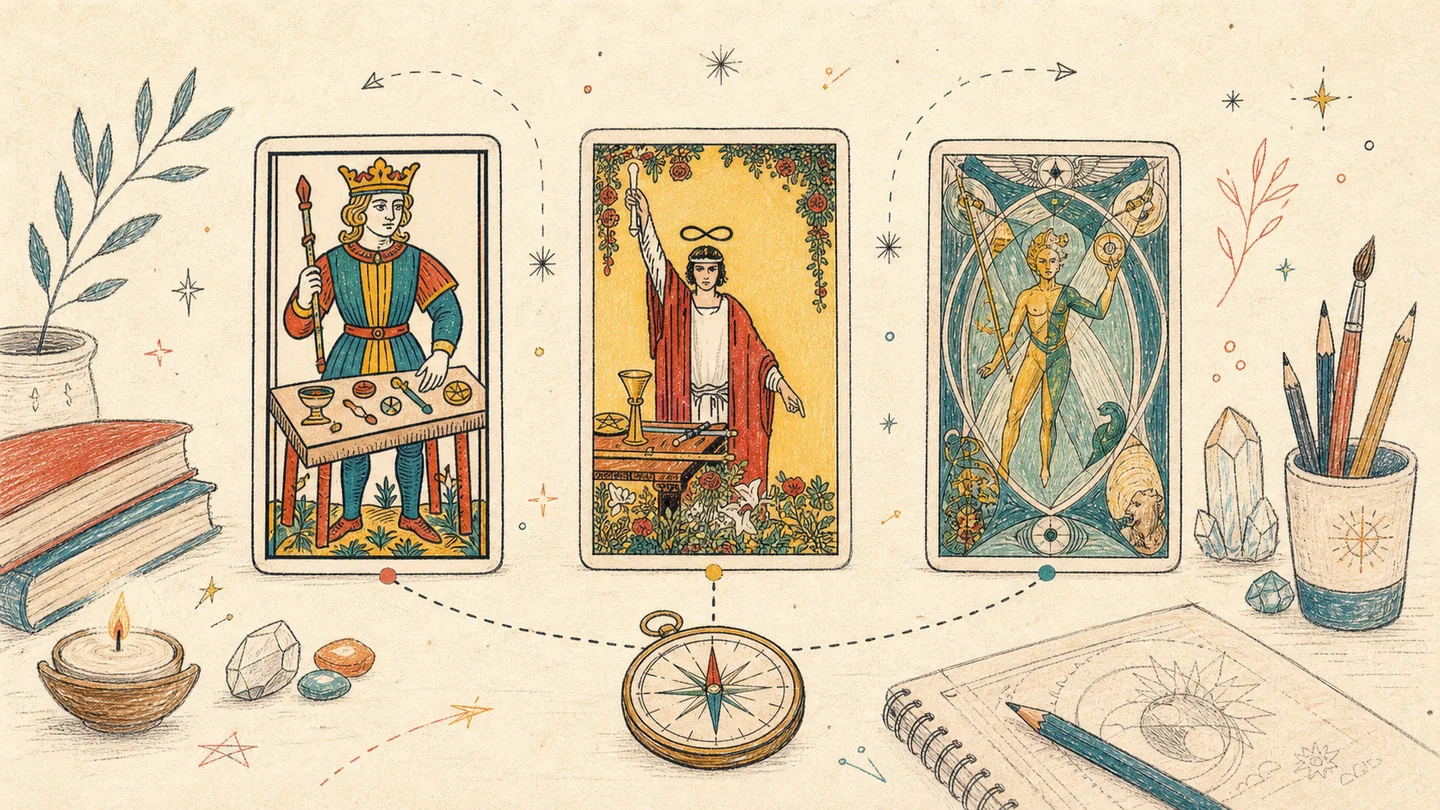
The Three Main Types of Tarot

Tarot is not a single, monolithic entity. Based on artistic style, symbolic systems, and philosophical backgrounds, it can be categorized into three main types: Tarot of Marseille, Rider-Waite-Smith (RWS) Tarot, and Thoth Tarot. While there are countless derivative systems, they all essentially stem from these three.
1. Tarot of Marseille: The Oldest Classic

The Tarot of Marseille originated in 15th-century Italy and was later standardized by printers in the Marseille region of France, becoming the ancestor of modern Tarot. Its characteristics include:
- Non-scenic Minor Arcana: The pip cards only feature symbols representing the quantity (such as Swords or Cups). They lack narrative scenes and rely on the reader's intuition and numerological interpretation.
- Ancient Major Arcana Style: The color palette is dominated by red, yellow, blue, and green. The lines are simple, and the character expressions are abstract, filled with medieval alchemy and occult metaphors.
- Best For: Advanced learners who prefer intuitive reading, enjoy traditional semiotics, or wish to break away from a dependency on "reading the pictures."
2. Rider-Waite-Smith Tarot: The Most Popular Modern Classic

Designed by occultist Arthur Edward Waite and illustrated by artist Pamela Colman Smith in 1909, this was the first Tarot deck where the Minor Arcana also featured full scenic illustrations. Its revolutionary aspects include:
- Strong Narrativity: Each pip card has a specific scene—for example, the "Three of Swords" showing three swords piercing a heart, or the "Six of Cups" showing children offering flowers—communicating the card's meaning directly.
- Unified Symbolism: It integrates Kabbalah, astrology, and sacred geometry, yet the imagery remains intuitive and easy to understand.
- Best For: Beginners, professional readers who need to explain cards in detail to clients, and learners who prefer visual association.
3. Thoth Tarot: The Great Synthesis of Occultism
Designed by British occultist Aleister Crowley and painted by artist Lady Frieda Harris, this deck was completed in the 1940s. Its characteristics include:
- Vibrant and Abstract Imagery: With saturated colors and flowing lines, it is packed with Egyptian mythology, astrological symbols, alchemy, and Kabbalistic paths.
- Unique Card Order and Naming: For instance, "Strength" is renamed "Lust," "Justice" becomes "Adjustment," and the Court cards of the Minor Arcana are changed to "Knight, Queen, Prince, and Princess."
- Best For: Scholars deeply studying magick, astrology, and Western esotericism, as well as seasoned enthusiasts willing to spend time internalizing complex symbols.
Other Notable Tarot Types
4. Golden Dawn Tarot
Strictly following the esoteric system of the Hermetic Order of the Golden Dawn, these cards are covered in Hebrew letters and planetary symbols. It is the precursor to the Thoth Tarot and is suitable for serious occult researchers.
5. Lenormand
Often mistaken for Tarot, this is a German-style deck system consisting of only 36 cards. Each card depicts a mundane symbol (such as a Ship, Fox, or House) and excels at predicting specific, concrete events.
6. Modern Art and Themed Tarot
Examples include the Cat Tarot, Mythic Tarot, and Fairytale Tarot. These are artistic adaptations based on the Rider-Waite or Marseille systems, suitable for collectors or specific thematic readings.
How to Choose the Right Tarot for You?
- For Beginners: The Rider-Waite-Smith Tarot is highly recommended for its clear imagery and abundant learning resources.
- For Tradition Seekers: Choose the Tarot of Marseille to train your intuition and understanding of numerology.
- For Deep Systems: If you are familiar with Kabbalah and astrology, the Thoth Tarot will open a new world for you.
- For Emotional Connection: Pick an artistic deck that you feel an "instant spark" with, and trust your intuition.
Conclusion
The differences between Tarot types are not a matter of better or worse, but rather different linguistic systems. The Tarot of Marseille is like ancient poetry, the Rider-Waite-Smith is like a modern fable, and the Thoth Tarot is like a grand symphony. Whichever deck you choose, the most important thing is to use the cards to dialogue with your inner wisdom. We hope you find the deck that belongs to you in your exploration.