
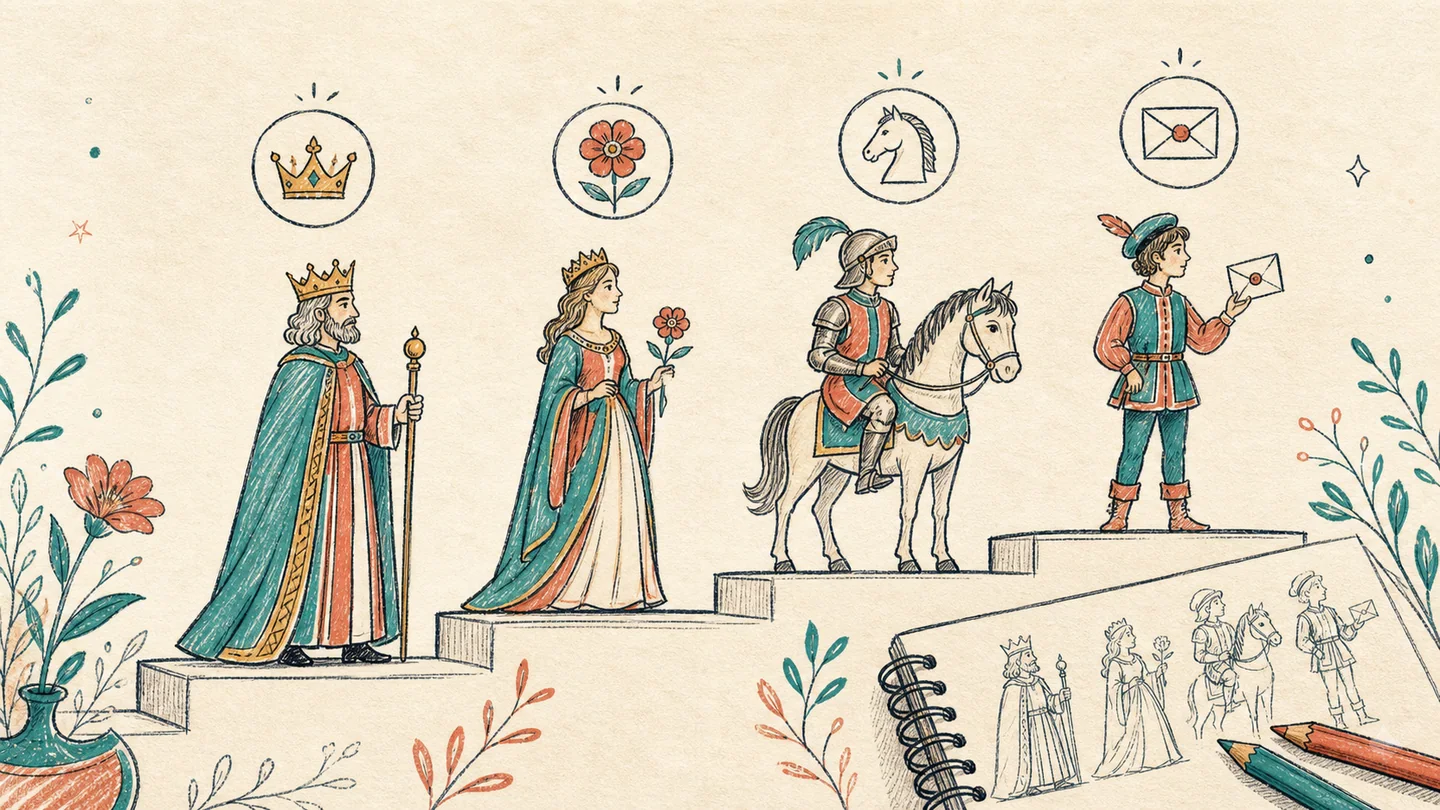
The Ultimate Hurdle in Tarot Reading: The Myth of Court Cards
In the process of learning Tarot, many beginners, after mastering the grand narratives of the Major Arcana and the concrete life scenes of the Minor Arcana, often get stuck on the "Court Cards." These 16 cards can represent the querent themselves, other people appearing in their life, or even a certain psychological state or specific energy vibration.
The most common challenge is: if a spread contains both a King and a Knight, or a Queen and a Page, how do we precisely distinguish the subtle differences? This is not just about memorizing card meanings; it is about a deep understanding of "energy maturity" and "action levels."
Pages: The Germination of Energy and Messengers of Information
Pages represent the most primitive, innocent, and unstable stage among the four elements. In the mapping of the four elements, Pages are usually linked to the characteristics of "Earth," meaning that energy is in its earliest stage of manifestation.
- Personality Traits: They are like children or students, full of curiosity but lacking experience. A Page often represents a novice or someone just starting out in a particular field.
- Action Patterns: Pages usually do not participate directly in large-scale actions; they are more like "messengers." For example, the Page of Cups might bring an emotional signal, while the Page of Pentacles might be conceptualizing an initial plan to make money.
- Key Distinction: When you see a Page, remember "potential" and the "beginner's mind." If you are asking about a career, it predicts a learning opportunity or an entry-level position rather than a final result.
Knights: Extreme Action and Drivers of Change
Knights are the most dynamic rank among the court cards. They are closely associated with the characteristics of "Fire," representing the release and expansion of energy.
- Personality Traits: Knights are usually seen as adolescents or passionate adults. They have clear goals and are willing to take action to achieve them. However, this energy often carries a certain extremity and lacks balance.
- Action Patterns: Knights are the "executors." Think of the dash of the Knight of Wands, the breakthrough of the Knight of Swords, the pursuit of the Knight of Cups, and the steady advance of the Knight of Pentacles. They represent things "in progress" and often bring changes to the environment.
- Key Distinction: The difference between a Knight and a Page lies in "execution." The Page is still reading the manual, while the Knight is already on his horse and moving. The Knight represents an extreme state of energy, lacking the stability of the King and the introspection of the Queen.
Queens: Internalized Mastery and Emotional Maturity
Queens symbolize the ultimate expression of feminine/yin power, corresponding to the characteristics of "Water." They represent maturity, compassion, intuition, and internal management.
- Personality Traits: Queens represent those who have already mastered the power of their corresponding element, but they tend to explore inward. They are mature female figures or individuals with high perceptivity. They do not need to prove anything to the outside world because they are the embodiment of that energy themselves.
- Action Patterns: Queens are often "passive controllers." She will not actively charge onto the battlefield (that is the Knight's job), but she can dominate the situation through emotional influence or internal composure. For example, the Queen of Cups resolves conflict through empathy rather than authority.
- Key Distinction: The best way to distinguish a Queen from a King is to observe the direction of the energy. The Queen is inward, emotional, and nurturing; she is the soil that nourishes the growth of the seed.
Kings: Authority, Order, and Command of the External World
Kings are the supreme commanders of the four elements, corresponding to the characteristics of "Air" (some systems also attribute them to Fire). They represent social status, responsibility, power, and stability.
- Personality Traits: Kings are experienced decision-makers. They represent fathers, bosses, mentors, or figures who have reached the pinnacle of a field. A King's energy is outward-facing and structured; they care about rules, strategy, and ultimate control.
- Action Patterns: The King is the "manager." He does not need to run around like a Knight, nor is he deeply immersed in emotions like the Queen. He maintains the operation of the world by issuing instructions and establishing norms. He represents a sense of stability, "holding the fort" from behind the scenes.
- Key Distinction: The difference between a King and a Queen lies in the "direction of authority." The King aims to establish order; the Queen aims to establish connection. When you see a King, it means you need to handle the issue with reason, logic, and a long-term perspective.
How to Quickly Distinguish in Practice?
To precisely distinguish these four ranks, we can use a simple logical model:
- Look at "Maturity": The Page is a child, the Knight is a youth, and the Queen and King are adults.
- Look at "Movement": The Page is observing, the Knight is running, the Queen is sitting still, and the King is making decisions.
- Look at "Social Roles": The Page is a student, the Knight is an employee/vanguard, the Queen is a counselor/mother, and the King is a CEO/father.
When you are interpreting a spread, try to see these four levels as different stages of energy evolution. From the flash of inspiration of the Page, to the all-out effort of the Knight, to the emotional sublimation of the Queen, and finally settling under the rational control of the King. Once you understand this logic, the 16 court cards will no longer be a confusing crowd, but a precision tool for analyzing the blueprint of life.