
Introduction: What is 'Western Esotericism'?
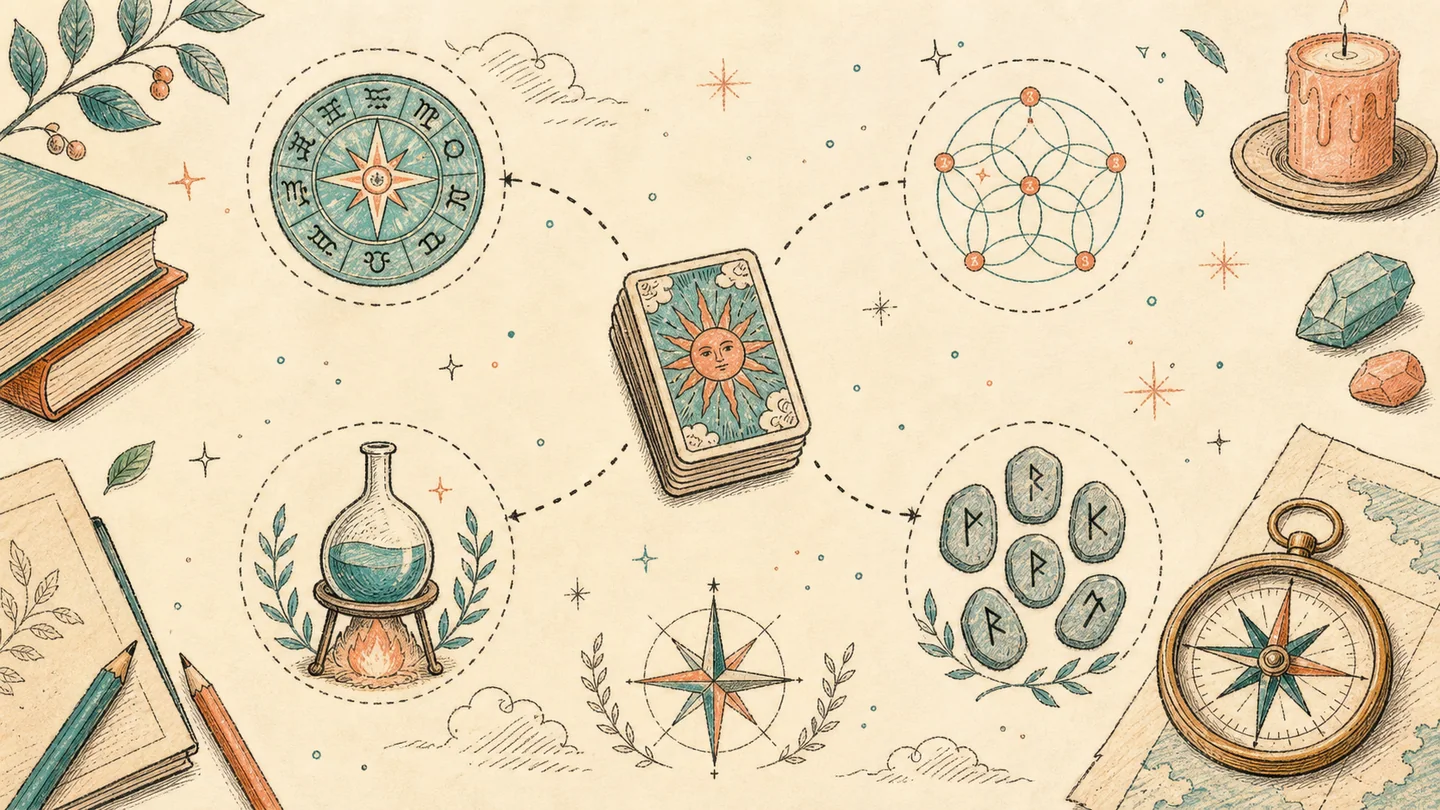
Before diving deep into the status of Tarot, it is necessary to define the scope of our discussion. 'Western Esotericism' refers to a broad range of traditions and systems of knowledge and practice focused on exploring the hidden structures of the universe, spiritual truths, and the connection between the individual and the divine source. It is not a single discipline, but a vast network woven together by many branches, including Astrology, the Kabbalistic Tree of Life, Alchemy, Hermeticism, and Ritual Magic. Within this network, Tarot cards, with their unique symbolic language and practical flexibility, play an extraordinary role as both an independent system and a universal 'translator.'

Historical Evolution: From Gaming Cards to Spiritual Mirrors
The earliest history of Tarot dates back to 15th-century Italy, where it began as a card game for the nobility known as Trionfi. Its true occult turn occurred in the 18th century, initiated by French occultists such as Etteilla and Court de Gébelin. They systematically mapped the 22 Major Arcana cards to the planets and twelve signs of Astrology, the 22 paths of the Kabbalistic Tree of Life, and the Hebrew alphabet, constructing an unprecedentedly grand symbolic system. While this 'historical reconstruction' remains controversial among historians, it successfully elevated Tarot from secular entertainment to a 'Book of the Universe' and a 'Spiritual Map,' officially granting it entry into the temple of Western Esotericism.

The Core Position of Tarot in Western Esotericism
1. As a Comprehensive Symbolic Library
The greatest power of Tarot lies in its condensed symbolic system. The imagery, numbers, colors, and elements (Fire, Water, Air, Earth) of every card carry multiple layers of meaning. This symbolic library forms a profound intertextuality with other Western esoteric systems:
- With Astrology: The Major Arcana correspond to planets and zodiac signs (e.g., 'The Wheel of Fortune' corresponds to Jupiter, 'The High Priestess' to the Moon), the Court Cards of the Minor Arcana correspond to the zodiac, and the numbered Pip Cards correspond to planetary qualities.
- With Kabbalah: The 22 Major Arcana perfectly correspond to the 22 paths on the Tree of Life, manifesting the abstract process of divine emanation as stages of a spiritual journey.
- With Alchemy: Card imagery (e.g., 'The Devil' symbolizing bondage/calcination, 'The Sun' symbolizing the completion of the Philosopher's Stone) serves as visual metaphors for different stages of the alchemical process. Therefore, learning Tarot is almost equivalent to learning a universal language of Western Esotericism.

2. As a Flexible Tool for Practice and Introspection
Compared to Astrological charts which require complex calculations, or Ritual Magic which requires long periods of cultivation, Tarot offers a very low barrier to entry with immense cognitive depth. Anyone can use spreads to ask questions, draw cards, and interpret them, initiating self-reflection or external exploration. This flexibility makes it:
- An Entry Point for Beginners: Tarot is for many people the most friendly and direct starting point for encountering Western Esotericism.
- A Partner to Depth Psychology: The Jungian school views Tarot cards as manifestations of archetypes from the collective unconscious, allowing it to shine in the fields of modern psychotherapy and personal growth.
- A Mirror for Spiritual Practice: Through daily card draws, meditation, and spread planning, practitioners can converse with their inner wisdom and monitor their spiritual progress.
3. As a Bridge Between Different Traditions
Historically, various esoteric schools (such as the Hermetic Order of the Golden Dawn) were dedicated to synthesizing all systems of knowledge. Tarot is the perfect vehicle and proof of this synthesis. When you interpret a Tarot reading, you are simultaneously drawing upon:
- Numerology (the numbers of the cards)
- Elemental Philosophy (the four suits)
- Astrological Correspondences (celestial bodies and zodiac signs)
- Kabbalistic Paths (the ladder of spiritual ascent) This cross-system linkage makes Tarot not just a tool, but an integrative way of thinking, helping learners build a coherent, multi-dimensional esoteric worldview.
Continuous Evolution in the Modern Context
In the 21st century, the status of Tarot is not fixed; rather, it continues to evolve:
- Secularization and Psychologization: More and more people view it purely as a powerful tool for intuition and self-analysis, stripping away traditional theological backgrounds.
- Cultural Fusion: Tarot symbols constantly collide with Buddhism, Shamanism, modern art, and more, giving rise to countless new themed spreads and artistic decks.
- Feminism and Diverse Perspectives: A re-examination of gender and power structures in traditional card meanings has led to more inclusive ways of interpretation. These evolutions prove the vitality and adaptability of the Tarot system—it is not a rigid dogma, but an open, living tradition waiting to be reinterpreted.
Conclusion: A Hub, Not an Appendix
In summary, Tarot divination in Western Esotericism is by no means a simple "fortune-telling" accessory. It is:
- A three-dimensional textbook of cosmic symbols.
- A universal framework for spiritual practice.
- A core hub connecting different esoteric traditions. Its status stems from its unparalleled symbolic density, practical elasticity, and the deep foundation created by historical layering. For any seeker wishing to delve deep into the realm of Western Esotericism, understanding Tarot is almost equivalent to understanding the grammar and vocabulary of the entire Western esoteric universe. It is not just a box of cards; it is a doorway to a hidden world where symbols, energy, and consciousness are deeply intertwined.