
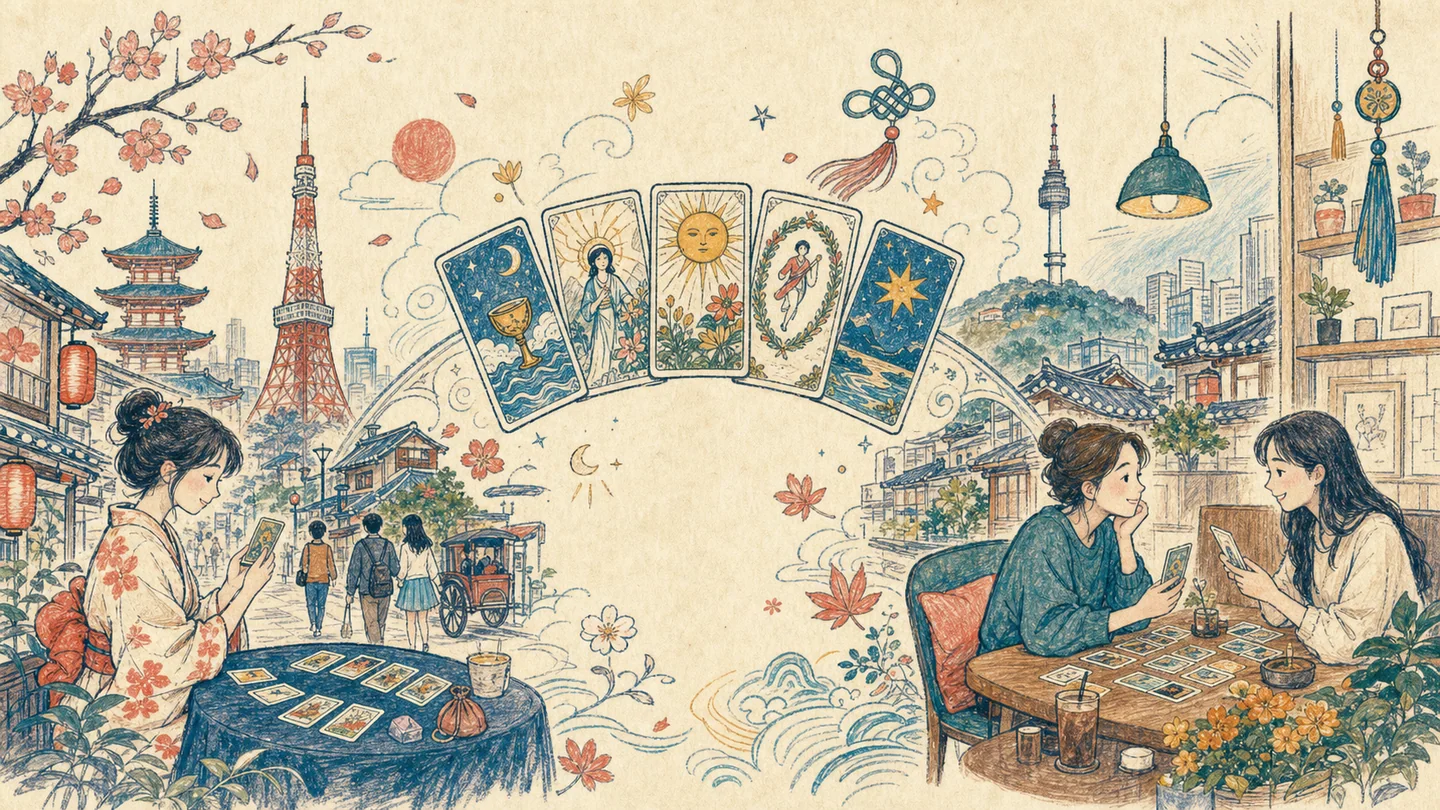
In the corner cafes of Seoul's Hongdae and the creative boutiques of Tokyo's Harajuku, exquisitely designed Tarot decks of various styles always occupy a prominent position. This is not a simple transplant of Western occultism, but a profound "localization" revolution occurring within the East Asian cultural context. As Tarot enthusiasts and cultural observers, it is essential to explore why Tarot has become a persistent and unique spiritual phenomenon in the highly modernized and tech-driven societies of Korea and Japan.
1. Historical Origins: Not "First Contact," but a "Rediscovery"

Tarot's contact with East Asia happened much earlier than we might imagine. As early as the Meiji Restoration, Western astrology and occultism entered Japan alongside opening-up policies. However, it only truly became a social "trend" in the last thirty years. South Korea, on the other hand, saw a surge in the public's need for understanding destiny and self-identity following the 1997 Asian financial crisis and the resulting drastic changes in social structure, providing the psychological soil for Tarot's penetration. The key turning point was when it ceased to be viewed as a "foreign divination tool" and was instead repackaged as a universal psychological tool and a creative artistic medium, dissolving cultural barriers.
2. Cultural Core: Resonance with East Asian Fatalism and "Self-Exploration"

Both Korean and Japanese cultures possess deep-rooted concepts of fate (such as Korea's "In-yeon" / "인연" and Japan's "En" / "縁"). The Tarot does not provide rigid prophecies, but rather a mirror system for self-dialogue. This aligns perfectly with the East Asian tradition of "seeking within oneself" for self-cultivation. When young people seek Tarot readings, they aren't just asking "Will I get into university?" or "Will I get a promotion?" Their core request is: "What does my current state reflect about my internal patterns?" or "What has this relationship taught me?" This is a wisdom that internalizes external divination into a growth mindset, perfectly meeting the urgent needs of contemporary East Asian youth for "self-understanding" and "emotional healing" in a high-pressure society.
3. Pop Culture Engine: Empowerment from Anime, Film, and Idols

Japanese anime and light novels are the invisible hands spreading Tarot. From the card-based magic in Yu-Gi-Oh! to the world-building in Magi: The Labyrinth of Magic based on King Solomon and labyrinths, Tarot symbols (such as the "Wheel of Fortune" and "The Lovers") have entered public consciousness as metaphors. The Korean entertainment industry has gone a step further, with idol groups showcasing Tarot cards in variety shows and music videos, shaping it into a fashionable and tasteful lifestyle aesthetic. When top stars hold an "Artist Tarot" or "Tokyo Tarot," it instantly sheds the stereotype of "superstition" and becomes a collectible, displayable identity marker and creative expression.
4. Commercialization and Creative Ecosystem: From "Divination Tool" to "Cultural Commodity"
In Korea and Japan, Tarot has already completed the transformation from a "functional product" to a "high-value creative commodity."
- Design Diversification: Local artists combine the traditional Tarot structure (22 Major Arcana and 56 Minor Arcana) with domestic mythology, anime styles, and modern illustration art, resulting in countless "limited editions" and "artist collaborations."
- Scenario Integration: Tarot has merged with cafes (the many "Tarot Cafes" in Seoul), bookstores, select shops, and even clothing brand collaborations, becoming a form of experiential consumption and social currency.
- Professionalization of Services: Professional Tarot consultants, courses, and certification systems have formed a mature industry chain, enhancing the professional standards and credibility of the field.
This ecosystem allows Tarot to be more than just "fortune-telling"; it is a complex cultural product integrating art collection, psychological exploration, and social leisure.
5. Social Psychology: Seeking a "Narrative Framework" in an Uncertain Era
Both Korean and Japanese societies face common challenges such as low birth rates, high-intensity job competition, and interpersonal alienation. In the uncertain "VUCA era," Tarot provides a gentle framework for narrating personal stories through symbolic language. It doesn't give definitive answers but offers a "pause button" and an opportunity for "reinterpretation." This "sense of controlled exploration" precisely satisfies the contradictory psychological state of modern people who crave control over their lives while feeling weary of linear narratives. It has become a low-cost, private tool for "meaning-making."
Conclusion: A Successful "Cultural Translation"
The popularity of Tarot in Korea and Japan is, in essence, an extremely successful cultural translation and innovation. It has stripped away the complex religious and historical baggage of Western occultism and grafted onto it East Asian cultural psychology, aesthetic preferences, and commercial logic. Ultimately, it has evolved into a modern spiritual ritual and creative lifestyle for East Asian urban youth. It reminds us that the vitality of any foreign cultural form ultimately depends on whether it can grow new branches of meaning in local soil and gently respond to the most hidden breaths of the era.