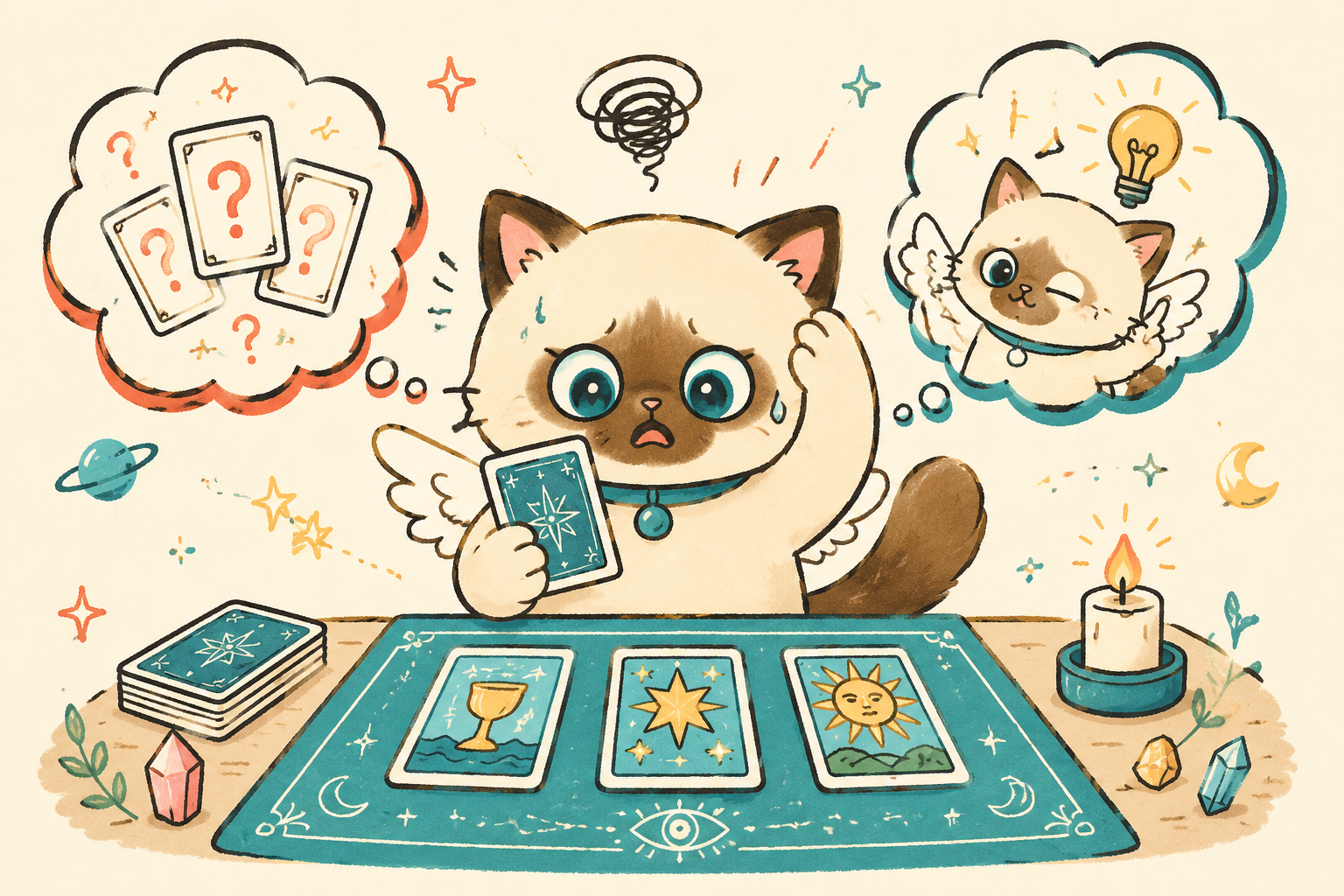
Imagine this scene: the querent is sitting before you with eyes full of expectation and anxiety (or perhaps they are staring intently at the chat box on the other side of the screen). You calmly shuffle, cut, and lay out the spread. However, the moment you flip over one of the cards, your brain suddenly "glitches"—the keywords you usually know by heart have vanished, and you can't remember for the life of you what this card means.
This is likely a "nightmare moment" that every Tarot reader encounters on their journey to mastery. Whether you are a beginner just starting out or an experienced reader with years of practice, fluctuations in state, fatigue, or external distractions can all lead to such brief memory lapses. If this happens, don't panic. Forgetting rote-memorized meanings is often the perfect opportunity to break through a plateau and awaken deeper intuition. Here are several practical "rescue" and advancement strategies.
Stay Calm: Accept the "Brain Freeze" Moment
When you realize you've forgotten a card's meaning, your first reaction is often a racing heart and a fear of being seen as "unprofessional" by the querent. In reality, the querent has no idea about the internal chaos you are experiencing. In their eyes, you might simply be engaging in deep reflection and spiritual connection.
Strategy: Take a deep breath. Give yourself 5 to 10 seconds. You can shift your gaze away from the card, adjust your posture, or take a sip of water. You can even say calmly: "The energy this card brings out is very interesting; let me take a moment to feel the specific details it's conveying in the context of your situation." This not only buys you time to remember but actually makes the querent feel your rigor and focus.
Return to Intuition: Let the Imagery Be Your Guide

The greatness of the Rider-Waite Tarot (and its derivative systems) lies in its rich visual metaphors. Tarot is never just a dry dictionary; it is a flowing art gallery. When you forget the textbook definition, go directly back to the image itself.
Strategy: Observe closely what is happening in the story on the card. You can approach an intuitive reading from several dimensions:
- Color Tone: Is the card a warm, bright yellow, or a gloomy, heavy gray? Colors directly reflect the current emotional energy.
- Character State: What are the people in the card doing? Is their expression joyful, pained, or confused? Which direction are they facing?
- Core Symbols: What object catches your eye the most? Is it a sharp sword or an overflowing cup? By describing the elements on the card and linking them to the querent's question, you will often provide a highly insightful reading that is more precise than a forced textbook definition.
Rely on the Framework: Deconstructing and Reconstructing Underlying Logic

Memories may fade with time or state, but once an underlying logical system is established, it becomes muscle memory for your readings. When you forget a specific card meaning, you can rely on the systemic framework to deduce it.
Strategy: Systematically review where the card belongs. As long as you have completed solid Tarot Structure Learning, you can deconstruct it like a math problem. For example, if you forget the specific meaning of the "Five of Wands," you can deduce it in two steps: First, recall which element it belongs to. Accessing your knowledge of The Four Elements System, you remember that "Wands" represent the Fire element, signifying action, passion, willpower, and conflict. Second, combine it with the essence of the number. The number 5 in Tarot usually represents change, challenge, and instability. Combining "Fire" with "Instability/Challenge," you can easily deduce the core meaning of the card: this is a situation involving competition, conflict regarding goals or actions, or a chaotic mess that needs to be overcome. Interpretations derived from a framework are often more logically persuasive than rote memorization.
Sincere Communication: Exploring Energy with the Querent
Reading is never a one-way output of information from the Tarot reader; it is an energetic resonance involving the reader, the cards, and the querent. When you feel stuck on a card or feel that its traditional meaning doesn't fit the current spread, try handing the initiative to the querent temporarily.
Strategy: You can point to the card and gently ask the querent: "When you first look at this card, what is your feeling?" or "Which detail in this card resonates with you the most?" The querent's answer will often serve as the key to unlocking the puzzle. Their subconscious will accurately capture metaphors on the card related to their own predicament. After the co-created reading, remember to record a review at the end of the session. For cards where you felt stuck, go back to the 78 Tarot Card Meanings Encyclopedia for an in-depth comparison. Reviewing with a specific problem in mind makes originally dry meanings feel incredibly vivid.
Conclusion: Forgetting Card Meanings Is the Starting Point for Freedom
Memorizing a thousand keywords is not as good as truly "seeing" a card. Occasionally forgetting a meaning during practice is not a collapse of professional ability, but rather your subconscious reminding you: it's time to let go of dogma.
As advanced Tarot practitioners often discuss—What happens after learning Tarot? The end is the beginning of freedom and truth. When we are no longer bound by fixed "card meanings" and can move freely between visual intuition, elemental structure, and empathetic communication, we truly complete the transformation from a "card reader" to a "spiritual guide." The next time your mind goes blank, smile slightly and bravely welcome that gift belonging to intuition.