
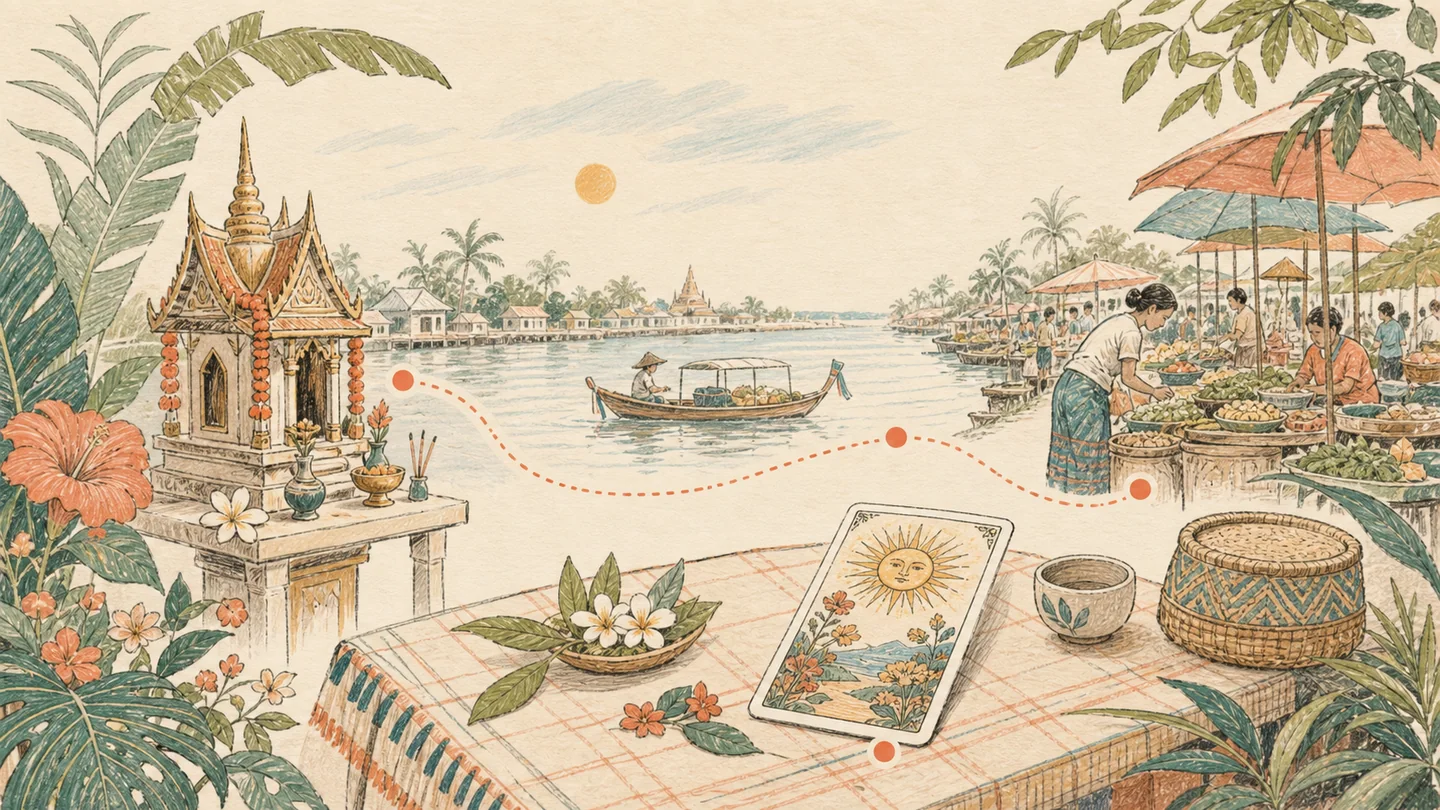
Introduction: When Occultism Meets Tropical Vibes

Beside a bustling street market in Bangkok, you might find an exquisitely decorated Tarot tea house; in a Singaporean co-working space, young professionals are booking online appointments for a Tarot reader to interpret career dilemmas; and at yoga retreats in Bali, Tarot cards often appear alongside astrology and Reiki on workshop schedules. Tarot, a deck of cards carrying Western esoteric symbols and artistic aesthetics, has long since quietly crossed geographical and cultural borders to take root in Southeast Asia, evolving into a unique set of localized expressions. As Tarot enthusiasts and researchers, we cannot help but ask: Is Tarot actually popular in Southeast Asia? What logic of cultural fusion and spiritual demand lies behind its popularity?
I. Historical Roots: Not a Completely Foreign Visitor

To understand the current state of Tarot in Southeast Asia, we must first briefly review its path of entry. Western colonial history was an important channel for early dissemination. The colonial activities of countries like Portugal, the Netherlands, Britain, and France in Southeast Asia inevitably brought cultural elements, including occultism. However, what truly allowed Tarot to take root in the local soil was the acceleration of globalization and the ubiquity of the internet over the past thirty years.
More importantly, Southeast Asia itself possesses a deep and active spiritual tradition. From Indonesia's "dukun" (shamans/healers) and Malaysia's "bomoh," to the Philippines' "albularyo" (traditional healers), and the widely circulated culture of Thai amulets, divination, and talismans, this land has a high level of cognition and acceptance for the "supernatural," "energy," and "destiny." The arrival of Tarot was not seen as a completely foreign "other," but rather as a new, systematic spiritual tool and path for self-exploration, creating a fascinating chemical reaction with local belief systems.
II. Contemporary Popularity: From the Margins to the Edge of Mainstream Visibility

When discussing "popularity," one must avoid overgeneralization. Southeast Asia is not a homogeneous market; the acceptance of Tarot varies significantly across countries due to differences in religion, social openness, and economic development.
Singapore and Malaysia: As cosmopolitan international hubs, Singapore's Tarot community is the most mature and open. It boasts professional Tarot schools, regularly held occult fairs, and many professional readers who practice Tarot as a side gig or full-time career. In Malaysia, particularly in Kuala Lumpur, the situation is similar, but influenced by a mainstream Islamic social background, related activities tend to be more underground or semi-public, circulating mainly within specific communities (such as the Chinese community or expat circles).
Thailand: The Thai passion for the occult is world-renowned. Here, Tarot is usually seen as a "foreign but friendly" divination tool, often coexisting with local astrology, physiognomy, and pendulums. On Bangkok's Khao San Road and Sukhumvit Road, one can find many shops offering Tarot readings, which often incorporate Thai Buddhist elements (such as using Buddha images for card backs or mentioning karma during interpretations). However, its mainstream status is far below that of local amulet worship or temple blessings.
Indonesia, Vietnam, the Philippines: In these countries, Tarot is more of a niche interest or confined to expat and urban elite circles. In Bali, due to the influence of spiritual tourism, Tarot services are common in yoga studios and resorts, catering to tourists and expats seeking "soul healing." In Jakarta and Ho Chi Minh City, there are some discreet communities and online groups in operation.
Overall Characteristics: The popularity of Tarot in Southeast Asia is characterized by being "urban-centered," "community-based," and "service-oriented." It is rarely spread as a serious religious or philosophical system, but exists more as a personal growth tool, an entertainment/social activity, a professional consulting aid, and a tourism experience project. Social media (especially Instagram and Facebook) serves as the core platform for dissemination and client acquisition.
III. Cultural Fusion: The "Southeast Asianization" of Tarot
One of the most fascinating phenomena of Tarot in Southeast Asia is the innovative fusion it creates with local cultural symbols, beliefs, and aesthetics. This is not just a simple duplicate of "Chinese-style Tarot" or "Japanese Tarot," but a deep cultural dialogue.
Local Reconstruction of Symbol Systems: Some Southeast Asian artists and Tarot readers have begun creating decks with local characteristics. For example, replacing "The Empress" in traditional Rider-Waite imagery with the Indonesian goddess "Nandi," or depicting "The Chariot" as a Thai dragon boat race. Deities from Hindu-Buddhist mythology (such as Hanuman or Garuda), spirits from local legends (like Indonesia’s "pontianak" or the Philippines' "tikbalang"), and even images from daily life (such as tuk-tuks, spice markets, and durians) are incorporated into the cards, making interpretations more culturally resonant for locals.
Flexible Adjustment of Interpretive Context: When interpreting, Tarot readers consciously integrate concepts familiar to locals. When discussing "destiny," they might combine it with the ideas of "Karma" or "Merit"; when exploring "challenges," they might cite local philosophies of "trials" or "tribulations." In business consulting, Tarot readings might be combined with Feng Shui or numerology (such as the "Niskala" concept in Malaysia).
Localization of Ritual and Energy: Some Tarot readers perform brief localized "cleansing" rituals before a reading, such as lighting local incense, sprinkling holy water (or coconut water), or reciting short blessings (which may stem from Buddhist or Hindu traditions). Seekers also often expect the reader to possess a certain degree of "mediumship" or psychic ability, echoing their imagination of the powers held by local "bomoh" or "dukun."
This fusion is not without controversy; some traditional Tarot purists believe this "distorts" the original system of Tarot. However, from the perspective of cultural dissemination, this is precisely the vitality that allows Tarot to survive and thrive in Southeast Asia—it has become a "negotiable" spiritual practice.
IV. Challenges and Future: Finding a Balance Between Commercialization and Spirituality
The popularity of Tarot in Southeast Asia also faces challenges. First is the impact of commercialization and entertainment. Many practitioners, in an effort to attract customers, package Tarot readings as a "novelty experience" or "psychological massage," weakening its role as a tool for deep self-reflection and spiritual growth. Second is the lack of regulation and a crisis of trust. Since the industry lacks oversight, the quality of Tarot readers varies greatly. Cases of exaggerated predictions or fear-based marketing to solicit high fees occur occasionally, damaging the public's perception.
Looking ahead, the development of Tarot in Southeast Asia may deepen along two paths:
Professionalization and Education: More systematic Tarot courses and certification systems (albeit unofficial) will emerge, improving the overall quality of practitioners and shifting Tarot from "fortune-telling" toward "counseling" and "empathy."
Deep Cultural Integration: Higher-quality localized Tarot products (decks, books, courses) with profound cultural insights will appear, along with interdisciplinary research and practice combining Tarot with psychology (such as Jungian archetypes), local philosophy, and art therapy.
Conclusion: A Crystal Mirror Reflecting the Pluralistic Self
Is Tarot "popular" in Southeast Asia? The answer is: it is flourishing within a vibrant niche circle and continues to permeate broader social strata. Its popularity essentially reflects the successful grafting of a Western occult tool onto Southeast Asia's rich spiritual traditions, cultural identities, and the spiritual needs of contemporary urbanites in the era of globalization.
For Tarot enthusiasts, observing this process is highly enlightening. It reminds us that Tarot is not a set of rigid dogmas, but a flexible "mirror" or a map that can—and should—be redrawn by practitioners from different cultural backgrounds using their own familiar languages and symbols. Under the tropical sun of Southeast Asia, Tarot cards are shining with a luster that is both familiar and novel, reflecting a unique narrative of destiny, choice, and self-awakening belonging to this land.