
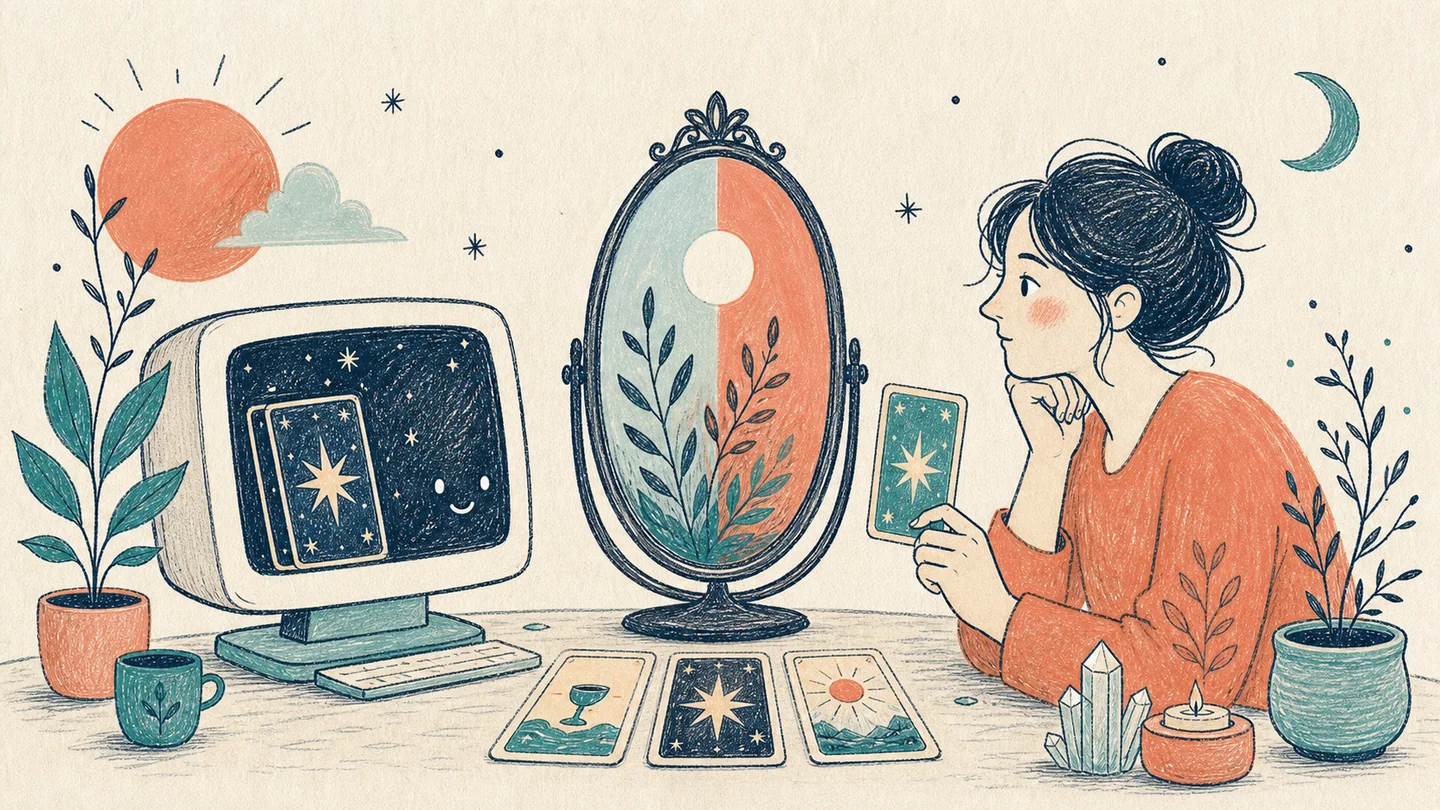
The Essence of Tarot: A "Living Mirror" Reflecting the Inner Self

Before exploring whether AI divination is accurate, we must return to the ultimate core of Tarot: it is not a "prophecy machine" for predicting good or bad luck, but a sophisticated system of symbols and a tool for psychological projection. In the classic Rider-Waite Tarot, the imagery, colors, and elements of every card are imbued with rich archetypal meanings. In traditional divination, the spread, positions, and orientations (upright or reversed) intertwine with the querent's situation to present a dynamic picture reflecting the querent's subconscious state, inner conflicts, and latent possibilities. The key to its "accuracy" lies in the reader's (or the querent's own) ability to interpret this picture—a comprehensive art combining intuition, life experience, and knowledge of card meanings. Therefore, the core of the issue has never been "whether the cards themselves are accurate," but rather "whether the interpretation hits the mark."
How Does AI "Interpret"? Symbolic Reorganization Under Algorithms

The working principle of current AI divination (such as ChatGPT or specialized divination AIs) is essentially based on statistical correlations and pattern generation from massive amounts of text data, including classic card meanings, case studies, and psychological theories. When you input a question and draw a spread, the AI will:
- Identify Card Symbols: It knows that "The Chariot" is associated with victory and will, while "The Wheel of Fortune" is associated with change and cycles.
- Match Question Context: Based on the "career choice" or "relationship dilemma" you input, it retrieves the most relevant combinations of card meanings from its database.
- Generate a Coherent Narrative: Using Natural Language Processing (NLP), it weaves these associated card meanings into a smooth, seemingly targeted passage of text.
This process is highly rational, decontextualized, and depersonalized. AI has no "intuition," no energy resonance, and no understanding of the argument you just had with your partner yesterday or your deep-seated fears about work. Its output is more like a probability-based answer that fits the most common "mass interpretation template."
The Dialectics of "Accuracy": You Are the Ultimate Reader

So, is AI divination actually accurate? The answer is: It can "sound very accurate," but its "accuracy" is bestowed by you, not inherent to it.
Why does it "seem accurate"? AI-generated descriptions often use positive, vague, and universal language (known in psychology as the "Barnum Effect"). For example: "You are recently facing a bottleneck that requires courage to break through; there is a force within you urging you forward, but it may be accompanied by hesitation toward the unknown." This applies to almost anyone in a period of transition. When you read this description with a specific question (like "Should I quit my job?"), your subconscious automatically matches it to your own situation, creating a resonance of "Wow, that's so spot on!" This is a form of self-confirmation.
Why might it be "inaccurate"? True Tarot insight often points out core contradictions that the querent hasn't even clearly realized, or provides metaphors that overturn conventional perspectives. Because AI lacks real interaction, follow-up questioning, and energy connection, it struggles to achieve this. Its interpretations are "flat," failing to touch the unique details and emotional textures of your personal history. It cannot, like a human reader, observe your tone or pauses and ask a critical follow-up like: "Your mood shifted when you mentioned family just now; how does that relate to the Nine of Cups you drew?" Such questions are what unearth the truth beneath the surface.
The New Role of Tarot Readers: From "Interpreting Oracles" to "Empowerment Guides"
The emergence of AI is not the end of Tarot readers, but an evolution of their role. Today, when AI can provide basic card meanings and general narratives, the value of a top-tier Tarot reader becomes even more prominent:
- Personalized Integration: Deeply merging the AI's general information with a perception of the client's real-time state and their unique life story to provide a one-of-a-kind interpretation.
- Deep Inquiry and Healing: Guiding clients through dialogue toward self-exploration, answering the "why" and "how" that AI cannot handle, and providing psychological support and actionable advice.
- Energetic Safeguarding and Ethics: Tarot consultation involves deep psychology. Human readers can navigate the ethical boundaries of consultation and provide emotional processing—something a cold algorithm cannot replace.
AI can be a powerful entry-level tool: it helps you quickly familiarize yourself with card meanings, generates multiple interpretative angles as a starting point for thought, or provides another "voice" during solitary reflection. But it can never replace the deep dialogue with your own soul.
Practical Advice for Enthusiasts: How to Use AI Divination Wisely?
- Clarify Intent and Ask Responsible Questions: Avoid questions like "When will I get rich?" which surrender your agency. Instead, ask: "To gain more financial security, what inner perception do I most need to adjust right now?" Focus on self-empowerment and actionable insights.
- Use It as a "Brainstorming Partner": After drawing cards, immerse yourself in thought first and write down all your intuitive associations. Then look at the AI's interpretation to compare, supplement, or question it. Ask yourself: "Which point made by the AI resonated with me? Which point feels irrelevant?"
- Always Return to Your Heart for Validation: The ultimate authority in Tarot is your own heart. Any external interpretation (whether from an AI or a human reader) must be filtered through your inner wisdom. That moment of a "heart skip" or a sudden realization is the true signal of "accuracy" for you.
- Beware of Over-dependence: Frequently using AI for divination can weaken your intuition and self-decision-making abilities. Treat it as an occasional catalyst for inspiration, not a crutch for daily decisions.
Conclusion: Beyond Tools, Retain a Sense of Awe
The debate over whether AI divination is "accurate" ultimately leads us back to a more fundamental question: What do we hope to gain through divination? If it is merely to obtain a definitive, external answer, then AI might provide an exquisite illusion. But if you seek self-understanding, the awakening of potential, and the courage to move forward amidst uncertainty, then no algorithm can replace the journey of looking inward. The essence of Tarot lies in it prompting you to become the reader of your own life. In this digital age, let us utilize the convenience of AI while always maintaining awe and connection to our inner wisdom—for that is the source of true "accuracy."