
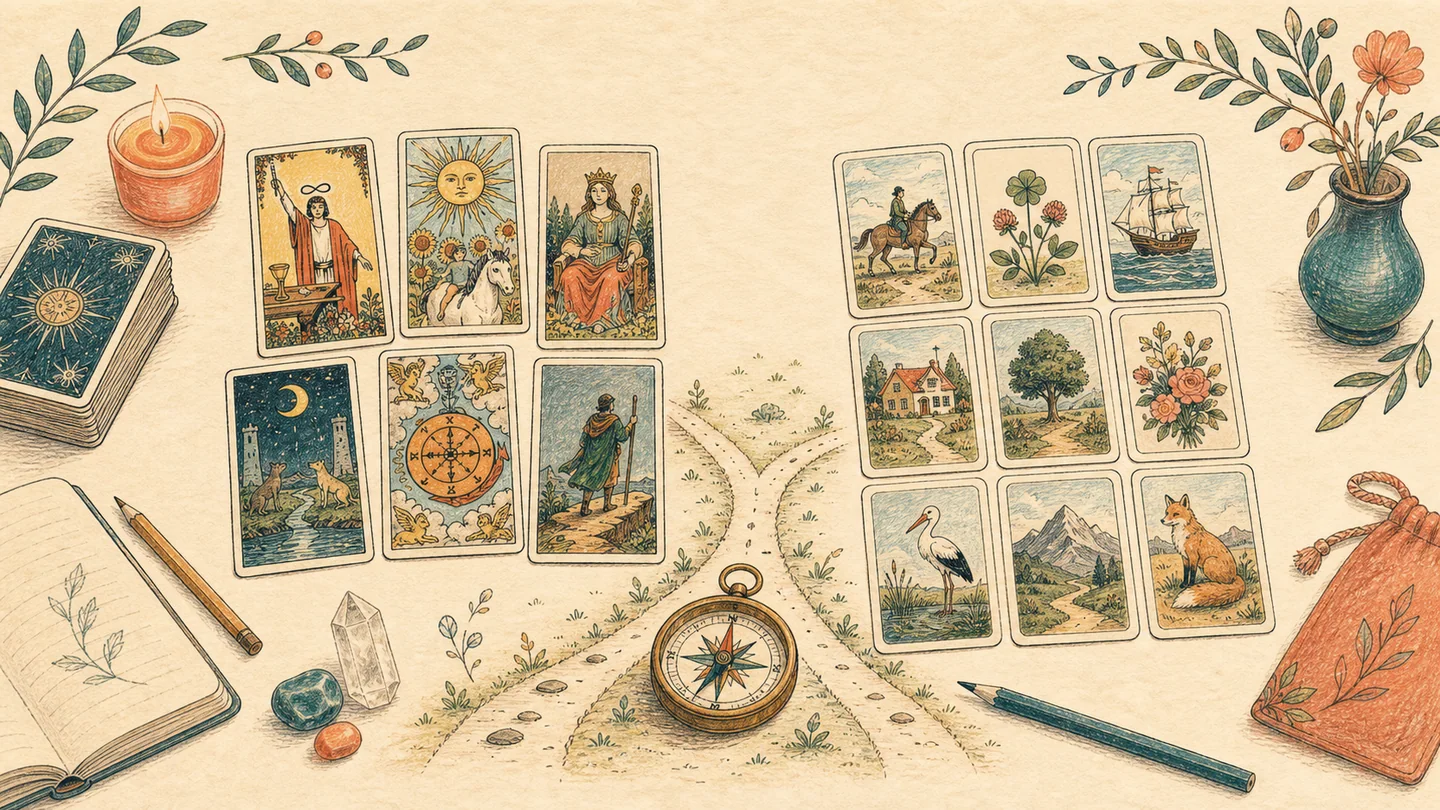
Tarot vs. Lenormand: Not Opposites, But Different Perspectives
In the realm of occultism, Tarot and Lenormand are often discussed side-by-side and frequently mistaken as "the same kind of thing." In reality, they are rooted in entirely different philosophical soils and serve very different purposes. This article will delve into the core differences between the two, helping you clearly identify their essence so you can make informed choices in your spiritual exploration.
1. Origins and Philosophy: Psychological Theater vs. Objective Mirror

Tarot is a profound system of symbolism. Its origins can be traced back to Renaissance Italy, blending the Kabbalistic Tree of Life, Christian philosophy, Greek mythology, and Renaissance humanism. It is an introspective, psychologically-oriented tool. The "Hero's Journey" comprised of the 22 Major Arcana is essentially an epic of the growth and transformation of individual consciousness. The querent and the spread together construct a miniature "psychological theater." The answer lies not in predicting a fixed future, but in revealing current energies, subconscious patterns, and potential possibilities, providing insights and advice for growth.
Lenormand was popularized in 19th-century Europe by the famous French fortune-teller Marie Anne Lenormand. It is a descriptive, event-oriented tool. The 39 (or 36) cards use concrete images of everyday objects, such as keys, letters, hearts, trees, and foxes. Its philosophical foundation is closer to "symbolic linguistics" or "street wisdom," holding that the universe and the subconscious communicate with us through clear, straightforward symbols that directly reflect the external environment, specific events, and interpersonal dynamics. It does not dig deep into "why," but focuses on "what is" and "what happens next."
2. Reading Logic: The Storyteller vs. The Precision Locator

Tarot reading is an art of synthesis. A single card has rich and diverse meanings filled with metaphor (for example, "The High Priestess" can represent intuition, mystery, latent knowledge, or a time for introspection). Its core interpretation relies on the positional relationships of cards in a specific spread (such as the Celtic Cross), the interaction of elements (Fire, Water, Air, Earth), and the coherence of the narrative across the cards. Interpretation is like piecing together a psychological puzzle, telling a story about the querent's internal state or long-term lessons. There is significant room for subjectivity and intuition.
Lenormand reading is a grammar of combinations. Single card meanings are extremely specific and narrow (for example, "The Letter" almost always represents news, mail, or communication; "The Fox" represents deception, cunning, workplace issues, or health concerns). Its essence lies in card pairings. Two cards combined create a new meaning (e.g., "Heart + Key" might be "opening one's heart" or "obtaining key emotional information"), and three cards form a more complete sentence. It is like a precision instrument that locates the timing of specific events, the people involved, and the outcome through linear combinations of symbols. Interpretation is more objective and focused on factual details.
3. Timeframes and Question Types: Life Chapters vs. Recent Snapshots

Tarot excels at exploring mid-to-long-term issues, psychological patterns, soul growth, and the deep impact of major decisions. It answers questions like "What is my growth in this relationship?" or "What does this career choice mean for my overall life path?" The timeframe can span months to years, focusing on the flow and transformation of energy.
Lenormand excels in short-term, specific, factual questions. It answers "What will the result of next week's interview be?", "Will he contact me this weekend?", or "Will this contract be signed successfully?" The timeframe is usually days to weeks, sometimes extending to a month or two. It is not designed to explore abstract spiritual topics but is incredibly accurate at depicting schedules, itineraries, messages, financial transactions, and interpersonal dynamics.
4. How to Choose? Based on Your Needs and Nature
Choose Tarot if you:
- Desire deep self-exploration and want to understand the psychological motivations behind behaviors.
- Face major life decisions and need to weigh the energy and potential consequences of different choices.
- Are not satisfied with "yes/no" answers and hope for parables and wisdom that nourish the soul.
- Enjoy the process of symbolic, metaphorical, and creative interpretation.
Choose Lenormand if you:
- Need clear, straightforward guidance on specific, pressing issues (such as work, studies, or romantic progress).
- Prefer a fact-oriented approach and want verifiable, event-based predictions.
- Like the sense of logical combination and "decoding" precision rather than open-ended interpretation.
- Want to quickly obtain direct clues about "what happens next."
Conclusion: Two Different Keys in the Toolbox
Tarot and Lenormand are not about which is better; they are two different paradigms of cognition and communication. Tarot is the psychologist taking you into the deep sea of consciousness, while Lenormand is the observer broadcasting the real-time weather for you. Many experienced practitioners use them in combination: using Tarot to gain insight into the core nature and deep dynamics of an issue, and then using Lenormand to track the specific timeline of its external manifestation. Understanding their differences means mastering the wisdom of asking more precise questions and using the right tools to more efficiently receive messages from the universe.