
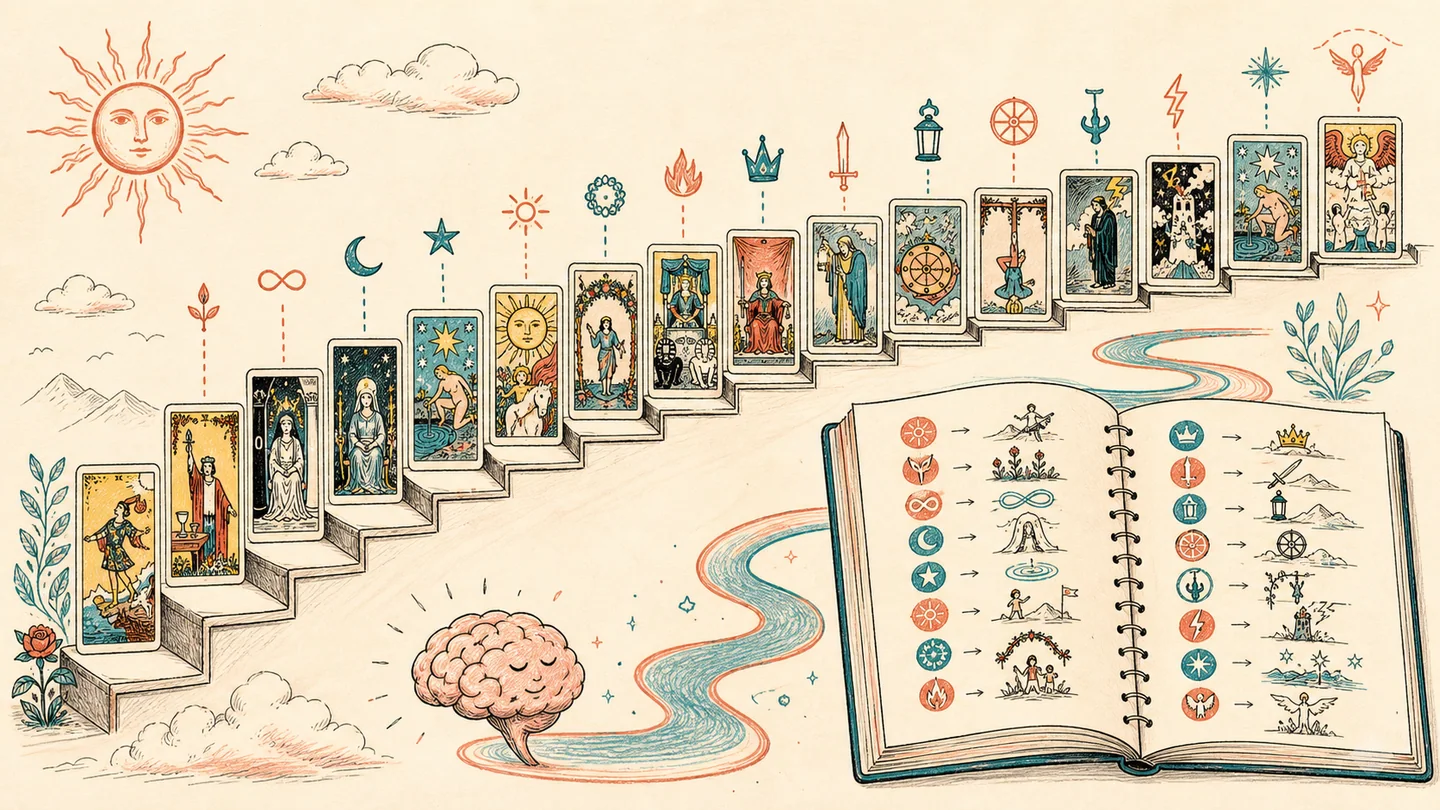
Introduction: Why Memory is the First Threshold of Tarot Practice?
For many Tarot enthusiasts, memorizing 78 cards is the first and most challenging threshold toward proficient divination. In particular, the 22 Major Arcana cards, with their Roman numerals (I-XXII) and complex symbolic systems, often intimidate beginners. Many fall into the trap of mechanical repetition, which is inefficient and confusing. This article moves away from fragmented tips to provide a memory solution rooted in understanding and framed by a system, focusing on the logical connection between Roman numerals and sequence to help you build a stable, fast, and extensible network of card meanings.
Part 1: Decoding Roman Numerals—The Hidden Skeleton of Tarot
Roman numerals are not simple serial numbers; they are the explicit code for the internal evolutionary logic of the Major Arcana. Understanding the progression from I to XXII means understanding a spiritual journey from "start" to "completion."
1. The Storytelling Quality of Numbers
Use the visual image of numbers for association:
- I (1) - The Magician: Raising one finger (1) to demonstrate will and creation, exactly how the Magician uses the four elements (Wand, Cup, Pentacle, Sword) to create all things.
- V (5) - The Hierophant: Five fingers extended in blessing, or think of the pentagram, echoing the Hierophant’s religious rituals and sacred knowledge.
- X (10) - Wheel of Fortune: The most intuitive circular shape of a wheel resembles the number 0, while 10 represents a completed cycle, perfectly interpreting the theme of eternal rotation.
- XII (12) - The Hanged Man: Is 12 a number written upside down? No, it is the image of a human body suspended, further linked to the 12 signs of the Zodiac and the 12 Apostles, symbolizing the connection between sacrifice and cosmic order.
2. Symbolism of Number Combinations
Pay attention to the numbers at key turning points:
- III (3) - The Empress: Triangular stability, abundance, the Trinity (Mother, Wife, Virgin).
- VII (7) - The Chariot: The number 7 in occultism represents victory and completion (seven planets, seven stages); the Chariot is the triumph of will over chaos.
- XIII (13) - Death: The unease of 13 fits perfectly with the fear of transformation, though one must understand its essence is "irresistible and inevitable change."
- XXI (21) - The World: The highest card among the triple-digit-related numbers (though written in Roman), 21 is 3×7, symbolizing complete harmony (3) achieved through multiple trials (7)—the ultimate achievement.
Action Suggestion: Create a chart with Roman numerals on the left and the image or story keyword you associate with them on the right. Review it once a day; within a week, the anchoring between numbers and cards will become automatic.
Part 2: Mastering Sequence—Building Your Narrative Map
Sequence is the language of dialogue between cards. Rote memorization that I is The Magician and II is The High Priestess is meaningless. You must establish causal relationships and thematic groupings.
1. Core Theme Grouping Method (The Classic Path)
Divide the 22 cards into three main stages, each with a clear theme:
- Phase 1: Awakening of Individual Consciousness (I-VIII) The Magician (1) -> The High Priestess (2) -> The Empress (3) -> The Emperor (4) -> The Hierophant (5) -> The Lovers (6) -> The Chariot (7) -> Strength (8). Narrative: From "I have the power to create" (1) to "I introspect for wisdom" (2), then to "I am nurtured and protected" (3-5), experiencing "choice and emotion" (6), "harnessing the will for victory" (7), and finally "learning the power of gentleness" (8). This is a process from outward exploration to inward integration.
- Phase 2: Trials and Insights of the External World (IX-XVI) The Hermit (9) -> Wheel of Fortune (10) -> Justice (11) -> The Hanged Man (12) -> Death (13) -> Temperance (14) -> The Devil (15) -> The Tower (16). Narrative: After gaining inner strength, one faces the "solitary quest" (9), "the cycle of impermanence" (10), "the judgment of karma" (11), "forced suspension and sacrifice" (12), "subversive endings" (13), "self-regulation and healing" (14), "material bondage" (15), and "apocalyptic collapse and awakening" (16). This is the deep tempering of the soul.
- Phase 3: Spiritual Transcendence and Completion (XVII-XXI) The Star (17) -> The Moon (18) -> The Sun (19) -> Judgement (20) -> The World (21) -> (sometimes including 0 The Fool as the start/end). Narrative: After the collapse, "rekindling hope and inspiration" (17), "facing the subconscious and fear" (18), "attaining pure joy and success" (19), "listening to the soul's calling, resurrection and integration" (20), and "achieving holistic harmony and returning to completion" (21).
2. Logical Association Memory Techniques
- Contrast Pairs: Strength (8) and The Chariot (7) both represent victory, but The Chariot is conquering the external, while Strength is taming the internal. Justice (11) and Judgement (20) both involve "verdicts," but Justice is worldly cause and effect, while Judgement is spiritual awakening.
- Number Leap Anchors: Remember several key points: 1 as the start, 7 as The Chariot, 13 as Death (midpoint), 19 as The Sun (near the end), and 21 as the end. Other cards are positioned around these points.
- Story Chaining: Tell yourself a continuous story. For example: "The Fool (starting from 0) meets The High Priestess (learning mysteries), separates from The Lovers (experiencing love), drives The Chariot (pursuing a career) into The Tower (suffering a blow), and under The Star (recovering spirits) finds The World (final completion)." The more personal and exaggerated the story, the firmer the memory.
Action Suggestion: Use three blank cards to write down the themes and core cards of the three phases. Post them where you often see them. Repeatedly "play" this three-act play in your mind.
Part 3: Integration Strategy—Making Memory Serve the Reading
The ultimate goal of memory is fluent reading, not reciting serial numbers.
- One Card a Day Deep Immersion: Focus on only one card each day. Study its imagery, symbols, upright and reversed meanings, and say aloud: "This is card number X, it belongs to Phase XX, the theme is XX, the card before it is XX, and the card after it is XX." Establish horizontal connections between cards.
- Spreads as Narrative Scenes: When using spreads like the "Celtic Cross," do not look at cards in isolation. View the 10 cards as a continuous story scene. How does Card 1 (Current Situation) lead to Card 2 (Challenge)? How does Card 4 (Foundation) affect Card 7 (Self)? This forces you to think within the sequential logic of the cards.
- Active Testing and Output: Close your book, draw a card at random, and ask yourself: "What is its number? How is the Roman numeral written? Where is its approximate position in the phases? Which card is it most closely related to?" Consolidate memory by teaching others.
- Accept Vagueness and Gradual Progress: In the beginning, allow yourself to remember only "zones" (e.g., "those are the darker cards in Phase 2"). As usage frequency increases, details will emerge automatically. The focus is on building the systemic framework; details will fill in naturally.
Conclusion: Memory is the Bridge to Intuition
The essence of fast card memorization is understanding the Tarot Major Arcana as a complete spiritual evolution model. Roman numerals are its mathematical skeleton, and the sequence is its narrative thread. When you no longer see them as isolated pictures but as a dynamic "map of soul growth," memory will become second nature. This method applies not only to the 22 Major Arcana; its core logic of "Understanding-Grouping-Narrative" can also be transferred to the four suits and court systems of the 56 Minor Arcana.
Start building your memory system today. From now on, when you draw a card, take an extra look at the Roman numeral on the face and feel its coordinates in this great journey. Soon, you will find that you can not only remember all the cards but also keenly capture the profound and subtle dialogue between any two cards in a spread, defined by sequence and number.