
Introduction: A Seemingly Simple Yet Vital Number
When you first pick up a standard Tarot deck or arrange your own spread, have you ever wondered: why exactly 78 cards? Was this number chosen at random? Or does it hide an ancient wisdom that transcends the rules of a game? For Tarot enthusiasts, understanding the composition of the number "78" is the key to unlocking deep connections within card meanings and mastering the entire symbolic system. It is no accident, but rather an exquisite encoding within the Western mystery tradition that integrates the journey of human consciousness, cosmic elements, and sacred geometry.

Historical Origins: Evolution and Standardization from Game to Divination
The roots of Tarot can be traced back to mid-14th century Italy, originally as a card game known as "Tarocchini." Early deck sizes varied, but by the late 15th century, with the development of printing, a system containing four suits (usually Wands, Cups, Swords, and Pentacles) along with specific court cards and pip cards began to standardize, forming approximately 56 Minor cards. Simultaneously, a separate series of "Trump cards"—the Major Arcana—originally used for high-scoring in the game, were imbued with occult meanings by Italian nobles and scholars of the Renaissance due to their rich allegorical imagery. When French occultists like Eliphas Lévi and later the Hermetic Order of the Golden Dawn mapped these images to astrology, the Kabbalistic Tree of Life, and other systems, the combination of 22 Major Arcana and 56 Minor Arcana was firmly established as the standard structure in the late 18th to 19th centuries, totaling 78. This process of solidification bound gaming, art, and esoteric knowledge into an inseparable whole.

The Foundations of Numerology: The Composition of 78 and Sacred Geometry
From the perspective of Numerology, 78 is not just a single number reduced to a single digit, but its components carry core significance.

The Major Arcana (22 Cards): The Full Spectrum of Divine Consciousness
The 22 Major Arcana cards, from "0. The Fool" to "21. The World," represent a complete journey of soul evolution. The number 22 is considered a "Master Number" in occultism, symbolizing the perfect manifestation of divine ideas in the material world. It corresponds to the 22 paths on the Kabbalistic Tree of Life that connect the 10 Sephiroth, serving as the vital channels for divine emanation into human consciousness. The Fool’s 0 represents infinite potential, while The World’s 21 marks completion and integration; together, the 22 cards depict a sacred narrative from the source of the unconscious to cosmic unity.
The Minor Arcana (56 Cards): The Quartet of the Material World
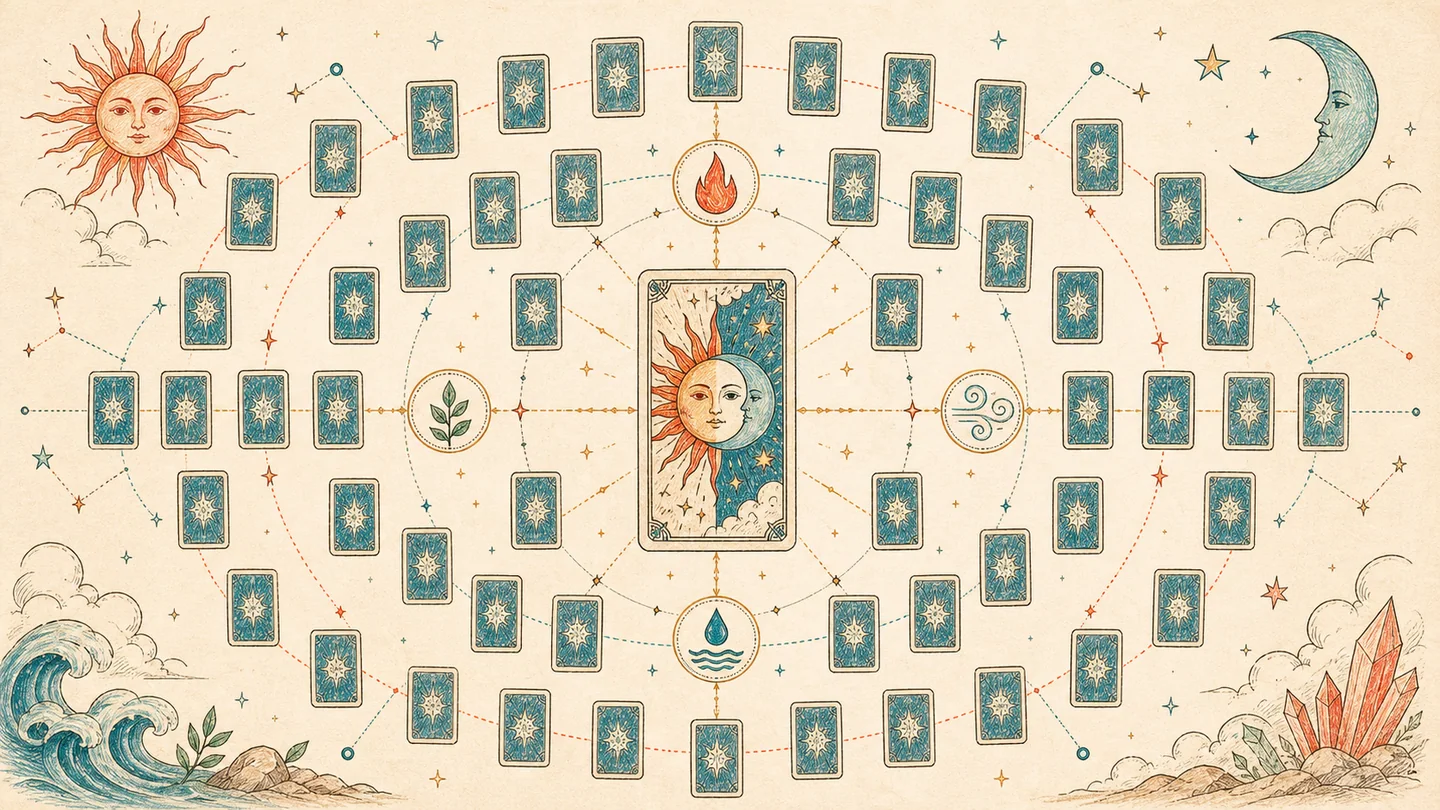
The 56 Minor cards consist of 4 suits × 14 cards (Pip cards 1–10 + Court cards: Page, Knight, Queen, King). The number 4 is the cornerstone: it corresponds to the four elements (Fire-Wands, Water-Cups, Air-Swords, Earth-Pentacles), the four cardinal directions, and the four temperaments. The 14-card sets (numbers 1–10 plus 4 personified court cards) precisely map to reflections of the four "worlds" in the Tree of Life, fully covering the dimensions of mundane experience from material foundations (Pip cards) to personified energies (Court cards). The number 56 (7×8) is also traditionally associated with "change and challenge," hinting at the dynamic balance and continuous learning within the physical realm.
The Sum of 78: Wholeness and Integrity
22 + 56 = 78. When reduced numerologically, this total becomes 7+8=15, and then 1+5=6. In occultism, the number 6 often symbolizes harmony, balance, and responsibility (as seen in the Hexagram). This suggests that when we integrate the divine 22 with the mundane 56, the 78 cards together constitute a complete teaching system for "achieving divine harmony within the material world." 78 is thus a self-contained microcosm capable of responding to any circumstance in life.
The Integrity of the Symbolic System: An All-Encompassing Matrix
The design of the 78 cards constructs a rigorous and intertextual network of symbols. Every card is a node within this network:
- The Interweaving of Elements and Astrology: The 4 suits directly correspond to the four elements, while the Minor Pip cards (especially 2–10) have traditional correspondences with zodiac signs, planets, or decans, ensuring every card carries multi-layered symbolism.
- The Personified Ladder of Court Cards: The four ranks of court cards within each suit can correspond to social structures, psychological developmental stages (from subconscious to manifestation), and even the four internal functions of an individual (intuition, emotion, thought, sensation).
- The Archetypes of the Major Arcana: The 22 cards cover the core archetypes of human consciousness (Strength, Justice, Death, The Sun, etc.). These archetypes combine with the specific situations of the Minor cards in a spread to produce infinite depth of interpretation. This 78-card system is like an instrument with 78 unique frequencies, capable of performing a symphony of all possible themes in life. With fewer cards, the breadth of symbolic coverage and intertextual depth would be significantly diminished; with more, the internal balance and symmetry might be disrupted.
Philosophical and Spiritual Significance: 78 Classrooms for the Soul
From the perspective of spiritual growth, the 78 cards can be viewed as 78 core lessons or "classrooms" for the soul's experience in the material world.
- The 22 cards of the Major Arcana are "advanced courses" concerning the ultimate meaning of life, karma, and the divine journey.
- The 56 cards of the Minor Arcana are "basic courses" for daily life, covering aspects of relationships (Cups), thoughts and conflict (Swords), creativity and action (Wands), and materiality and wealth (Pentacles). A mature Tarot reader acts as a guide, helping seekers identify which lesson they are currently facing on this "spiritual map" of 78 cards, understanding the elemental and archetypal forces behind it to gain wisdom for awareness and transformation. This number is the answer provided by ancient civilizations in symbols to the question: "How much guidance does one need to fully experience this life?"
Conclusion: A Vessel of Wisdom Beyond Numbers
The answer to "Why are there 78 Tarot cards?" is a multi-layered resonance of historical selection, numerological precision, semiotic rigor, and spiritual philosophy. It is both a practical standard refined over centuries and a profound, self-referential vessel of wisdom. Understanding the composition of 78 is not about showing off technical knowledge; it is about approaching the deck with deeper reverence for the designer's grand intent. It allows us to more accurately calibrate, within these 78 symbolic frequencies, the one answer that resonates uniquely with our soul's questions. These 78 cards are the most concentrated encyclopedia of philosophy, psychology, and cosmology on your bookshelf.