
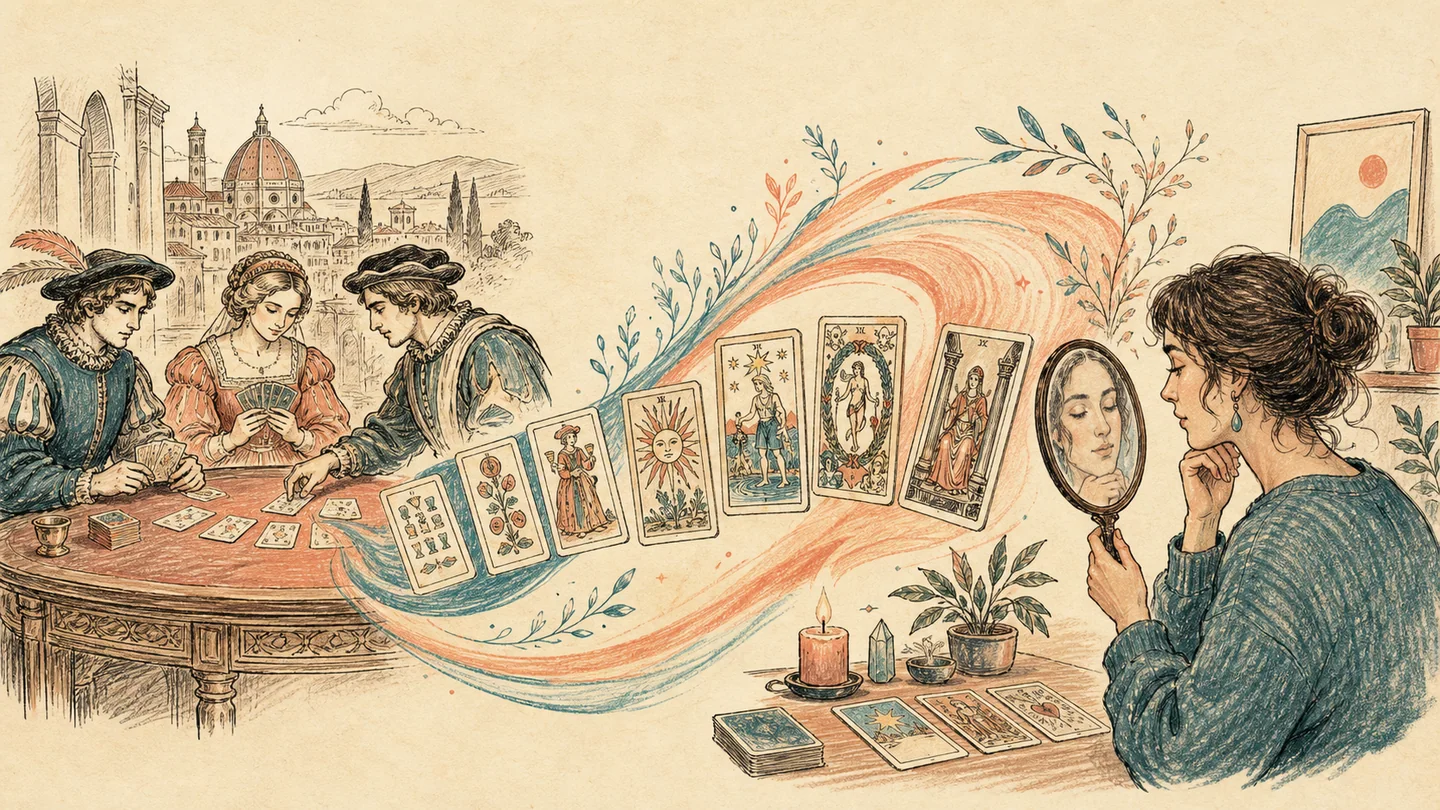
In the realm of occultism, Tarot cards are often endowed with profound symbolism and divinatory functions, as if they were born with a mission to reveal destiny. However, peeling away the layers of mystical attire added by later generations, the true origin of Tarot is more like a dusty chapter of European social history—it began as a card game among the nobility. Through centuries of evolution, where chance and necessity intertwined, it eventually became a symbolic system connecting Eastern and Western mystical thought. Based on surviving historical documents and artifacts, this article reconstructs that thousand-year journey from the Italian courts to a global tool for the soul.
I. The Dawn of Cards: From the East to Italy

The direct ancestors of Tarot cards were ordinary playing cards. Academics generally believe that playing cards were first invented during China's Tang Dynasty (around the 9th century) and later reached Europe via the Arab world. The first to arrive were the Egyptian Mamluk cards (14th century), which subsequently spread to Italy, Spain, and other regions. In 14th-century Italy, the earliest hand-painted playing cards appeared. These decks contained court cards and pip cards of four suits, but they did not yet feature the 21 "Trump" cards (usually translated as "Major Arcana") and the "Fool" card that would later define Tarot. These early decks were luxury items for the nobility, exquisitely painted and used for a clear purpose: gaming.
II. Birth of the Name: The Meaning of Tarocchi

The word "Tarot" originates from the Italian "Tarocchi." In the 15th-century Milanese dialect, "taroc" meant "to add" or "trump," specifically referring to the 21 cards with special rule-based powers added to a standard deck. These "trumps" were originally used only as the highest-ranking cards in a game, with no fixed sequence of images or mystical meanings. In French, the word evolved into "Tarot." The name itself reveals its functional origin: an "additional rule" for a game.
III. A Game for Nobles: The Luxurious Witness of the Visconti-Sforza Deck

The oldest and most complete surviving physical Tarot cards are the hand-painted decks commissioned for the Duke of Milan's families (the Visconti and Sforza) in the 15th century, known as the "Visconti-Sforza Tarot." These cards were painted with gold leaf and lapis lazuli pigments, demonstrating peak craftsmanship. The themes included mythology, allegory, and court life, but the card imagery differed greatly from the later Waite system, and no occult texts exist to support their use for divination. They clearly indicate that in Renaissance Italy, Tarot was first and foremost a status symbol and an entertainment tool, even carrying political propaganda (such as the Duke’s image appearing on the cards).
IV. The Starting Point of Mystification: The 18th-Century Invention of the "Egyptian Origin Theory"
The fundamental turning point in the meaning of Tarot occurred in late 18th-century France. During the late Enlightenment, a wave of interest in ancient wisdom emerged. In the 1770s, French author Court de Gébelin claimed in his work Le Monde primitif that Tarot cards originated from the secret wisdom of ancient Egyptian priests and were remnants of the "Book of Thoth." He mapped the 22 Major Arcana cards to Egyptian deities and myths, assigning them divinatory meanings. Although this claim had no historical basis (ancient Egypt had no playing cards), its romantic narrative fit the spirit of the times and was quickly adopted by occultists. Later, the French occultist Etteilla further systematized the Tarot divination process and illustrated the first deck specifically designed for divination. Tarot’s "mystical identity" was thus officially established.
V. The Golden Dawn and the Waite Revolution: The Shaping of Modern Tarot
At the end of the 19th century, the British secret society "The Hermetic Order of the Golden Dawn" integrated Tarot, Kabbalah, astrology, and alchemy into a rigorous system of Western occultism. Members (such as Aleister Crowley) assigned complex Kabbalistic Tree of Life paths and astrological correspondences to the 22 Major Arcana cards. However, what truly popularized Tarot globally was the "Rider-Waite-Smith" (RWS) deck, illustrated by artist Pamela Colman Smith under the direction of scholar A.E. Waite in 1909. This deck was the first to feature pictorial scenes for all 78 cards (including the Minor Arcana), and the imagery strictly followed the symbolic system of the Golden Dawn. Its intuitive visuals and unified style greatly lowered the barrier to learning, becoming the design blueprint for almost all contemporary Tarot decks.
VI. Controversy and Truth: How Should We View the Origins?
Modern academic research (such as the works of historian Michael Dummett) has thoroughly refuted romantic origin theories involving Egypt, the Jews, or Gypsies, confirming that Tarot was born in Northern Italy in the first half of the 15th century as a card game called "Tarocchi." Its occult significance is a "layered" product constructed by people from the 18th century onward. This is not to deny the value of Tarot divination—meaning is generated through the interaction between people and symbols. Understanding the true origins allows us to be more clear-headed: the charm of Tarot comes both from the aesthetic accumulation of its images over centuries and from the rich symbolism bestowed upon it by countless readers, artists, and thinkers. It is a mirror reflecting the evolution of the human soul and culture, and its "origin story" is itself a most moving mystical allegory.
Exploring the roots of Tarot is not to negate its mystery, but to embrace its complexity more deeply. When you shuffle the cards, what you hold in your hands is not just cardstock and ink, but five centuries of human imagination, gaming, and the eternal quest for the unknown.